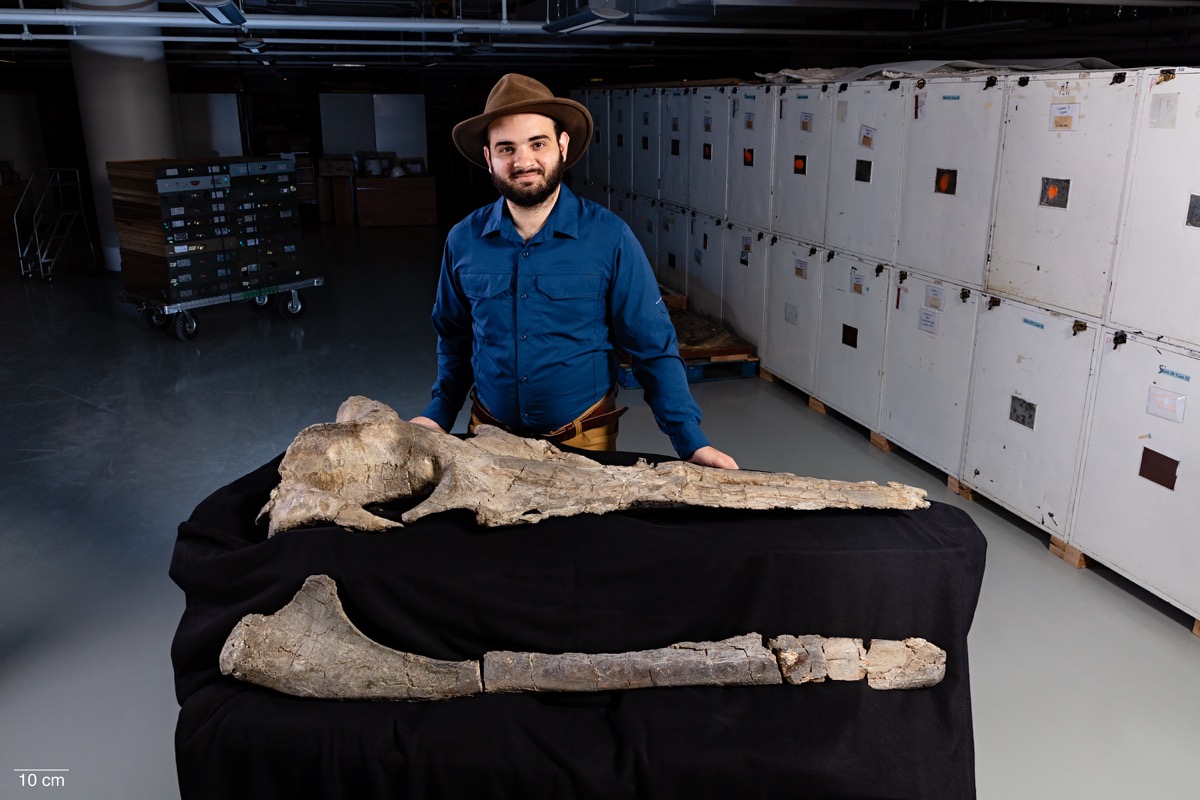
On a black cloth in the Smithsonian collections, the skull of Maiabalaena nesbittae looks less like an answer than an interruption. Its long upper jaw has no teeth. The mandible below it has no tooth sockets. Yet the palate also lacks the broad, thickened architecture and vascular signature that researchers who described the fossil expected from a baleen-bearing whale. Their conclusion was startlingly spare: this animal probably fed with neither teeth nor baleen.[5]
That makes Maiabalaena a problem for the most intuitive account of baleen origins. A clean story would let one tool shrink while its replacement grows: teeth, then a transitional mouth containing teeth and proto-baleen, then baleen alone. The fossil record does contain evidence compatible with that sequence. It also contains toothed mysticetes with very different jaws, a toothless probable suction feeder, and disputed bony traces of soft tissue that almost never fossilizes.[2][3][4][5][6]
The stronger evolutionary lesson is not that one reconstruction has defeated every rival. It is that tooth loss, suction feeding and baleen-assisted filtration were partly separable changes. Early mysticetes experimented with them across branches near the Eocene–Oligocene boundary. The origin of the modern filter is therefore a lineage problem, not a three-frame transformation of one animal.
A mysticete before the moustache
The name Mysticeti now belongs to whales that strain prey through keratin plates, but the lineage acquired that identity before it acquired its namesake apparatus. Mystacodon selenensis, from the roughly 36.4-million-year-old Yumaque Member of Peru's Paracas Formation, is among the oldest known mysticetes. Its relatively complete holotype retains differentiated adult teeth and several anatomical features inherited from earlier fully aquatic whales. At the same time, its flattened rostrum, expanded palate and other skull characters place it on the mysticete side of the split from toothed whales.[1]
No baleen is preserved with Mystacodon. Its teeth show heavy wear, and the original anatomical study considered suction-assisted bottom feeding among the plausible ways it gathered prey. That behavioral reconstruction remains an inference from wear, jaws and comparisons—not a preserved mouthful. The secure result is more basic: a whale could already be a stem mysticete while depending on an adult dentition.[1]
Early Oligocene aetiocetids widen the range rather than supplying the next rung of a ladder. Fucaia buelli, from the Makah Formation of Washington State, was small and fully toothed. Across aetiocetids, postcanine crowns range from relatively robust and close-set to simpler, more widely separated teeth. The describing authors read this variation as part of a transformation in feeding anatomy, but it also warns against imagining a single standard “toothed baleen whale.” Different mouths were testing different combinations of prey capture, processing and suction.[2]
Those taxa are branches, not a filmed ancestor–descendant sequence. Their value lies in the minimum conditions they establish. Adult teeth persisted after the mysticete lineage began, and feeding anatomy diversified before the living baleen-whale mouth became the only surviving version.
Why teeth plus baleen made sense
The classic stepwise model came from small openings and grooves on aetiocetid palates. In living mysticetes, branches of the superior alveolar blood vessels and nerves pass through lateral palatal openings to supply the tissue from which baleen grows. In 2008, Thomas Deméré and colleagues argued that comparable structures in toothed aetiocetids were osteological correlates of baleen. If the inference was correct, animals such as Aetiocetus carried adult teeth and an incipient keratin rack at the same time.[3]
That proposal joined three kinds of evidence. Fossils documented adult teeth and palatal anatomy. Living embryos showed that mysticetes still initiate tooth development. Tooth-specific genes in living baleen whales carried disabling mutations, molecular remnants of a dentate ancestry. Together they supported a staged change from teeth, to teeth plus baleen, to baleen without an erupted adult dentition.[3]
It remains an elegant hypothesis because it gives an apparently useless gap no place in the sequence: a feeding structure is always available. It is also testable. If the palatal openings really indicate baleen, their internal canals should connect to the same neurovascular route that serves baleen in living whales. The spacing of teeth and plates must also allow both tools to function without colliding.
The difficulty is that a hole in bone does not preserve the soft structure it once nourished. Vessels also serve gums, teeth and other oral tissues. A groove that resembles a baleen-related groove from the outside may connect differently inside the skull. The intermediate mouth was plausible, but plausibility was doing some of the work that missing keratin could not.[4]
A whale with neither tool
In 2017, Carlos Peredo, Nicholas Pyenson and Alexandra Boersma separated four hypotheses that had often been blended together: filtration by elaborate teeth; baleen growing medial to a working tooth row; baleen beginning behind a reduced anterior dentition; and suction feeding bridging the interval between biting and filtering. They argued that tooth loss and baleen origin should not be assumed to be one coupled event. The two traits have different tissues, developmental pathways and mechanical demands.[4]
Maiabalaena gave that decoupling model a fossil body. The holotype, USNM 314627, came from the early Oligocene Alsea Formation of Lincoln County, Oregon, and is about 33 million years old. It includes a nearly complete skull with ear bones, both mandibles, hyoid elements and parts of the postcranial skeleton. The jaws lack adult teeth and distinct alveoli. CT evidence did not show the internal connection between palatal openings and the superior alveolar canal expected under the authors' baleen criterion.[5]
The feeding inference came from a combination rather than one magic feature. The upper jaw was narrow and comparatively thin, offering little attachment area for a substantial baleen rack. The hyoid apparatus was robust, providing a large surface for muscles involved in retracting the tongue and floor of the mouth. Peredo and colleagues therefore reconstructed Maiabalaena as a suction feeder that drew small prey inward with water.[5]
Each step has a confidence boundary. Toothlessness is preserved in the jaws. A large hyoid is preserved. Suction is a functional inference from those bones and comparison with living marine mammals. The absence of baleen is more difficult still: no keratin survived, portions of the palate are incomplete, and the conclusion depends on which bony correlates are considered diagnostic. Maiabalaena is strong evidence for a toothless feeding experiment; “baleen-free” is the describing team's best-supported reconstruction, not soft tissue caught in stone.[5][6]
The scan that reopened coexistence
The teeth-plus-baleen case gained a sharper anatomical test in 2021. Eric Ekdale and Deméré used high-resolution CT data from the holotype skull of Aetiocetus weltoni, UCMP 122900, an approximately 25-million-year-old toothed mysticete from Oregon. They traced the canals beneath the palate instead of judging surface grooves alone.[6]
The lateral palatal openings connected internally with the superior alveolar canal. Separate branches of that system reached the tooth sockets, while other branches reached the palate. The more medially positioned greater palatine route remained distinct. In living grey whales, the corresponding superior alveolar network supplies baleen; in living toothed cetaceans, it serves teeth. Ekdale and Deméré interpreted the doubled destination in Aetiocetus as evidence that an ancestral dental blood supply had been co-opted to nourish proto-baleen while adult teeth remained.[6]
This is stronger than matching holes by eye. It tests homology through internal plumbing and gives the coexistence model a predicted anatomical connection. It still does not preserve a keratin plate. Critics can ask whether the same vessels supplied thickened gum rather than baleen, and whether teeth could shear or seize prey beside a filter without damaging it. The CT result narrows that disagreement: the question is no longer whether the canals connect, but what soft tissue occupied their far end and what that tissue did.[4][6]
The two headline fossils therefore do not cancel each other. Aetiocetus supports one branch with teeth and a baleen-like vascular supply. Maiabalaena supports another toothless branch for which substantial baleen was judged unlikely. Their placements, ages and preservation do not turn them into successive stages of one species. They show that the Oligocene sea held more than one solution while the modern filter-feeding apparatus was taking shape.
Development repeats components, not a fossil sequence
Living minke-whale embryos retain another record of the transition. A 2019 CT-based developmental series followed ten fetal specimens through skull growth, tooth-germ formation and resorption, and the appearance of baleen-associated tissue. Tooth germs begin, then regress before birth; baleen develops from the palate on its own schedule. For a limited prenatal interval, dental remnants and early baleen-related tissues can be present in the same developing animal.[7]
That overlap does not prove that adult Aetiocetus had baleen. Nor does an embryo replay a line of fossil ancestors. Development is useful here for a narrower reason: it demonstrates that tooth suppression and baleen formation are distinct processes that can overlap in time. Baleen is not a tooth stretched into fringe. It is a separate keratinous system built in a mouth that still carries developmental traces of teeth.[3][7]
This distinction prevents two opposite mistakes. The first is to assume that a continuous evolutionary transition must leave a perfectly intermediate object. The second is to treat every mosaic as a direct ancestor of the living condition. Aetiocetids, Maiabalaena and later toothless mysticetes may preserve experiments along neighboring branches. Phylogenetic position and anatomy tell us which changes had occurred in each branch; they do not guarantee a single conveyor belt from one named genus to the next.
The missing mouth is the point
Three evidence levels now belong in any honest account of baleen origins.
What is directly preserved includes adult teeth in early mysticetes, toothless jaws in Maiabalaena, palatal openings and their internal canals in Aetiocetus, and hyoid and skull shapes that constrain feeding mechanics.[1][2][5][6] What is strongly inferred includes suction feeding in some taxa and a baleen-related function for the Aetiocetus canal network.[4][5][6] What remains disputed is the exact first appearance of functional baleen, whether teeth and baleen operated together in particular adults, and which fossil state lies on the branch leading to living mysticetes rather than beside it.
The safest sequence is consequently broad. Toothed mysticetes were present by the late Eocene. Around the Eocene–Oligocene transition and afterward, several lineages reorganized teeth, jaws, tongue mechanics and palatal blood supply in different combinations. Eventually, toothless baleen-bearing whales became obligate bulk filters. Between those anchors, the record preserves a radiation of mouths—not a neat swap of one material for another.[1][4][5][6]
That uncertainty is not an empty space in the story. It is the story. Baleen's soft tissue vanished, leaving bone to record its infrastructure and embryos to retain fragments of its developmental history. Read together, those traces show evolution working by uncoupling, overlapping and repurposing systems. The modern whale filter did not simply replace a row of teeth. A changing lineage first had to invent new ways to feed while the replacement was still incomplete.
Sources
- Christian de Muizon et al., “Mystacodon selenensis, the earliest known toothed mysticete from the late Eocene of Peru: anatomy, phylogeny, and feeding adaptations,” Geodiversitas 41 (2019)—holotype anatomy, 36.4-million-year age and feeding interpretations.
- Felix G. Marx, Cheng-Hsiu Tsai and R. Ewan Fordyce, “A new Early Oligocene toothed ‘baleen’ whale from western North America: one of the oldest and the smallest,” Royal Society Open Science 2 (2015)—Fucaia dentition and aetiocetid feeding transitions.
- Thomas A. Deméré et al., “Morphological and Molecular Evidence for a Stepwise Evolutionary Transition from Teeth to Baleen in Mysticete Whales,” Systematic Biology 57 (2008)—the teeth-plus-baleen hypothesis, palatal correlates and molecular evidence.
- Carlos Mauricio Peredo, Nicholas D. Pyenson and Alexandra Boersma, “Decoupling Tooth Loss from the Evolution of Baleen in Whales,” Frontiers in Marine Science 4 (2017)—four transition hypotheses and the suction-feeding alternative.
- Carlos Mauricio Peredo et al., “Tooth Loss Precedes the Origin of Baleen in Whales,” Current Biology 28 (2018)—description of Maiabalaena nesbittae, CT evidence, hyoid anatomy and the toothless suction-feeding interpretation.
- San Diego State University, “Ancient Baleen Whales Had a Mouthful” (2021)—institutional summary of Eric Ekdale and Thomas Deméré's Aetiocetus weltoni CT study and its teeth-plus-baleen interpretation.
- Agnese Lanzetti, “Prenatal developmental sequence of the skull of minke whales and its implications for the evolution of mysticetes and the teeth-to-baleen transition,” Journal of Anatomy 235 (2019)—ten-specimen fetal series, tooth-germ resorption and baleen development.
- Science Friday, “How Whales Got Their Mouth Bristles” (2018)—Smithsonian-credited archival photograph of Carlos Mauricio Peredo with the Maiabalaena nesbittae holotype used as the article image.