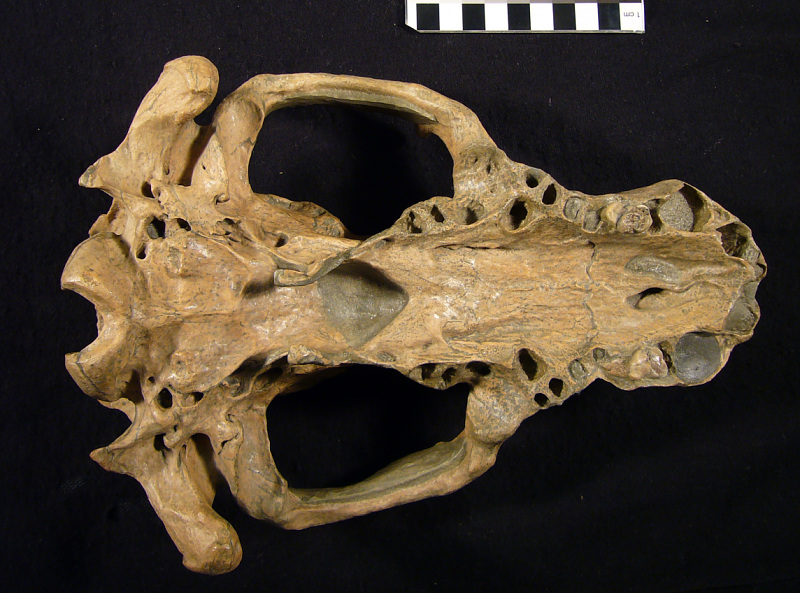
Seen from below, a Kolponomos skull looks as if force has been routed toward both ends. Broad, worn cheek teeth occupy the back of the mouth. The front of the lower jaw is deep and nearly vertical. Behind them, large mastoid processes offered generous attachment area and leverage for muscles that moved the head against resistance.[1][2] The parts do not resolve into a familiar living animal. They resolve into a sequence of actions.
That sequence is the most convincing way to meet this Early Miocene carnivoran. Researchers have proposed that Kolponomos set the front of its jaw against a hard surface, clamped shell-bearing prey between its incisors and canines, pulled with its neck, and then moved the dislodged food backward to be crushed.[1][2] A sabretoothed cat supplies the closest mechanical comparison for the anchoring phase. A sea otter supplies the obvious dental comparison for the crushing phase. Neither is a reliable portrait of the whole animal.
The distinction matters because Kolponomos has repeatedly been introduced through unstable labels: marine raccoon, sea bear, otter-like mollusc eater, stem pinniped. Each catches one piece of evidence and risks turning it into a costume. The fossils support something more interesting—a carnivoran with no close living mechanical equivalent, reconstructed one load-bearing region at a time.[2][3]
Two species, mostly skull
The genus began with Kolponomos clallamensis, named in 1960 from partial cranial and mandibular material found in marine rocks of the Clallam Formation at Clallam Bay, Washington. Its first classification leaned toward procyonids, the group containing raccoons. Better material from Oregon changed that address. In 1994, Richard Tedford, Lawrence Barnes and Clayton Ray described K. newportensis from the Nye Mudstone near Newport: a nearly complete cranium, a mandible, partial dentition and a small amount of postcranial bone. They treated the animal as a littoral, bear-adjacent arctoid and built the first detailed account of how its skull may have worked.[1][3]
Later phylogenies moved it again. A 2020 total-evidence analysis, combining living-animal molecular data with anatomical characters from fossil and living carnivorans, recovered Kolponomos along the pinniped stem with such taxa as Puijila, Potamotherium and Enaliarctos.[4] That result makes it relevant to the wider history of seals, sea lions and walruses, but it does not turn Kolponomos into a seal with an unusual face. Its placement has shifted with datasets, and the animal is still known chiefly through heads and teeth rather than a complete skeleton.[1][2][4]
The secure frame is therefore modest. Two named species occur in Early Miocene marine deposits along the northeastern Pacific margin. Their skulls combine a short, downturned front end, robust muscle-attachment regions and heavily used crushing teeth. Amphibious, nearshore living is plausible from anatomy and depositional setting; exact swimming style, body outline and time spent ashore are not preserved.[1][2]
The front of the jaw became a foothold
The proposed feeding sequence begins at the mandibular symphysis, where the two halves of the lower jaw meet. In Kolponomos, this region is deep and vertically oriented. The enlarged mastoid processes at the rear of the skull imply powerful muscles capable of flexing and turning the head. Together, those structures led researchers to propose an “anchor bite”: the animal placed the reinforced front of the jaw against the substrate, enclosed an attached shell between its front teeth, and used head movement to apply prying torque.[2]
This is where Smilodon becomes useful—and only here. A sabretoothed cat needed a stable front jaw and strong neck action while driving long upper canines into prey. Kolponomos did not have sabres and was not performing a killing bite. The suggested common problem was structural: both jaws had to resist deformation while the skull rotated around a braced anterior contact. Grooved wear on the opposing sides of Kolponomos canines is consistent with contact against hard objects during such a motion.[2]
The hard objects are not caught in the mouth. Shellfish enter the reconstruction through converging clues: the nearshore marine context; clams and mussels in the fossil formations; canine wear compatible with hard contact; and broad cheek teeth suited to breaking resistant food.[1][2] That makes prying attached invertebrates a tested functional interpretation, not observed behavior. The same biomechanical study explicitly noted that suction feeding could not be excluded, and chemical tests of tooth enamel could still refine what the animal actually ate.[2]
The back of the jaw chose stiffness
Once prey was detached, the cheek teeth took over. In K. newportensis, preserved teeth are worn so deeply that broad “lakes” of dentine sit inside enamel rims. K. clallamensis retains simpler, round-cusped cheek teeth with less extreme wear. Both resemble the crushing dentition of sea otters more than the more intricately cusped teeth of terrestrial omnivorous bears.[1][2]
Resembling an otter tooth, however, is not the same as crushing like an otter jaw. In 2016, Z. Jack Tseng, Camille Grohé and John Flynn built micro-CT-derived models of the K. newportensis mandible and compared it with six other carnivorans. They simulated two different tasks: an anterior anchor bite and unilateral crushing bites along the tooth row. They also tested three-dimensional jaw shape.[2]
During the simulated anchor bite, Kolponomos and Smilodon shared unusually high mandibular stiffness and similar overall jaw shape, especially around the symphysis. The crushing tests broke the apparent otter match. Sea otter jaws combined lower stiffness with greater mechanical efficiency. Kolponomos combined greater stiffness with lower efficiency and clustered most closely with the brown bear in that task. Similar blunt teeth had reached a similar dietary capability through a different structural tradeoff.[2]
That result prevents an easy collage. Kolponomos was not simply a sabretooth at the front and a sea otter at the back. The front-jaw comparison concerns resistance to torque, not prey type. The rear-tooth comparison concerns shell-breaking surfaces and wear, not identical force transmission. The useful concept is mosaic convergence: particular anatomical regions can approach the performance of distant animals without the entire skull, body or lineage becoming broadly alike.
A whole-skull test narrowed the analogy
A 2022 study asked whether the sabretooth resemblance extended beyond the mandible. The researchers digitally corrected deformation in the K. newportensis holotype and compared its skull with 159 three-dimensional models representing 98 living and extinct carnivoran species. Across the whole cranium, Kolponomos was not distinctly closer to Smilodon than several pinnipeds were. Its overall shape fell within the broad variation sampled among otariids.[3]
The local map told a sharper story. Similarities with sabretoothed cats concentrated near the canines, the postorbital constriction and the area associated with the temporalis muscle—the places most directly implicated in applying and resisting a forceful bite. The later study therefore did not erase the anchor model. It set a boundary around it. Convergence appeared where the shared mechanical demand predicted it and faded when the entire skull was treated as one object.[3]
That is also why phylogenetic placement and functional resemblance must remain separate. A stem-pinniped result describes relationship; an otter comparison describes tooth form; a bear comparison describes one simulated crushing profile; a sabretooth comparison describes anchoring mechanics. None of those statements licenses a complete life reconstruction by itself.[2][3][4]
The animal left a mechanism, not a portrait
The evidence for Kolponomos can be sorted into three levels. The fossils directly preserve the deep symphysis, enlarged mastoid region and broad cheek teeth, with extreme dental wear in K. newportensis; locality and stratigraphy establish the marine-rock context.[1][2] Models support a two-stage pry-and-crush repertoire and show that the front and rear of the jaw handled different loads.[2][3] Inference supplies the rocky feeding surface, the exact shelled prey, the transfer of food through the mouth and the animal's movements in water and on land.[1][2]
That last category is not a flaw. It is where the fossil becomes scientifically productive, provided the boundaries stay visible. The best Kolponomos reconstruction is not a furry hybrid assembled from a bear, an otter and a sabretooth. It is a sequence constrained by scars, surfaces and stress: brace, pull, release, crush. One skull could plausibly have performed all four actions without looking, as a whole, like anything alive today.
Sources
- Richard H. Tedford, Lawrence G. Barnes and Clayton E. Ray, “The Early Miocene Littoral Ursoid Carnivoran Kolponomos: Systematics and Mode of Life,” Proceedings of the San Diego Society of Natural History 29 (1994)—species material, anatomy, locality and original functional reconstruction.
- Z. Jack Tseng, Camille Grohé and John J. Flynn, “A Unique Feeding Strategy of the Extinct Marine Mammal Kolponomos: Convergence on Sabretooths and Sea Otters,” Proceedings of the Royal Society B 283 (2016)—CT models, finite-element tests, dental wear and the anchor-then-crush hypothesis.
- M. Modafferi et al., “One among many: the enigmatic case of the Miocene mammal, Kolponomos newportensis,” Biological Journal of the Linnean Society 136 (2022)—whole-cranium comparison and the anatomical limits of sabretooth convergence.
- Ryan S. Paterson et al., “A Total Evidence Phylogenetic Analysis of Pinniped Phylogeny and the Possibility of Parallel Evolution Within a Monophyletic Framework,” Frontiers in Ecology and Evolution 7 (2020)—placement of Kolponomos among stem pinnipeds.
- Smithsonian Institution, Wikimedia Commons file page for the photographed Kolponomos clallamensis skull used as the article image.