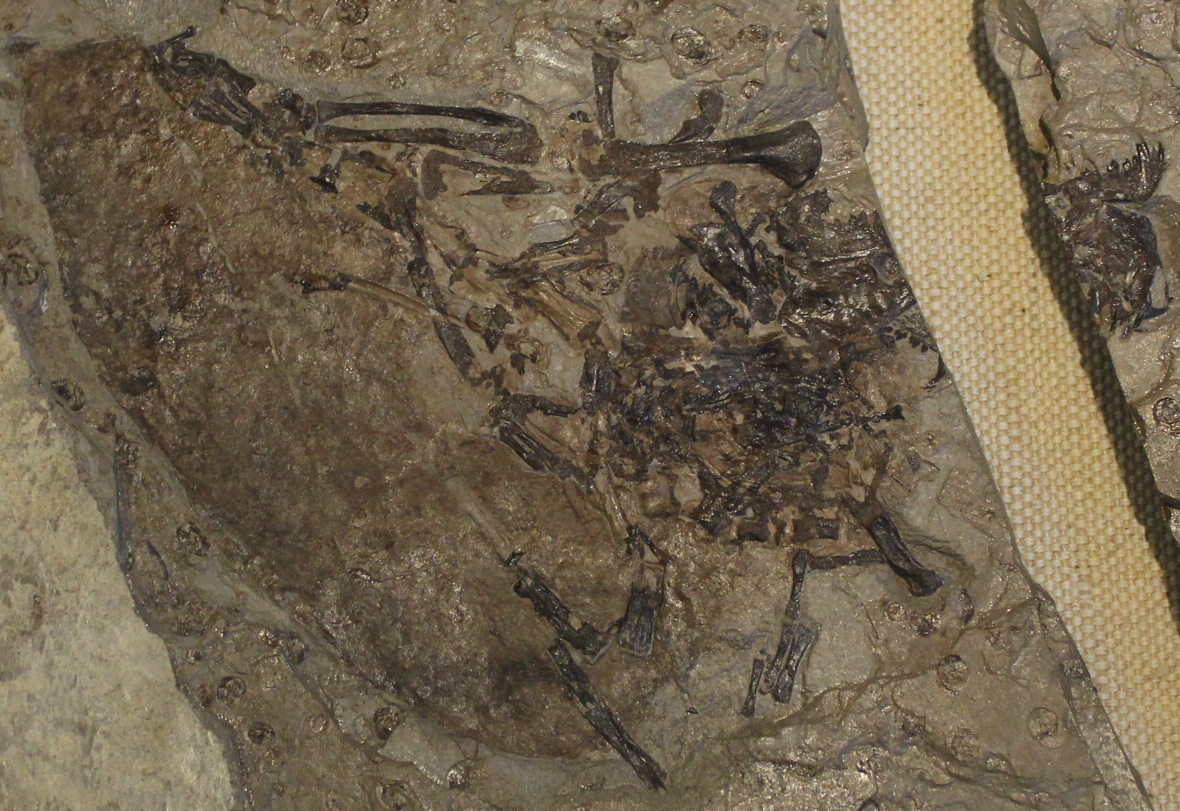
At first glance, the museum photograph looks like a small mammal caught beneath dirty ice. The skeleton is compressed into grey-brown stone. A hind limb angles away from the body; ribs and vertebrae crowd the middle; a broad, dark film spreads beyond the bones. Nothing resembles the clean kite shape of a flying-squirrel photograph. That untidy margin is precisely where the fossil becomes extraordinary.
The holotype of Volaticotherium antiquum, from the Daohugou beds of Inner Mongolia, preserves a carbonized soft-tissue film between the limbs. The original description identified the structure as a hair-covered patagium: an airfoil made from the body wall, not from feathers or an enlarged hand. Long limbs, an extended tail and climbing-related anatomy support the same interpretation. Its sharp, unusual teeth place a small predator or insect eater inside that proposed aerial body.[1][5]
The tempting conclusion is that the fossil simply proves a Jurassic mammal could glide. The stronger conclusion is more exact. The preserved membrane makes gliding persuasive; the skeleton and teeth explain what kind of animal carried it; neither records an actual launch, glide path or landing. Later comparisons have also shown that limb proportions alone do not sort every fossil neatly into “glider” and “non-glider.” Volaticotherium is compelling because the rare soft tissue leads the argument, while the more familiar silhouette remains supporting evidence.[1][4][5]
The membrane is evidence before it is a wing
A patagium is not a bone. In most fossil mammals it disappears, leaving researchers to infer aerial locomotion from elongated limbs, specialized wrists or ankles, and resemblance to living gliders. A carbonized body-wall film changes the evidentiary order. In Volaticotherium, the film extends between the forelimb and hind limb and carries traces interpreted as dense hair. If that boundary is correctly identified as skin, then together with a flattened, elongated tail and long limbs it outlines a surface capable of producing lift during descent.[1][5]
That is direct evidence of anatomy, not direct evidence of behavior. The fossil does not preserve a takeoff perch, a sequence of poses or air moving over the membrane. “Glider” is a functional inference made by comparing a real structure with the patagia of living mammals. It is much stronger than assigning flight from one long bone, but it still stops short of powered flight. Nothing in the specimen shows the repeated flapping stroke, reinforced hand wing or shoulder mechanics that would be needed to call Volaticotherium a Jurassic bat in another guise.[1][7]
The distinction also protects the fossil from a misleading modern analogy. Flying squirrels, anomalures, marsupial gliders and colugos all use skin membranes, but they belong to separate lineages and attach and control those membranes in different ways. The shared engineering problem can lengthen limbs without forcing every skeleton into one standard design. A broad comparative study of living and fossil gliders found convergence in longer, more gracile limbs, yet also found substantial separation among gliding groups in skeletal shape. A patagium is a recurring solution, not a badge of close kinship.[5]
This is why the dark halo around the holotype carries so much weight. A generic “squirrel-like” reconstruction would make Volaticotherium look familiar too soon. The slab shows the opposite: an aerial surface attached to a body assembled under a different evolutionary history.
Long limbs help, but no ratio gets the last word
The original study did not rely on skin alone. It described relatively elongated forelimbs and hind limbs, feet suited to an arboreal setting, and a tail that could enlarge or stabilize the lifting surface. Those features make sense as one functional package. An animal cannot glide merely by owning loose skin; it must spread, tension and control that skin while moving through a three-dimensional habitat.[1]
Yet a crushed skeleton is a difficult measuring instrument. Flattening can displace joints. Some elements are incomplete or overlap. A limb ratio reduces that complicated preservation to two lengths, then asks a living comparison set to supply the behavior. The move is useful, but only if the reference sample actually separates climbers, terrestrial mammals and gliders.
That boundary became visible in 2017, when researchers described additional Jurassic mammaliaforms with preserved membranes and compared their skeletons with living ecological groups. Their expanded dataset placed the new haramiyidan gliders convincingly near modern gliding morphospace. Volaticotherium was less tidy: one previously used jaw-to-limb index could not reliably distinguish several presumed arboreal mammals from terrestrial or digging forms, and a multivariate comparison separated Volaticotherium from the main modern-glider region on one axis. The authors therefore questioned what the proportions could prove by themselves.[4]
The sharper quantitative test arrived in 2020. A linear discriminant analysis compared 20 measurable traits of Volaticotherium with 99 living mammals of known locomotor mode. It assigned the fossil a 97.75% probability of belonging with nongliding arborealists, less than 0.01% in either glider class, and 2.25% as terrestrial. The model itself correctly classified about three quarters of its living comparison sample, and its authors stressed that deep phylogenetic distance makes modern analogues imperfect. The result is therefore a serious skeletal counterweight, not a recording of behavior.[5]
This did not make the proposed patagium vanish. It changed the hierarchy of claims. The soft-tissue interpretation remains the specimen-specific reason to infer a glide; long limbs and tail are biomechanically coherent but quantitatively equivocal; no ratio gets to act as a behavioral detector. The later work is not a clean reversal from “glider” to “ground mammal.” It exposes a real tension between the film and the skeleton—and leaves open the possibility that an extinct lineage built a glider unlike the living reference set.[4][5]
The distinction matters beyond this animal. When only teeth or isolated limb bones survive, paleontologists may recognize relatives of a known glider without recovering the glide itself. A close relationship can generate a hypothesis. It cannot manufacture missing skin.
The teeth keep the animal out of the flying-squirrel costume
The head of Volaticotherium is small and imperfectly preserved, but its dentition is highly distinctive. The molariform teeth carry tall, recurved cusps arranged in a row, producing a narrow shearing apparatus rather than the grinding surface expected in a seed- or leaf-eating squirrel. The original authors interpreted this as a specialized insectivorous dentition, with the larger front teeth adding to the picture of a small faunivore.[1]
Diet here is comparative inference. No insect sits inside the ribcage, and a tooth can constrain food processing more securely than it can name every prey item. “Insectivorous or small-prey specialist” is therefore safer than imagining a precise nightly menu. What the teeth do rule out is the idea that the fossil is simply an ancient member of a familiar herbivorous glider group.
They also changed its family address. In 2006, the animal looked isolated enough for its describers to erect a new family and order, Volaticotheriidae and Volaticotheria.[1] Better material from Argentoconodon in Argentina later supplied a wider comparison. A 2011 phylogenetic analysis grouped Argentoconodon with Volaticotherium, placed Ichthyoconodon nearby, and recovered the cluster among triconodontid eutriconodonts. Similarities in the South American animal's postcranial bones raised the possibility of a more geographically widespread gliding lineage, but without a preserved membrane in Argentoconodon, that part remains a hypothesis.[3]
The broad placement is more stable than every rank around it. Eutriconodont relationships can shift when analyses change taxon sampling or emphasize teeth, skulls or postcranial anatomy. Recent work on Mesozoic mammal phylogeny explicitly shows how specialized ecologies and uneven anatomical sampling can erode support deep in the tree.[6] The responsible shorthand is therefore that Volaticotherium is a specialized eutriconodont, usually linked with other volaticotherians—not an ancestor of bats, squirrels or marsupial gliders.
Even the species name needed repair. The 2006 paper introduced Volaticotherium antiquus; a 2007 corrigendum changed the epithet to the grammatically matching neuter antiquum.[2] The correction is small, but it is useful discipline: the fossil has a formal history as well as an evolutionary one, and old summaries can preserve a superseded spelling long after the taxonomy has moved.
A Jurassic experiment, not a rehearsal for bats
The age story moved too. At publication, the Daohugou beds were still entangled in a long geological dating debate, and the original journal summary used a substantially younger estimate. High-precision U–Pb work published in 2023 dated tuffs at the Daohugou section to about 163.3 million years ago and placed the main Yanliao vertebrate layers between roughly 164 and 157 million years ago.[1][8] The useful anchor is now firm: this soft-tissue film belonged to a mammaliaform near the Middle–Late Jurassic transition, long before the first known bats. Correlating every fossil layer to a named formation remains a separate geological problem, so “Daohugou beds of the Yanliao Biota” is more honest than forcing the specimen into a disputed formation label.[8]
That does not make gliding a half-built version of powered flight. Modern mammal lineages have evolved gliding repeatedly without becoming bats. The 2017 fossils made the Jurassic record richer still: haramiyidans unrelated to Volaticotherium carried their own patagia and distinctive shoulder and ankle structures.[4] Deep time was not running one aerial trial toward a predetermined winner. Several branches were testing the space between trees with the bodies they already had.
What, then, does the holotype securely license? A small, furred mammaliaform from Inner Mongolia preserved a broad carbonized film around elongated limbs and had teeth suited to shearing animal food. Interpreting that film as a patagium makes gliding the best functional explanation for the package, but the living-mammal classifier does not independently recover a glider. Its exact control surfaces, launch behavior, glide performance and daily ecology remain unobserved. Its closest relatives and higher mammalian position are hypotheses that improved after discovery and can improve again.[1][3][4][5][6]
That is enough. Volaticotherium does not need to be a miniature bat, the sole “first glider,” or a perfect match for a modern limb ratio. The dark film around its bones records something rarer than a familiar silhouette: an extinct mammal lineage turning skin into an airfoil on its own terms.
Sources
- Jin Meng et al., “A Mesozoic gliding mammal from northeastern China,” Nature 444 (2006)—original description of the holotype, patagium, pelage, limbs, tail, dentition and gliding interpretation.
- Jin Meng et al., “Corrigendum: A Mesozoic gliding mammal from northeastern China,” Nature 446 (2007)—formal correction of the species epithet from antiquus to antiquum.
- Leandro C. Gaetano and Guillermo W. Rougier, “New materials of Argentoconodon fariasorum and its bearing on triconodont phylogeny,” Journal of Vertebrate Paleontology 31 (2011)—comparative anatomy, eutriconodont placement and the proposed wider volaticotherian lineage.
- Zhe-Xi Luo et al., “New gliding mammaliaforms from the Jurassic,” Nature 548 (2017)—independent Jurassic gliders, preserved membrane anatomy and the limitations of limb-ratio classifications for Volaticotherium.
- David M. Grossnickle et al., “Incomplete convergence of gliding mammal skeletons,” Evolution 74 (2020)—comparative evidence for diverse glider skeletons and the quantitative arborealist classification of Volaticotherium.
- Lucas N. Weaver et al., “Conflict Resolution for Mesozoic Mammals: Reconciling Phylogenetic Incongruence Among Anatomical Regions,” Frontiers in Genetics 11 (2020)—how anatomical sampling and ecological specialization affect placement of early mammal groups.
- Stephen M. Jackson and Peter Schouten, Gliding Mammals: Taxonomy of Living and Extinct Species, Smithsonian Contributions to Zoology 638 (2012)—comparative criteria and evidentiary limits for recognizing fossil gliders.
- Hui He et al., “Temporal framework for the Yanliao Biota and timing of the origin of crown mammals,” Earth and Planetary Science Letters 617 (2023)—U–Pb dates for Daohugou and the wider Yanliao vertebrate sequence.
- Wikimedia Commons, “Volaticotherium—Paleozoological Museum of China (cropped)”—Jonathan Chen's 2019 photograph of the holotype used as the article cover.