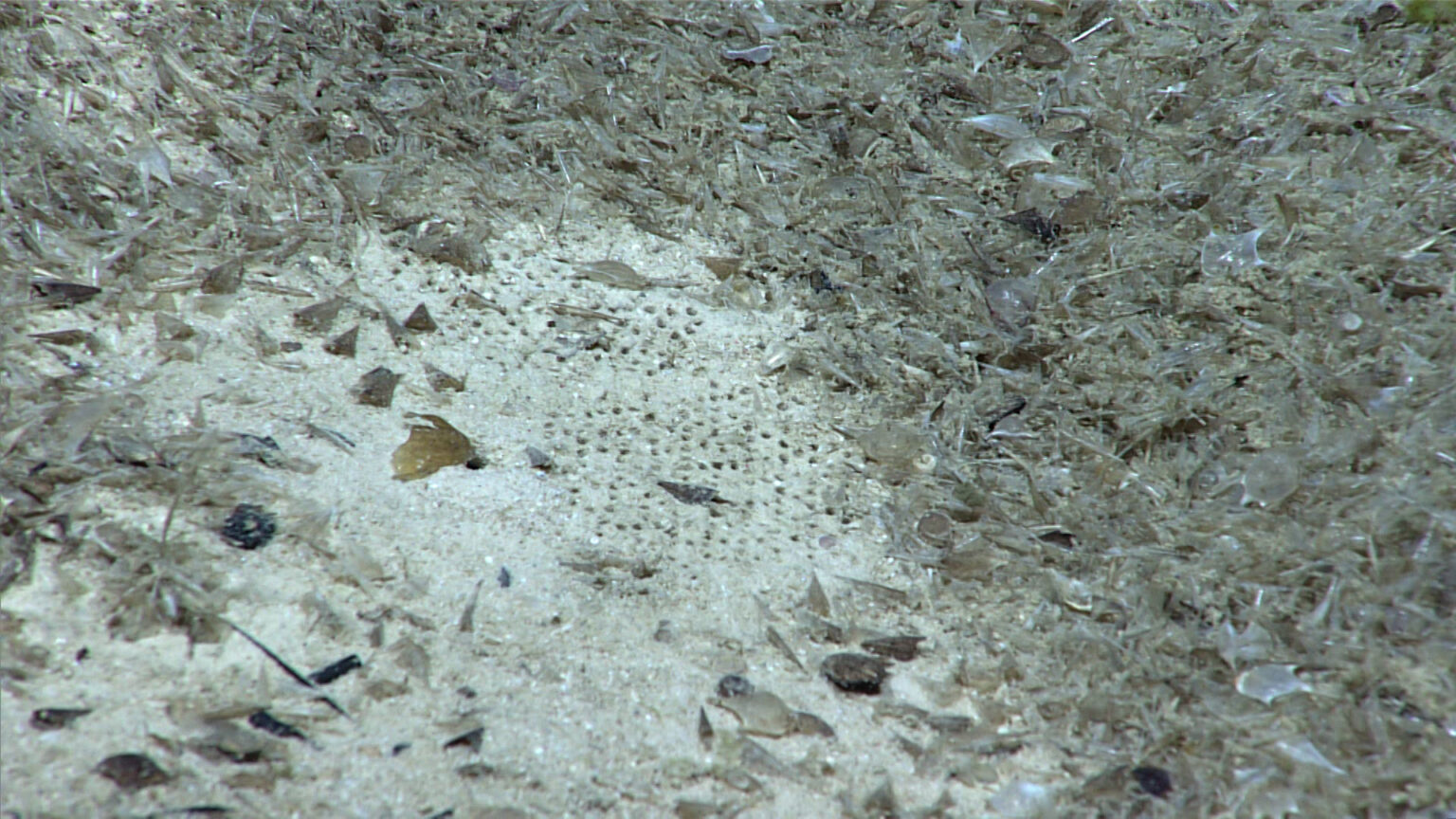
The cover photograph contains two constructions and no constructor. Against gray Atlantic sediment, pteropod shells lie at every angle. Near the center, much less conspicuous, small openings repeat in ordered rows. NOAA’s caption calls them two Paleodictyon traces, possibly P. nodosum, while preserving the most important uncertainty: their biological origin is unknown.[6]
The pattern is easy to promote into an animal. It has persisted in rocks for hundreds of millions of years, and closely comparable meshes occur on the present deep-sea floor. One influential study even put “a living fossil” in its title.[2] Yet Paleodictyon is classified as an ichnogenus, not as the biological name of a maker. Most specimens are read as traces, although a retained alternative interprets the mesh as a compressed sponge body.[1][2] The name therefore tracks a recurring structure without guaranteeing whether it records construction, growth, or the same kind of organism each time. The hexagon may endure even if the performers changed.
That distinction is more than taxonomic caution. It turns one of paleontology’s prettiest geometries into a test of what traces can actually prove. Fossils establish the architecture’s deep history. Modern seafloor observations add its third dimension. Failed recoveries limit several maker hypotheses. Disturbance experiments show that patterns can reappear quickly on newly disturbed surfaces. A 2026 review makes a quantitative, mechanical case for arthropods as serious candidates. Every step narrows the mystery; none yet puts an organism inside the act.
A fossil name for an act
Fossil Paleodictyon commonly appears in positive relief on the underside of deep-water sandstone beds. What is preserved there is often a cast: sediment filled a network at an older seafloor, then later erosion exposed its geometry from below. The familiar plan is a field of adjoining polygons, predominantly hexagons. In modern examples, the same basic plan announces itself at the sediment surface as three sets of apertures aligned along axes that meet at about 120 degrees.[1][4]
The time range is extraordinary but internally uneven. Traces assigned to Paleodictyon first occur in the Lower Cambrian. Their recorded distribution shifted from shallower settings into the deep sea by the early Ordovician, and the traces became especially common and diverse in Late Cretaceous and early Cenozoic strata. The particular arrangement in which a buried mesh connects upward through shafts to a regular array of seafloor openings is younger in the fossil record, appearing in the Cretaceous.[1] “Cambrian-to-present” therefore compresses several changes in form and setting; it is not evidence that one unaltered engineering species worked continuously through that interval.
The name classifies the result rather than awarding authorship. A burrow can record feeding, dwelling, farming, ventilation, or some combination of behaviors. Alternatively, a netlike body could itself make the pattern as it grows. Similar finished structures need not share a builder, and one builder can vary its work around obstacles. That is why an ichnotaxon can be stable while the organismal interpretation moves.
This boundary is visible in a large comparative study by James Lehane and A. A. Ekdale. They measured roughly 400 graphoglyptid traces from the Cambrian to the present and found no single, smooth march toward smaller or more optimized patterns. Different topological groups changed at different times; widths in network traces decreased only until the Late Cretaceous and then increased. The authors inferred that different species or genera probably produced different graphoglyptid categories, contrary to treating the entire group as the work of close relatives.[4] Their result does not prove a succession of makers for Paleodictyon specifically. It does remove any warrant for turning broad graphoglyptid continuity into one biological dynasty.
The living seafloor restores a hidden level
Rock specimens reveal the plan elegantly but often lose the relationship between buried mesh and water above it. Modern surveys supply that missing level. On the Mid-Atlantic Ridge, P. nodosum patterns measured about 24 to 75 millimeters across. The surface holes connected by short vertical shafts to a horizontal hexagonal tunnel system only a few millimeters below the seabed. Some examples also had a raised shield, peripheral lip, and shallow moat—surface relief not ordinarily preserved with the fossil casts.[1][2]
The Pacific record shows both regularity and accommodation. In 1,500 non-overlapping autonomous-vehicle photographs covering about 2,600 square meters of the Clarion–Clipperton Zone, Jennifer Durden and colleagues identified 841 patterns, or 0.33 per square meter. Their mean maximum dimension was 45 millimeters. Of the complete forms, some carried equal row counts along all three axes, while others departed slightly from that rule. Most of the 841 patterns were interrupted by polymetallic nodules.[1]
Those interruptions matter. An ideal mathematical honeycomb could be a physical self-organizing effect; a mesh interrupted by and built around surface or partly buried nodules looks more like a biological response to local ground. But neither regularity nor adjustment identifies the responder. A burrowing animal might revise its route. A sessile organism might alter growth. Even “fresh” and “degraded” appearances remain visual interpretations until a maker, a building event, or a chemical signature can be tied to them.
The modern structure nevertheless closes a major evidential gap. Surface apertures, vertical shafts, and a horizontal network show that the fossil polygon is not merely a two-dimensional ornament. It is one level of a small three-dimensional system spanning sediment and water. The question becomes functional: what advantage could such a system deliver?
One proposal treats the mesh as a feeding or microbial-cultivation burrow, with its many shafts ventilating the network. Flow experiments and models examined whether the geometry could circulate water and particles. Other proposals treat the structure itself as an organism, with sponges and xenophyophores among the candidates. A useful design can invite convergence: if a hexagonal network efficiently samples, irrigates, or occupies sediment, unrelated makers might arrive at versions of it.[1][2]
The cores returned a disciplined absence
Peter Rona and colleagues did what the mystery most obviously demanded. They observed the Mid-Atlantic Ridge patterns in place, sampled them, imaged their internal structure, and examined recovered material using microscopy, staining, molecular methods, and microbiology. They did not find a tracemaker. Stains did not reveal the protoplasm expected of an organism filling the mesh. Genetic signals associated with foraminifera did not establish those organisms as builders, and microbial abundance inside the pattern did not supply the concentrated garden that one version of the farming hypothesis predicted.[2]
This was not a null result. It weakened particular versions of the body, foraminiferal, and microbial-farm explanations. It also defined what a core can miss. A mobile animal may leave before sampling. A tiny maker may occupy only part of the network. Its activity may be intermittent, or the photographed structure may already be abandoned. In areas with extremely slow sedimentation and little erasure by other burrowers, Durden and colleagues caution that a pattern could remain visible long after its occupant departed or died.[1]
The empty core therefore cannot be read in either extreme. It does not prove that the mesh constructs itself, and it does not leave every hypothesis equally healthy. Negative evidence has anatomy: it is strongest against organisms or enrichments that should have been present throughout the sampled structure, weaker against a transient builder, and weakest against an animal that completed the work and moved on.
That hierarchy suggests a better question than “What was not in the core?” Ask what each candidate predicts should remain. A sponge-body hypothesis predicts body material arranged with the geometry. A microbial-farming hypothesis predicts a reproducible enrichment relative to nearby sediment. A burrow hypothesis predicts wall structure, excavation traces, waste distribution, or an occupant caught during construction. The mystery becomes experimentally separable rather than merely romantic.
Disturbance turns persistence into an event
A visible pattern on undisturbed mud has an age problem. It might have been made yesterday or preserved on a slowly changing seabed for years. Simulated mining experiments created a rough temporal boundary by scraping or ploughing the upper sediment in Pacific nodule fields. Lilian Boehringer and colleagues later found Paleodictyon patterns on surfaces disturbed only 17–18 days earlier in the Clarion–Clipperton Zone and six weeks earlier in the DISCOL experimental area.[3]
The known structure reaches only about two to three millimeters into the sediment, while the experimental devices reworked at least the surface centimeters. If those operations erased the pre-existing meshes, then patterns on the new surfaces had to be rebuilt or exposed by a maker surviving deeper below. The authors accordingly proposed two live possibilities: rapid reconstruction or retreat beneath the disturbed layer followed by renewed connection to the surface.[3]
This is the strongest evidence that at least some modern patterns are current biological products rather than ancient empty impressions. It is not a direct film of construction. The cameras did not track a named pattern continuously through erasure and return, and surface photographs cannot confirm the full underground mesh beneath every array of holes. The experiment also measured ecological damage: pattern densities on disturbed ground remained lower than on nearby undisturbed ground after four years in one study area and 26 years in another, although the 26-year site lacked a suitable pre-disturbance photographic baseline.[3]
The careful conclusion is asymmetric. Reappearance after severe, dated disturbance is difficult to explain without recent biological activity. It still does not say whether that activity was excavation, growth, maintenance, or emergence, and it does not reveal a phylum.
An arthropod can turn the corners—but has not been caught doing so
A 2026 review by Andrea Baucon and colleagues reopens the maker question from the mechanics of construction. Their arthropod hypothesis begins with a constraint hiding inside the elegance: Paleodictyon consists of straight tunnel segments joined by repeated, abrupt turns near 120 degrees. The authors argue that a body constrained by a rigid exoskeleton and equipped with jointed appendages may negotiate and control those segments more plausibly than a soft, hydrostatic worm. They identify small crustaceans, particularly isopods or amphipods, as candidates capable of excavating complex sedimentary structures.[5]
The review’s morphometric analysis treats imperfections as information. Local departures do not accumulate until the network collapses; later cells can bring the pattern back toward its overall order. Baucon and colleagues interpret that error correction as compatible with a builder following local rules and responding while it works, rather than executing a flawless global blueprint.[5] This is a behavioral model, not a preserved behavior. Hexagonal order alone cannot distinguish a crustacean’s repeated decisions from another organism’s growth rule or from construction guided by chemical and physical feedback.
The hypothesis earns attention because it exposes testable signatures. A jointed excavator should impose limits on tunnel diameter, turning radius, branch sequence, and how corrections propagate around obstructions. Its scratch marks, pellets, molts, environmental DNA, or characteristic residence pattern might occur where and when a fresh network develops. An organism-body hypothesis predicts a different package. Geometry matters most when it generates these discriminating expectations.
The review’s own endpoint remains appropriately demanding: direct observation of construction, or a maker preserved in unambiguous association with a fossil burrow, would decide far more than another resemblance.[5] Arthropods have moved from imaginable to mechanically argued. They have not moved into the mesh on camera.
What would make the hidden maker visible
No single instrument is likely to close the case. A convincing identification would synchronize evidence that past studies have gathered separately.
First, repeated high-resolution imaging should establish a pattern’s biography: blank sediment, the first openings, expansion, repair, decay. Time-lapse work is especially powerful after a small, controlled disturbance because the starting surface is dated.[1][3] Second, minimally disruptive three-dimensional imaging should verify that the photographed holes connect to the characteristic buried mesh rather than merely resembling it from above. Third, precisely registered microcores could compare the active edge, center, and adjacent control sediment for animal DNA, microbial communities, wall linings, fecal material, and body remains. Sampling after the image sequence—not months later—would tie chemistry to a known construction stage.
Finally, the fossil claim and the living claim must meet without being collapsed. A modern animal filmed building P. nodosum would identify a present maker. It would not automatically identify the builders of Cambrian, Cretaceous, or Eocene examples. Fossil anatomy inside a mesh, repeated across specimens and supported by constructional details, would be needed to assign an ancient culprit. The most interesting outcome may be plural: a durable architecture recruited by more than one lineage.
Return, then, to the NOAA photograph. Its two ordered patches are not failed portraits of an unknown animal. At the scale the camera can see, they record a patterned surface and an absent maker.[6] Comparable meshes studied elsewhere add what this single still cannot: three-dimensional architecture, sampled cores that failed to reveal a builder, and reappearance after dated disturbance.[2][3] Together, that evidence constrains how the mud was organized while refusing an easy identity.
Paleodictyon has endured as a form. Whether any maker endured with it is the part still hidden below the image.
Sources
- Jennifer M. Durden, Erik Simon-Lledó, Andrew J. Gooday, and Daniel O. B. Jones, “Abundance and morphology of Paleodictyon nodosum, observed at the Clarion-Clipperton Zone,” Marine Biodiversity 47 (2017)—photographic census, morphology, fossil range, and limits on interpreting occupied patterns.
- Peter A. Rona et al., “Paleodictyon nodosum: A living fossil on the deep-sea floor,” Deep Sea Research Part II 56 (2009)—in-situ observations, recovered cores, internal architecture, and tests of maker and function hypotheses.
- Lilian Boehringer, Sofia P. Ramalho, Yann Marcon, Antje Boetius, Daphne Cuvelier, and Autun Purser, “Recovery of Paleodictyon patterns after simulated mining activity on Pacific nodule fields,” Marine Biodiversity 51 (2021)—dated disturbance surfaces, reappearance, density, and recovery caveats.
- James R. Lehane and A. A. Ekdale, “Morphometric analysis of graphoglyptid trace fossils in two dimensions: implications for behavioral evolution in the deep sea,” Paleobiology 42 (2016)—comparative measurements of roughly 400 graphoglyptids from the Cambrian to the present.
- Andrea Baucon et al., “Can arthropods produce Paleodictyon?” Earth-Science Reviews 281 (2026), 105639—morphological and behavioral tests of an arthropod-maker hypothesis.
- NOAA Ocean Exploration, “Biogenic Sediment,” Voyage to the Ridge 2022, Dive 04—official source and description of the documentary seafloor photograph used as the article image.