Stromatolites are easy to oversell in one sentence. Call them Earth's oldest fossils, and the reader gets the scale while losing the object. A stromatolite is not a fossilized microbe enlarged into a dome. It is a layered structure built where microbial mats, sediment, mineral precipitation, and local chemistry kept meeting each other in the same place long enough to leave architecture behind.[1][4]
That distinction matters because stromatolites are strongest as records of process. They do not simply say that microbes existed. They preserve how microbial communities interacted with moving grains, changing water, pauses in deposition, and, later in Earth history, the presence or absence of animals willing to graze or tear mats apart.[1][2][5] Once that frame stays in view, the famous domes and columns stop looking like primitive ornaments and start behaving like environmental negotiations written in stone.
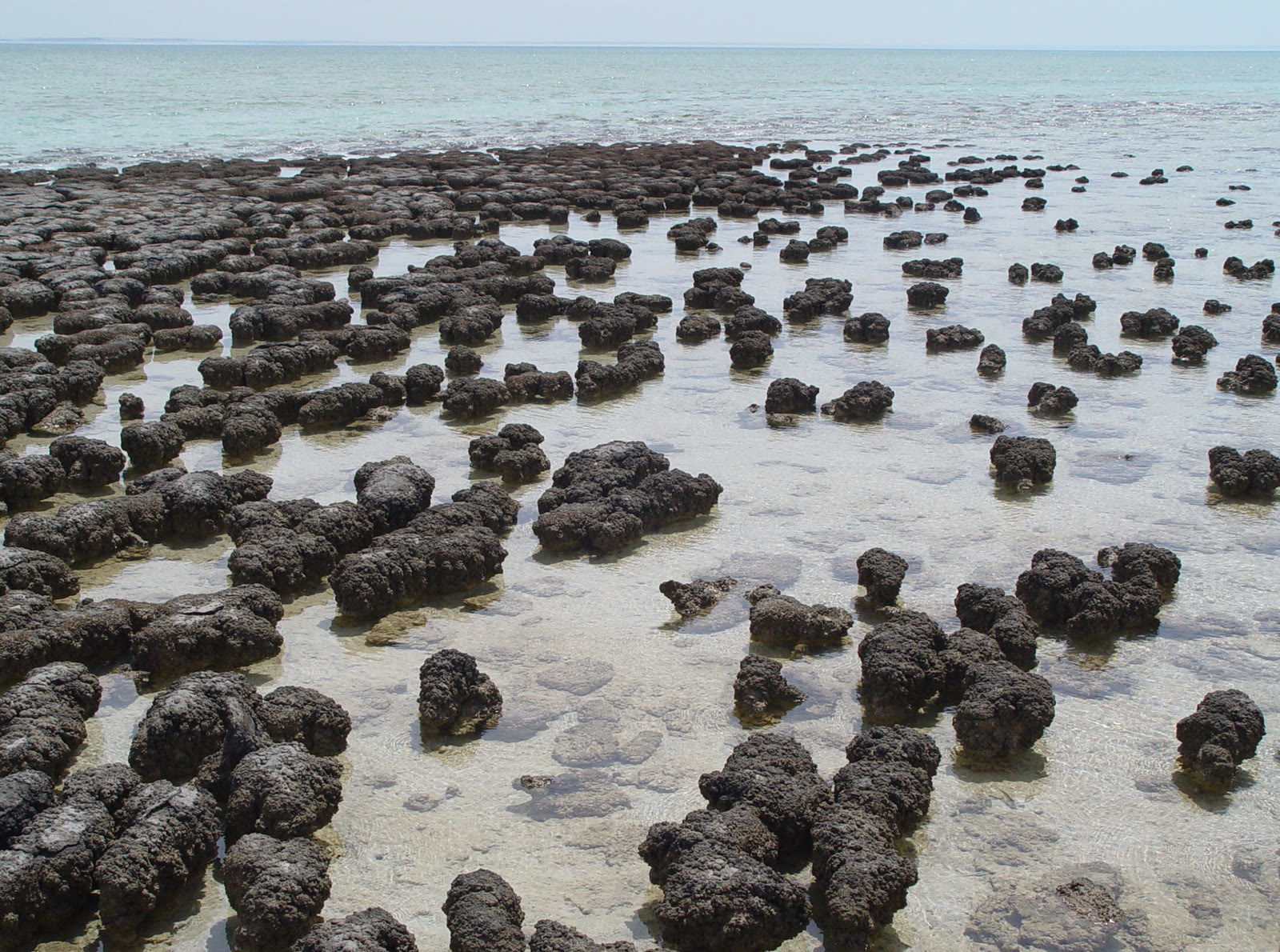
Image context: the lead image uses a real photograph of living stromatolites in Hamelin Pool, Shark Bay. It belongs here because the article is about reading structure together with setting. The shallow water and exposed domes make the point immediately: a stromatolite is never only a shape; it is a shape that survives because a specific environment keeps letting mats accrete and lithify.[2][7]
1) Lamination is the main event
The most useful correction to the popular picture comes from modern stromatolite work. Reid and colleagues argued from Bahamian marine stromatolites that growth is not a continuous upward miracle but a shifting balance between sediment accretion and intermittent lithification.[1] Periods of rapid sediment accumulation favor surface communities of gliding filamentous cyanobacteria. Hiatuses let exopolymeric films, heterotrophic bacterial activity, and later endolithic communities alter and harden the surface into thin carbonate crusts.[1] Lamination survives because these phases alternate, not because one microbial layer simply sits still for ages.
That is why a stromatolite should be read less like a body and more like a stack of events. Each lamina records timing, chemistry, and microbial occupation.[1][4] Smooth domes, columns, branching forms, and wrinkled surfaces are not decorative flourishes on top of a simple fossil category. They are clues to how growth kept responding to water movement, sediment supply, and the organization of the mat itself.[1][4][6]
The same point also explains why the phrase "living fossil" can mislead when used too casually. A living stromatolite setting does not give us a museum-perfect replay of the Archean. It gives us a modern system that helps show how laminated microbial structures can form at all.[1][2] The value is mechanistic, not theatrical.
2) The environment is part of the anatomy
Hamelin Pool in Shark Bay matters because it makes that mechanistic point visible without a microscope. The official Shark Bay guide describes the pool's microbial mats and stromatolites as among the most diverse in the world, and it ties their persistence to a specific marine setting rather than to microbial magic in isolation.[2] Modern stromatolites survive there in part because the environment is stressful for many of the animals that would otherwise browse, burrow through, or physically disrupt the mats.[2][5]
That ecological boundary is easy to miss if one looks only at the domes. Stromatolites are often treated as self-sufficient monuments rising out of empty water. In reality, they are community structures that become abundant when physical and biological pressure align in the right way.[1][2][5] Salinity, shallow-water energy, sediment supply, light, and the limited success of mat-destroying animals all belong to the explanation.[2][5][6]
The National Park Service's Glacier overview is useful here because it strips the lesson down to basics. In Proterozoic shallow seas, stromatolites flourished where cyanobacterial mats could trap sediment in clear, quiet water, and where the absence of grazing animals removed a major source of disruption.[6] That is the right causal scale. Stromatolites are not just old. They are what microbial communities can build when the surrounding world stops erasing the build.
3) Oldest-life claims only work when context stays attached
Deep time is where readers are most tempted to flatten the object into a slogan. Stromatolites do sit close to Earth's earliest convincing evidence for life, but the convincing part depends on context, not on domes alone.[3][4] Brasier and colleagues, testing biogenicity criteria in younger carbonate systems, emphasize a hard lesson that applies broadly to ancient claims: layered rocks can also be produced by strongly physical or chemical processes, so biogenic interpretation has to rest on petrography, asymmetry, fabrics, and associated evidence rather than on shape by itself.[4]
The Dresser Formation is such a strong case because it does not ask one texture to do all the work. Djokic and colleagues describe a 3.48-billion-year-old hot-spring system in Western Australia with stromatolites, geyserite, sinter terracettes, microbial palisade fabric, and bubbles preserved in mineralized exopolymeric material.[3] The force of the claim comes from convergence. Geological setting, hydrothermal facies, and multiple biosignatures all point in the same direction.[3] The stromatolites matter there because they stay tied to the larger sedimentary and geochemical frame.
That is the reading discipline stromatolites require everywhere. Ask what the layers are made of. Ask whether the surrounding deposit fits shallow marine, lacustrine, or hydrothermal conditions. Ask whether the structure records accretion by mats, mineral precipitation around biofilms, or something purely abiotic that only looks suggestive at first pass.[1][3][4] A stromatolite becomes more valuable, not less, when the case grows narrower and more explicit.
4) Their later decline is a story about ecology, not evolutionary failure
One reason stromatolites can feel primitive in the wrong sense is that they dominate so much of the Precambrian story while occupying only scattered refuges today. Sheehan and Harris give the clean explanation: microbialites were common and diverse through the Proterozoic, then declined as multicellular animals diversified and increasingly disrupted microbial mats.[5] By the Phanerozoic, they were largely restricted to stressed environments where animals were less effective competitors or grazers.[5]
That framing matters because it prevents a lazy rise-and-fall narrative. Stromatolites did not disappear because microbial communities became obsolete. They retreated because the ecological rules changed.[5][6] When mat-inhibiting animals decline after extinction events, microbialites can rebound; when grazers and burrowers return, the window narrows again.[5]
Read this way, stromatolites are not relics of a failed design. They are indicators of who else is present, how rough the water is, how sediment arrives, and whether a microbial surface can remain intact long enough to turn growth into rock. That makes them less romantic than the oldest-life slogan, but far more informative.
5) What a stromatolite actually preserves
The strongest summary is that stromatolites are archives of repeated surface management. They preserve microbial labor, yes, but never microbial labor alone.[1][2][3][4][5][6] They preserve the meeting point between mats and minerals, between deposition and pause, between shallow-water opportunity and biological pressure.
That is why they remain central to paleontology. A bone fossil usually gives you an organism first and a setting second. A stromatolite often reverses the order. It gives you a setting-shaped record first and asks you to infer the communities and processes that kept the structure growing.[1][3][4] Once that inversion is accepted, the object stops seeming vague. The layers themselves become the evidence.
Sources
- R. P. Reid and others, "The role of microbes in accretion, lamination and early lithification of modern marine stromatolites," Nature 406 (2000).
- Shark Bay, "Stromatolites" at Hamelin Pool, official overview of the living stromatolite environment and World Heritage context.
- Tara Djokic and others, "Earliest signs of life on land preserved in ca. 3.5 Ga hot spring deposits," Nature Communications 8 (2017).
- A. T. Brasier and others, "A Test of the Biogenicity Criteria Established for Microfossils and Stromatolites on Quaternary Tufa and Speleothem Materials Formed in the Twilight Zone at Caerwys, UK," Astrobiology 15, no. 10 (2015).
- Peter M. Sheehan and Mark T. Harris, "Microbialite resurgence after the Late Ordovician extinction," Nature 430 (2004).
- National Park Service, "The Stromatolites of Glacier National Park," overview of Proterozoic stromatolite growth conditions and exposures.
- Wikimedia Commons file page for the Hamelin Pool stromatolite photograph used as the article image.