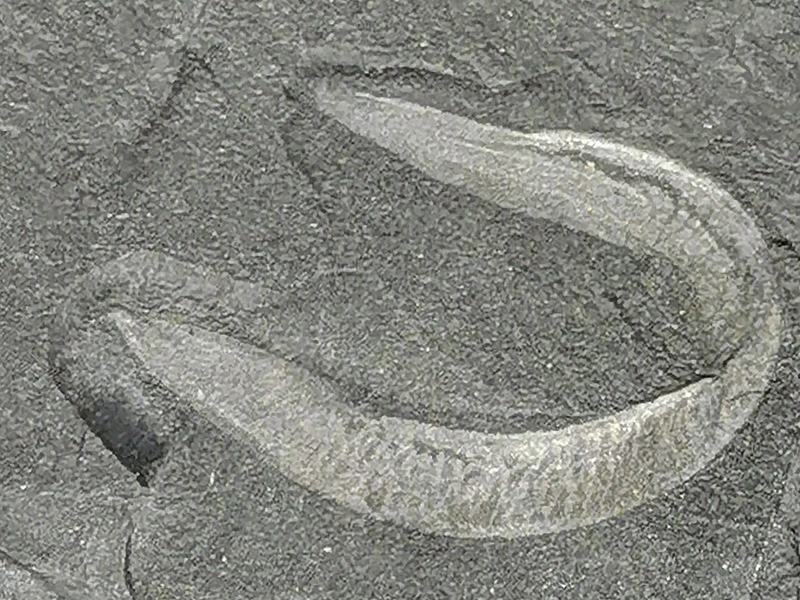
Pikaia gracilens is often introduced as though the Cambrian somehow produced a neat preview of later fish.[1][4] The fossil does not reward that shortcut. What makes Pikaia important is not that it already looked like a finished vertebrate. It is important because a very small, very thin Burgess Shale animal preserves a body organized around segmented muscle blocks, a narrow axial system, and a swimming style that was probably much weaker than that of later chordates.[1][2][3][4]
That profile matters because it keeps two things together that are often separated in popular retellings. First, Pikaia really does carry a serious chordate signal: myomeres, a narrow gut, a terminal anus, an elongate laterally flattened body, and structures near the head that have long been discussed in relation to gill openings.[1][4] Second, the fossil still resists a fully modern reading. Even in 2024, the identity of the axial support system remains unsettled enough that the dorsal organ has become part of the argument rather than a detail to be brushed aside.[3]
Image context: the cover uses a photographic image of a real Pikaia fossil in the Royal Ontario Museum collection, via Wikimedia Commons. That choice matters because this is a profile about fossil restraint. The specimen is not visually spectacular in the way a giant skull or armored dinosaur is spectacular. Its force comes from body layout, and the photograph keeps that modest evidentiary scale in view.[6]
A profile built from a narrow body and repeated segments
The safest way to start a Pikaia profile is with size and setting. The Burgess Shale page from the Royal Ontario Museum places it in the Middle Cambrian, about 505 million years old, from the Walcott Quarry on Fossil Ridge, and gives a maximum size of 55 mm.[4] It is also rare in that community, representing only 0.03% of the counted specimens in Caron and Jackson's census as quoted by the ROM page.[4] Those numbers matter because they keep the animal scaled correctly. Pikaia was not a dominant predator or a giant transitional icon. It was a small, uncommon swimmer or near-bottom swimmer in a famously odd marine ecosystem.[4]
Morphologically, the profile is clearer than the old mythology. Conway Morris and Caron treated Pikaia as a stem-group chordate and emphasized the repeated vertical bands running through most of the body, interpreted as myomeres or muscle blocks.[1] The ROM page describes the same body in more public-facing language: laterally flattened, elongate, with a small anterior region, a probable ventral fin toward the posterior, and a narrow dorsal structure that may represent a notochord, though that identification remains unconfirmed.[4] That is the right evidentiary balance. The muscle pattern is the strongest anchor. The axial rod is important, but not equally secure.[1][4]
This is why Pikaia should not be profiled as "the first fish." A fish headline pulls the reader toward jaws, paired sensory equipment, fast burst locomotion, and a cleaner vertebrate-style body architecture than the fossil actually shows.[1][3] The better profile is more disciplined: an early chordate-grade animal whose body had already organized itself into serial muscular units, but whose support system and exact placement within chordates still need careful wording.[1][3][4]
The animal probably swam, but not like later chordates
The most useful corrective to the "first fish" story comes from mechanics. Lacalli's 2012 EvoDevo commentary focused on the geometry of the myomeres and argued that the boundaries between them were only gently curved, with minimal overlap compared with the strongly overlapping V- and W-shaped myomeres of living chordates.[2] That matters because overlapping myomeres transmit force more effectively during powerful swimming. If Pikaia lacked that later arrangement, then it was probably incapable of the fast-twitch escape and attack behavior familiar from many living fishes and other modern chordates.[2]
That does not make the animal primitive in some empty sense. It makes it specific. Pikaia looks like an organism operating before the chordate body became a high-performance propulsive machine. Lacalli suggests either that it lacked fast-twitch fibers altogether or that its musculature retained an ancestral condition functionally closer to slow fibers.[2] Read alongside the ROM ecology notes, which describe it as mobile, nektonic to nektobenthic, and potentially a deposit feeder because mud occurs in the gut, the result is a coherent life habit.[2][4] This was probably a slender animal that could swim above the seafloor but still belonged partly to the benthic world rather than to the open-water pursuit lane.[4]
That behavioral profile is more interesting than the old ancestor slogan. It tells us that early chordate organization did not arrive all at once with vertebrate-style performance. The body could become chordate before it became fast.
The hardest part of the profile is the long axial structure
This is where a good Pikaia profile has to slow down. The fossil is often cited for its putative notochord, but the 2024 Lacalli paper makes clear that the best-preserved axial structure extending the length of the body is the dorsal organ, which has no obvious counterpart in living chordates.[3] Whether Pikaia had a typical notochord and nerve cord in the expected positions remains unresolved.[3] That is not a minor technicality. It affects how we imagine the animal moving, how we compare it to living chordates, and how confidently we place it along the stem.
The value of the 2024 paper is not that it tears Pikaia out of chordates. It keeps the uncertainty where the fossil puts it. Lacalli argues that the dorsal organ may have contributed to body support, perhaps representing a transitional solution before the fully typical chordate notochord took over that role, or else Pikaia may represent an extinct lineage in which somites were clearer than the notochordal system.[3] Either way, the profile becomes more exact. Pikaia is important not because every canonical chordate character is cleanly preserved, but because the fossil captures a body plan near the point where those systems were still being assembled or rearranged.[1][2][3]
Why the profile still matters
The strongest modern profile therefore lands in a narrower place than the mythology but in a stronger one scientifically. Pikaia was a small Middle Cambrian chordate-grade animal with visible serial muscle blocks, an elongate flattened body, a narrow gut, probable near-bottom swimming habits, and an unresolved axial support system.[1][2][3][4] It matters because it shows that some of the deepest chordate architecture was already present before later vertebrate signatures became easy to recognize. The body had segmentation before it had speed, and perhaps before its internal support system had settled into the later chordate template.[2][3]
That is enough to make Pikaia one of the most useful fossils in the Burgess Shale without turning it into a mascot for evolutionary inevitability. The specimen does not hand us a finished ancestor portrait. It gives us something better: a compact record of how modest anatomical features, preserved with just enough fidelity, can show a body crossing into chordate organization while still carrying unresolved engineering inside it.[1][3][4]
Sources
- Simon Conway Morris and Jean-Bernard Caron, "Pikaia gracilens Walcott, a stem-group chordate from the Middle Cambrian of British Columbia," Biological Reviews 87 (2012), PubMed record.
- Thurston Lacalli, "The Middle Cambrian fossil Pikaia and the evolution of chordate swimming," EvoDevo 3 (2012).
- Thurston Lacalli, "The Cambrian fossil Pikaia, and the origin of chordate somites," EvoDevo 15 (2024).
- Royal Ontario Museum Burgess Shale site, "Pikaia gracilens" specimen page with morphology, ecology, locality, and specimen notes.
- Royal Ontario Museum news release, "Human's oldest ancestor found in Burgess Shale" (2012), on the Conway Morris and Caron redescription and its significance.
- Wikimedia Commons file page for the photographed Royal Ontario Museum Pikaia fossil used as the lead image.