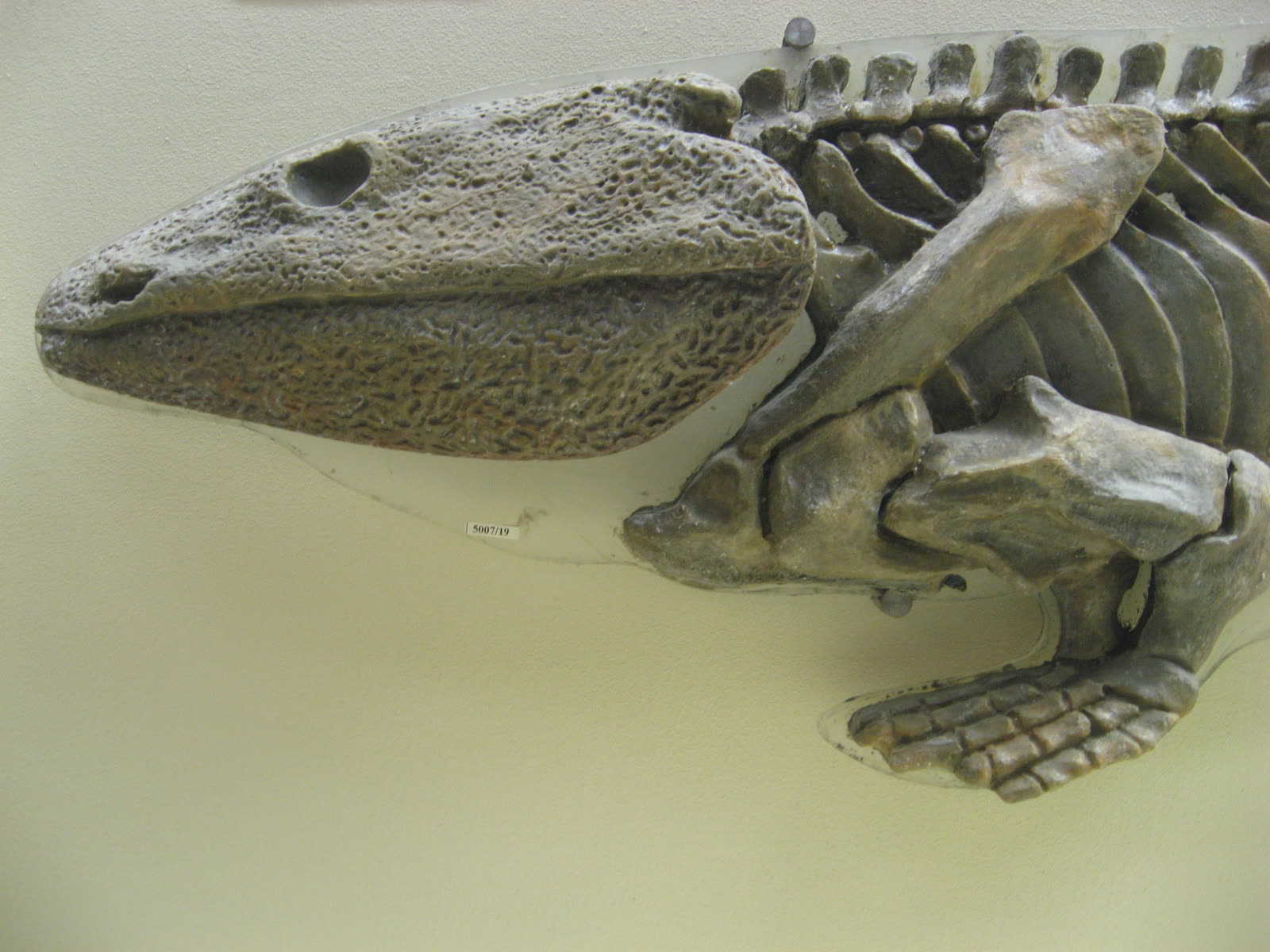
Ichthyostega still gets introduced as if it were the first land vertebrate that almost figured walking out.[1][2][3] That description survives because it is easy to picture: a fish becoming a salamander by stages, with limbs gradually taking over from the tail. The harder and better version is stranger. Modern reconstructions do not show an early tetrapod converging smoothly on an ordinary four-limbed gait. They show a front-heavy animal with a regionally specialized vertebral column, a deep and stiff trunk, ossified sternal support, and limbs that could work against the ground without yet delivering the alternating walking pattern most readers imagine.[1][2][3][4]
That distinction matters because Ichthyostega is not valuable merely as a transitional mascot. It is valuable because it keeps the water-to-land transition from being told as a single mechanical upgrade. In this animal, ribs, vertebrae, limb joints, and whole-body mass properties do not line up into a neat proto-salamander package. They line up into a mixed experiment. The body can do more on a substrate than a fish can. It still cannot do what a later crown tetrapod can.[1][2][3][4]
Image context: the lead image uses a real museum photograph of an Ichthyostega skeletal display from Wikimedia Commons. That choice matters because the article depends on body proportions staying visible at a glance. The shoulder mass, deep thorax, stout forequarters, and long tail are not background details; they are the whole argument about how odd this animal's locomotor design remained.[5]
1) The 2005 reset: the trunk stopped behaving like a fish
The 2005 Nature reconstruction is still the hinge point because it broke with the old whole-body picture directly.[1] Ahlberg, Clack, and Blom argued from original material and new specimens that Ichthyostega had a vertebral column more strongly regionalized than earlier reconstructions allowed.[1] The key consequence was mechanical. The presacral column did not look built for the broad side-to-side undulation expected in a fish-grade swimmer. It looked adapted for dorsoventral rather than lateral flexion.[1]
That is already enough to move the conversation. If the trunk is losing easy side-to-side flexibility while the limbs are gaining more purchase against a solid surface, the body is no longer solving movement through the old tail-first logic alone.[1][2] The famous Devonian transition is therefore not simply "tail down, limbs up." It is a reorganization of where bending happens, how the trunk is braced, and which part of the body takes the first serious load outside buoyant water.
Nature's editorial summary made the point bluntly at the time: the animal may have moved on land by a bilaterally symmetrical shuffling action rather than by the later left-right sequence associated with ordinary tetrapod walking.[1] That remains the right mental reset. Ichthyostega is not a failed salamander. It is an early tetrapod whose torso was already being re-engineered for a different mechanical problem.
2) The 2012 reset: the limbs had digits, but not a normal walking cycle
The 2012 joint-mobility paper sharpened that torso-first revision into a locomotion argument.[2] Pierce, Clack, and Hutchinson built a three-dimensional reconstruction and tested the limb joints quantitatively. Their conclusion was not that Ichthyostega could walk badly in a familiar tetrapod way. Their conclusion was narrower and more disruptive: it could not have used typical tetrapod locomotory behaviours such as lateral-sequence walking.[2]
The specific boundary is important. The paper argues that Ichthyostega lacked the long-axis rotational capacity in the limbs needed to push the body off the ground and move the limbs in the alternating sequence expected in later walkers.[2] In other words, digits alone did not deliver the gait. The skeleton had already crossed into limbed tetrapod territory, but the joint mechanics were still holding movement inside a very different operating envelope.
That makes the forelimbs more important than the usual popular image allows. The animal's locomotor future was not hiding in a generalized all-purpose four-limbed design. It was partitioned. The forequarters could contribute strongly to substrate-based movement, while the hindlimbs and axial system did not yet add up to the fully familiar quadrupedal cycle readers tend to project backward.[2][4] This is precisely why Ichthyostega remains so useful: it separates the origin of limbs from the origin of an ordinary walk.
3) The 2013 reset: the ribcage and sternum made the chest into a machine
The 2013 vertebral-architecture paper made the torso even more interesting.[3] Using synchrotron microtomography, Pierce and colleagues described the three-dimensional vertebral structure of Ichthyostega and reported several features that mattered for function as much as for classification.[3] Two stand out for this article. First, the vertebral design was not the expected ancestral template; the paper argued for a "reverse" rhachitomous arrangement, which forced a revision of what early limbed vertebral architecture might have looked like.[3] Second, the scans revealed the earliest known ossified sternal elements in a stem tetrapod.[3]
That second point is easy to underrate because sternum talk sounds technical and dry. It is not dry at all. An ossified sternal apparatus means the chest is no longer just a passive wrapper around lungs and viscera. It becomes part of a reinforced anterior body region, a place where ribs, shoulder girdle, and trunk support can begin to coordinate under load.[2][3] For an animal already inferred to rely heavily on the forequarters, that matters enormously.
The ribs belong in the same sentence. In the older literature Ichthyostega was often remembered through feet and tail because those are the obvious transition symbols.[1] The post-2005 picture says the thorax deserves equal billing. A stiffened, regionally differentiated trunk changes what the limbs can accomplish and how force can travel through the body. The chest stops being scenery for locomotion. It becomes one of the reasons locomotion looked the way it did.
4) The 2025 reset: the whole body stayed front-heavy
The newest turn came from digital volumetric modelling in 2025.[4] Strong, Bishop, Hutchinson, and Pierce reconstructed body mass properties and concluded that Ichthyostega had a uniquely robust body plan: front-heavy in the way fishes often are, yet paired with unusually well-developed limbs, especially the forelimbs.[4] That result is useful because it keeps the locomotor story from shrinking back into joints alone.
Body-plan arguments matter in transitions like this. A center of mass that remains relatively anterior changes how the limbs and trunk have to cooperate.[4] The 2025 study also found that plausible variation in body composition did little to change flotational attitude, which in practical terms means the animal's hydrostatic profile was not being transformed by some simple soft-tissue tweak.[4] The strange mechanics were deeper than that. Ichthyostega was built as a mixed system, not as a nearly finished terrestrial tetrapod waiting for a little more confidence.
Read together with the 2012 paper, the picture becomes quite tight. A front-heavy body with strong forequarters and limited limb rotation is exactly the kind of animal one would expect to handle substrate contact in a way that is real, forceful, and still unlike later ordinary walking.[2][4] The gait does not need to be dismissed as "not yet land-based." It needs to be described more carefully. It was landward, but it was landward through a chest-and-forelimb solution that kept a great deal of older body logic intact.
5) What the anatomy-first reading can now defend
The strongest defensible version of Ichthyostega is therefore more interesting than the old missing-link shorthand. It was a Late Devonian stem tetrapod from East Greenland with limbs and digits, but also with a deeply specialized axial skeleton, a stiffened and regionally organized trunk, ossified sternal elements, and a locomotor system that could not yet produce a conventional alternating walk.[1][2][3] The whole body remained robust and front-loaded enough in 2025 modelling to support earlier ideas of forelimb-dominated substrate movement.[4]
The limits matter too. None of this licenses the opposite simplification that Ichthyostega was basically still a fish with decorative limbs. The 2005 paper explicitly treated it as the earliest vertebrate with obvious adaptations for non-swimming locomotion.[1] The point is not that land was absent. The point is that land entered the story through a very particular anatomical route: a reworked torso, a reinforced chest, and forequarters doing more mechanical work than a later walker would require.
That is why this anatomy deep dive lands on the ribs. Feet and digits announce the transition to the eye, but the ribs and sternum tell you how the body was trying to survive it. Ichthyostega matters because it shows that terrestrialization did not begin by inventing an ordinary walk all at once. It began by building a strange body that could push, brace, and shuffle before it could really stride.
Sources
- Per Erik Ahlberg, Jennifer A. Clack, and Henning Blom, "The axial skeleton of the Devonian tetrapod Ichthyostega," Nature 437 (2005).
- Stephanie E. Pierce, Jennifer A. Clack, and John R. Hutchinson, "Three-dimensional limb joint mobility in the early tetrapod Ichthyostega," Nature 486 (2012).
- Stephanie E. Pierce, Per E. Ahlberg, John R. Hutchinson, Julia L. Molnar, Sophie Sanchez, Paul Tafforeau, and Jennifer A. Clack, "Vertebral architecture in the earliest stem tetrapods," Nature 494 (2013).
- Catherine R. C. Strong, Peter J. Bishop, John R. Hutchinson, and Stephanie E. Pierce, "Digital volumetric modeling reveals unique body plan experimentation in the Devonian tetrapod Ichthyostega," iScience (2025), via PubMed record.
- Wikimedia Commons file page for the photographed Ichthyostega skeletal display used as the lead image.