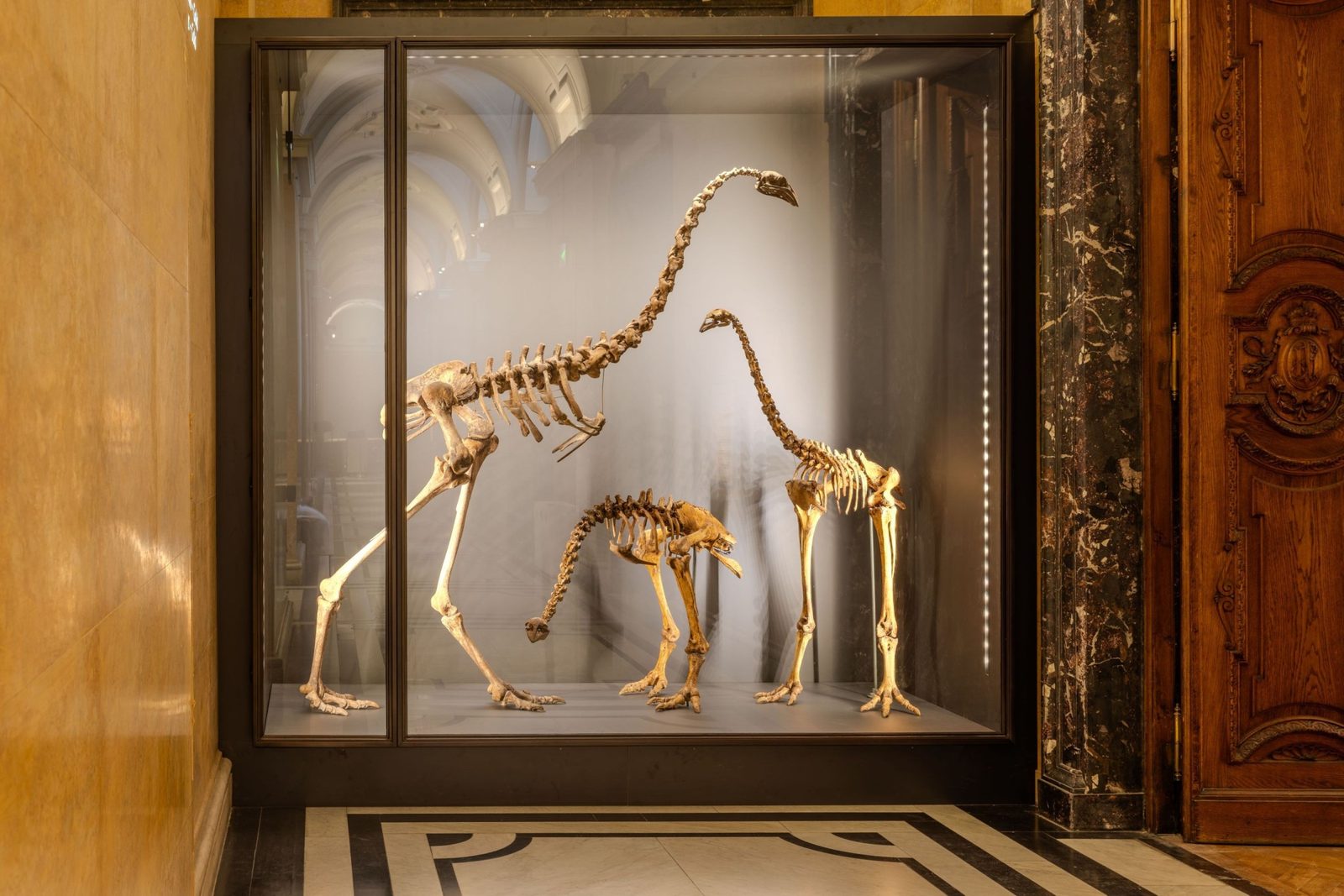
In the Natural History Museum Vienna's new moa case, the skeleton at left towers over the one at right. The labels identify both as Dinornis robustus: female on the left, male on the right. A shorter, more heavily built Euryapteryx stands between them.[8] The arrangement makes sex look like something the bones simply disclose.
Remove the labels, however, and the same display becomes an invitation to get the story wrong. The large and small Dinornis could be different species, an adult and a juvenile, animals from separate regions, or unusually distant points within one variable population. Their size difference is visible. Its cause is not.
That gap matters far beyond moa. Paleontologists routinely want to know whether a crest, horn, feather or body size differed between sexes. Such interpretations can then support stories about courtship, competition, division of ecological roles or reproductive behavior. Yet fossilization usually preserves the feature being explained while losing the independent evidence needed to identify sex.
Sexing one fossil and demonstrating sexual dimorphism are therefore different tasks. A molecular or reproductive-tissue marker may identify an individual. A large, well-controlled sample may show two anatomical groups. Connecting those groups to female and male requires another link, and explaining why the difference evolved requires another still. The best studies do not compress this chain into a single confident label.
Moa size once multiplied species
The Vienna pair is legible today because the broader female–male pattern was not established from skeleton size. In 2003, Michael Bunce and colleagues compared ancient DNA from Dinornis remains that had been divided among three markedly different size forms. Mitochondrial sequences grouped the animals by island rather than by those forms. The first sex-linked nuclear sequences recovered from an extinct animal then associated the largest forms with females and the smaller forms with males.[1]
The reversal was substantial. The study estimated that the largest females reached about 2.8 times the weight and 1.5 times the height of the largest males. Forms once treated as separate species on each island were instead extreme female and male morphs within the same island lineage.[1] Size remained useful evidence, but only after genetics supplied the category that size alone could not.
The case also exposes a less obvious trap: even a genetically sexed fossil sample may not represent a living population faithfully. Morten Allentoft and colleagues later analyzed ancient DNA from 267 moa and obtained molecular sex assignments for 227. Across their fossil sample, females outnumbered males by about 5.1 to one, while the imbalance varied sharply among deposits—from roughly 2.2 to one to 14.2 to one.[2]
Those counts were evidence about deposition as well as biology. They could not simply be read as the breeding ratio of moa across New Zealand. A fossil locality samples animals that entered a particular environment, died there or arrived after death, escaped destruction, fossilized, were exposed and were collected. If any of those filters differ by sex, the deposit can magnify one sex before a researcher measures the first bone.
Moa thus solve one problem and sharpen another. DNA can join a large skeleton and a small skeleton as sexes of one lineage. It cannot guarantee that the available skeletons contain the sexes in natural proportions. An independent marker improves the labels; taphonomy still governs the sample.
A reproductive tissue is a narrow window
For most extinct animals, recoverable sex-linked DNA is unavailable. Bone microstructure offers a rarer alternative in dinosaurs and fossil birds. Living egg-laying female birds temporarily deposit medullary bone inside parts of the skeleton as a readily mobilized calcium reserve for eggshell production. If the same tissue is securely identified in a fossil relative of birds, it can indicate not merely female sex but reproductive activity near the time of death.[3][4]
The positive signal is unusually specific. Its absence is not. Medullary bone is short-lived, can vary in skeletal distribution and may be removed during the laying cycle. The relevant cavity may not be preserved, exposed or sampled. A fossil without detectable medullary bone is therefore not identified as male; it may be a female that died outside the brief window, or one whose signal was lost or missed.[3][4]
The harder problem is deciding whether an unusual internal tissue really is medullary bone. Pathological and ordinary growth-related tissues can resemble it under a microscope. A 2016 study of Tyrannosaurus rex specimen MOR 1125 added histochemical and immunochemical evidence: the proposed medullary tissue shared a compositional pattern with medullary bone in living birds.[3] That made the diagnosis stronger than resemblance alone, but did not turn every spongy tissue in a dinosaur into a sex marker.
In 2018, Jingmai O'Connor and colleagues proposed nine criteria for fossil medullary bone, including its distribution across multiple elements, separation from cortical bone, the absence of external pathology and consistency with a reproductively mature growth stage. They also noted preliminary evidence that pathological bone can share a chemical signal used in the T. rex work, so chemistry itself still required further testing.[4] The methodological lesson is exacting: a potentially direct marker is only as direct as its tissue diagnosis.
One sexed bird cannot label every ornament
The changing interpretation of Confuciusornis sanctus shows how uncertainty at the marker propagates into an evolutionary story. Hundreds of these Early Cretaceous birds preserve striking plumage variation. Some have two long central tail feathers; others do not. The streamers were traditionally assigned to males and their absence to females, but plumage alone could not confirm that division.[5]
A 2013 study reported medullary bone in specimen DNHM-D1874, which lacks the long feathers. The authors interpreted the tissue as evidence of a reproductively active female and used that independently sexed individual to support the association between featherlessness and female sex.[5] Notice what even this favorable result could establish: at least one reproductively active female lacked the streamers. By itself, it did not demonstrate that every streamer-bearing bird was male or that every featherless bird was female.
The 2018 review then applied its expanded criteria to the same specimen. The proposed tissue was limited in distribution, was absent from the tibiotarsus where living birds consistently express medullary bone, and appeared associated with fragments the reviewers considered more likely to be cortex. They judged the identification "equivocal at best."[4] That reassessment did not prove DNHM-D1874 male, nor did it prove the streamers irrelevant to sex. Under the reviewers' criteria, it weakened the independent anchor and therefore every sex assignment built from it.
That was not the last word. In a 2020 osteohistological study, Chinsamy and colleagues directly rejected the cortex-fragment reading. They argued that the proposed medullary tissue is endosteally formed and attached to the inner circumferential layer, continued to describe the identification as probable, and retained the featherless-female interpretation as a working assumption.[9]
The result is active disagreement, not a one-way correction. The ornamental feathers remain real, and both teams examined the tissue's position. What is contested is whether those observations satisfy a medullary-bone diagnosis. Until that dispute is resolved, the plume-to-sex mapping has to carry the tissue uncertainty with it.
Dimorphism belongs to populations
When no individual marker survives, sexual dimorphism has to emerge from population structure rather than a memorable pair of specimens. That demands fossils from the same species, place and interval; enough individuals to reveal a distribution; and controls for growth, distortion and other sources of anatomical variation.
An exceptional theropod bonebed at Angeac-Charente in France offered unusually favorable material. A 2023 study referred the animals to Ornithomimosauria and treated the deposit as a herd of at least 61 coeval individuals. Romain Pintore and colleagues digitized 152 femora and tibiae, then used three-dimensional geometric morphometrics and mixture modeling to test how shapes were distributed. The femora separated into two shape clusters, particularly in shaft curvature and the distal end, and the difference was not explained by overall size.[7]
That clade assignment is now unsettled. A 2025 phylogenetic analysis instead recovered the unnamed Angeac-Charente taxon as a gracile-limbed abelisauroid convergent with coelurosaurs.[10] A separate 2025 review called its affinities ambiguous and treated Pelecanimimus from Spain—not the Angeac animal—as the only unequivocal European ornithomimosaur.[11] Those revisions change where the animal may sit on the theropod tree; they do not erase the measured bimodality in the bonebed sample.
The 2023 authors interpreted the two morphs as evidence of sexual dimorphism. That is a population-level inference, not a molecular sex determination. Coeval burial reduces time averaging, the statistical clusters make the pattern repeatable, and comparisons across living archosaurs and other tetrapods make a sex-linked explanation plausible. But neither cluster comes with a female or male label. Histology capable of independently identifying reproductive females could, in principle, map sex onto the shapes; without it, the safer conclusion is two morphs probably related to sex, not a known male femur and a known female femur.[7]
The difficulty is clearer in ordinary dinosaur datasets. Jordan Mallon re-tested nine non-avian dinosaur species for which sexual dimorphism had been proposed, using several statistical approaches. The available samples yielded no support for dimorphism in any of them.[6] That result did not establish that all nine species lacked sex differences. It showed that their fossils could not reliably demonstrate the claimed patterns. Small samples, prolonged growth, uncertain maturity, geographic or temporal mixing and measurement choices can all blur two real groups—or manufacture apparent groups where none existed.[6]
A pair of skeletons sits at the weakest end of this evidence spectrum. Any two animals can differ. Sexual dimorphism is a recurring relationship between sex and anatomy within a population, so the relevant evidence must recur too.
Keep four claims separate
The phrase “male and female fossils” often hides four claims of increasing reach.
Individual diagnosis asks whether one specimen carries an independent sex marker. Sex-linked DNA can do this for moa. Convincing medullary bone can do it for a reproductively active female, but not for a male and not for every female.
Population structure asks whether a controlled sample contains consistent anatomical groups. The Angeac femora supply a strong example because many coeval animals preserve a repeatable shape difference. A group can be real before its biological cause is known.
Sex mapping asks which group is female and which is male. This requires an independent marker inside the anatomical distribution, not an intuition that larger, more ornate or more robust must mean male. Dinornis is a warning against that intuition: the giants were female.[1]
Evolutionary explanation asks why the sexes differed. Courtship and competition are possibilities, but so are fecundity, locomotion, habitat use and other ecological differences. Even a secure female–male map does not preserve behavior. That final step needs comparisons with living animals and alternative hypotheses, not a more dramatic reconstruction.
The Vienna display succeeds because its labels embody evidence that the photograph cannot show. The female and male Dinornis remain visibly different, while the genetic work explains why the difference belongs within a species rather than between species. The Confuciusornis debate shows the reverse: when the independent label becomes uncertain, the tempting plumage story must become uncertain with it.
Sex is among the most consequential labels paleontologists can add to a fossil, and among the easiest to infer too early. A strong analysis begins with the narrowest claim its evidence can carry, then leaves each additional link visible. The bones preserve difference. Establishing what kind of difference it was is the science.
Sources
- Michael Bunce et al., “Extreme reversed sexual size dimorphism in the extinct New Zealand moa Dinornis,” Nature 425 (2003) — ancient mitochondrial and sex-linked nuclear DNA connecting extreme size forms to island lineage and sex.
- Morten E. Allentoft et al., “Highly skewed sex ratios and biased fossil deposition of moa: ancient DNA provides new insight on New Zealand's extinct megafauna,” Quaternary Science Reviews 29 (2010) — molecular sex assignments and deposit-level sampling bias.
- Mary H. Schweitzer et al., “Chemistry supports the identification of gender-specific reproductive tissue in Tyrannosaurus rex,” Scientific Reports 6 (2016) — histological and chemical evidence for medullary bone in MOR 1125.
- Jingmai O'Connor et al., “Medullary bone in an Early Cretaceous enantiornithine bird and discussion regarding its identification in fossils,” Nature Communications 9 (2018) — expanded diagnostic criteria and reassessment of earlier fossil claims.
- Anusuya Chinsamy et al., “Gender identification of the Mesozoic bird Confuciusornis sanctus,” Nature Communications 4 (2013) — original tissue interpretation and its proposed connection to ornamental tail feathers.
- Jordan C. Mallon, “Recognizing sexual dimorphism in the fossil record: lessons from nonavian dinosaurs,” Paleobiology 43 (2017) — statistical re-evaluation of nine proposed dinosaur examples.
- Romain Pintore et al., “Femora from an exceptionally large population of coeval ornithomimosaurs yield evidence of sexual dimorphism in extinct theropod dinosaurs,” eLife 12 (2023) — population-scale 3D morphometrics from Angeac-Charente.
- Natural History Museum Vienna, “New Moa showcase in the Natural History Museum Vienna” (2026) — institutional identification of the mounted moa and source of the cover photograph by Wilhelm Bauer-Thell.
- Anusuya Chinsamy et al., “Osteohistology and Life History of the Basal Pygostylian, Confuciusornis sanctus,” The Anatomical Record 303 (2020) — later defense of the proposed medullary-bone diagnosis and featherless-female interpretation.
- Andrea Cau and Alessandro Paterna, “Beyond the Stromer's Riddle: the impact of lumping and splitting hypotheses on the systematics of the giant predatory dinosaurs from northern Africa,” Italian Journal of Geosciences 144 (2025) — phylogenetic analysis recovering the Angeac-Charente taxon within Abelisauroidea.
- Denis Theda et al., “The first ornithomimosaur remains from Germany,” Acta Palaeontologica Polonica 70 (2025) — review treating the Angeac taxon's affinities as ambiguous in the current European record.