

No Jurassic night left a recording. A sound wave spends its energy in air and vanishes; fossils can preserve anatomy and other physical traces, but not the vanished pressure wave. That distinction should make every reconstructed chirp, honk, boom, and roar begin with a question more useful than “Is this the real sound?”: which parts of this playback are constrained by anatomy, and which parts had to be supplied by a model?
Two short videos make the evidence ladder unusually clear. The first accompanies a 2026 study of 20 fossil crickets, katydids, and their relatives from nine species in the Middle Jurassic Jiulongshan Formation of Inner Mongolia. Their hardened forewings preserve files, scrapers, and vein-bounded geometry used to infer resonating regions—the surviving pieces of the sound-producing instrument.[1][3] The second revisits a far rarer object: a three-dimensionally preserved syrinx from the Late Cretaceous bird Vegavis iaai. Its mineralized rings record the framework of a vocal organ, but not the soft membranes that actually vibrated.[2][4]
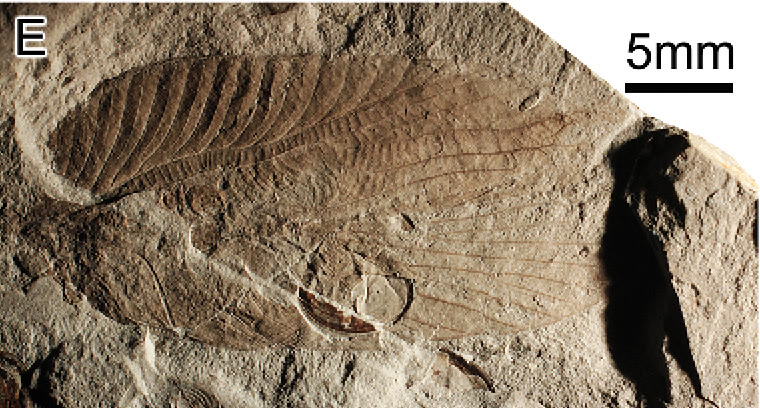
The cover fossil is the paratype forewing of Archaboilus polyneurus, described from the same Jurassic formation in 2021 and included as a species in the later acoustic reconstruction. It looks like a delicate fan pressed into tan stone. Near its base, however, venation becomes machinery: the toothed file on this forewing would have passed a scraper on its unpreserved partner, driving part of the wing into resonance. The photograph is a cropped specimen panel, not a drawing or a synthesized reconstruction.[3][6][7]
1. A wing file turns spacing into a pitch constraint
Science X's 104-second video pairs each fossil wing with the call reconstructed for it.[1] The presentation is seductive: one ancient wing appears, then a clean tone arrives as if the rock had been a phonograph record. Watch the visual sequence first without treating the audio as recovered sound. The important evidence is the repeated geometry—the file's teeth, the wing's size, and the cells of membrane enclosed by veins.
Living male ensiferans make calls by drawing a scraper, or plectrum, across a serrated vein on the opposite forewing. Each tooth strike excites the wing, while specialized membrane regions radiate the vibration. For a pure-toned call, tooth-strike rate and wing resonance must work together: a wing tuned near 5 kilohertz is most efficient when the file is swept at roughly 5,000 teeth per second. File length, tooth spacing, wing area, and the pattern of veins therefore carry acoustic information even after the animal is compressed into stone.[3]
The 2026 team did not simply convert tooth count into an audio file. It first tested its tools on living insects: a laser measured how their wings vibrated, while high-speed footage captured the scraper crossing the file. The researchers also built an evolutionary family tree from 1,077 genes and compared 95 living species to estimate how file length and ancestry relate to carrier frequency—the dominant pitch of a call. Only after those calibrations did the modeling pipeline move to the fossil wings.[3]
That sequence matters because no fossil wing can be played in its original physical state. Compression does not preserve its precise thickness, elasticity, three-dimensional posture, or how quickly a vibration would fade. For each fossil simulation, the researchers varied membrane thickness until the wing's first natural frequency fell inside the pitch range predicted from the living-species comparison. The simulation therefore did not independently confirm that pitch; it showed one mechanically plausible way the wing could vibrate within the predicted range and helped build the elementary syllable. Material properties and vibrating regions still had to be supplied from useful living comparisons.[3]
Within those limits, the result is richer than one Jurassic chirp. All 20 fossils came from the Daohugou assemblage and represent nine species that overlapped in place and geological time, roughly 157–165 million years ago. Five species were reconstructed with low pure tones around 5–7 kilohertz. Others occupied higher channels, and Sigmaboilus peregrinus was modeled at about 20.4–20.5 kilohertz—just above the conventional 20-kilohertz ceiling of human hearing. That places likely ultrasonic insect signaling deep in the Jurassic, long before bats appeared in the Eocene.[3][5]
The timing complicates a familiar evolutionary story. Ultrasound in modern katydids is often discussed as a response to echolocating bats. Bats cannot be the sole original driver if a Jurassic species was already signaling above 20 kilohertz. The authors propose two non-exclusive pressures: partitioning a crowded acoustic space so neighboring species did not mask one another, and evading earlier eavesdroppers such as small mammals capable of hearing high frequencies. The fossils support the early presence of diverse channels. The proposed predators and selective sequence remain an evolutionary inference, not a scene caught in the rock.[3]
The video's rhythm is the softest layer of all. Fossils preserve neither the nervous commands that set call timing nor a male's decision to repeat, pause, accelerate, or modulate a display. The researchers reconstructed a basic syllable from simulated tooth strikes, then used a model trained on living insects to estimate repetition rate. Loudness, behavioral variation, and longer call structure remain unknown. What we hear is an audible rendering of a constrained hypothesis: strong on the mechanism and approximate carrier frequency, weaker on the performance.
2. A syrinx preserves a floor plan, not a voice
The National Science Foundation video is also brief—93 seconds—but its fossil is radically different.[2] Vegavis lived about 66–69 million years ago in what is now Antarctica. Inside one fossil block, researchers recognized mineralized pieces of a syrinx at the junction where the trachea divides toward the lungs. CT imaging let them separate that tiny structure from surrounding bone without physically excavating it.[4]
The video's headline says the find suggests dinosaurs could not sing. Its most useful lesson is narrower. Birds are dinosaurs, and Vegavis preserves the oldest described Mesozoic example of their distinctive vocal organ. No comparable syrinx has yet been identified in a non-avian dinosaur. That absence may mean a complex syrinx arose relatively late in bird evolution, after flight and major respiratory innovations. It cannot mean that every non-avian dinosaur was silent: an animal can produce closed-mouth booms or other larynx-based sounds without a bird-style syrinx.[2][4]
What does the fossil itself permit? Fused rings form a well-mineralized central support called the pessulus. The left and right bronchial sides are asymmetric, a geometry associated in living birds with paired sound sources. Comparisons with CT scans of 12 living non-songbird species led the researchers to propose enlarged vibrating labia and the capacity for a relatively complex, waterfowl-like call.[4] That is a functional inference from architecture, not an identification of one exact honk.
The missing anatomy sets the boundary. A bird's voice depends on soft labia or membranes, their tension, muscle control, air pressure, airway shape, and behavior. Those variables determine pitch range, timbre, loudness, transitions, and phrasing. The fossil preserves supports around that system but not a complete playable organ. Even if a modern bird offers a close geometric comparison, selecting its call as a substitute would smuggle the living animal's tissues and behavior into the Cretaceous.
This makes the Vegavis inference broader than the insect result. A toothed wing file repeatedly strikes a scraper, so preserved spacing can constrain a periodic input to a resonator. The syrinx fossil shows where paired vibrating tissues were supported, but those tissues themselves are gone. The insect playback can therefore aim at a modeled carrier frequency and elementary syllable. The bird fossil more securely supports a kind of sound-producing apparatus and a possible call class than a specific note.
An honest soundtrack separates three evidence layers
The most defensible reconstruction separates observation, translation, and staging. Observation is the fossil geometry: wing teeth and veins, syringeal rings and asymmetry. Translation is the comparison with living systems and the mechanical or evolutionary model that converts shape into a range of possible functions. Staging is everything needed to make the result feel like a performance—tempo, loudness, pauses, number of callers, forest ambience, and an animal's response to rivals or predators.
Only the first layer is literally fossilized. The second can be rigorous, tested, and quantitatively uncertain. The third often makes a museum or video reconstruction memorable, but it should never be mistaken for recovered evidence. The new insect chorus is scientifically exciting without being a time capsule: nine coexisting species give researchers an ensemble of constrained acoustic channels, while the exact night heard in the video remains composed.[1][3] Ask what structure moved, which part survives, what living comparison calibrates it, and which settings the creator chose. A reconstruction becomes more—not less—impressive when those seams stay visible. The instruments crossed deep time; the performances belong to the models.
Sources
- Science X, “Reconstructed Jurassic insect calls evoke a 165-million-year-old forest soundscape,” YouTube video, August 27, 2026.
- National Science Foundation News, “Discovery of fossil ‘voice box’ of Antarctic bird suggests dinosaurs couldn't sing,” YouTube video, October 12, 2016.
- Jun-Jie Gu et al., “Reconstruction of an extinct soundscape reveals ultrasonic communication in the Jurassic,” open Research Square preprint with full methods, March 2026; peer-reviewed version published in Proceedings of the National Academy of Sciences 123 (2026), DOI 10.1073/pnas.2615107123.
- Julia A. Clarke et al., “Fossil evidence of the avian vocal organ from the Mesozoic,” Nature 538 (2016), PubMed record and abstract.
- University of Graz, “Jurassic Sounds: Biologist reconstructs insect songs from 165 million years ago,” research release, August 2026.
- Jun-Jie Gu et al., “New species and material of Hagloidea (Insecta, Ensifera) from the Yanliao biota of China,” ZooKeys 1033 (2021), including the photographed Archaboilus polyneurus specimen.
- Gu et al., “Archaboilus polyneurus … Figure 1,” original CC BY 4.0 fossil photograph and metadata, Wikimedia Commons.