Sclerotic rings are the kind of fossil detail that invite instant overreading. A circle of small bony plates sits inside an orbit, the eye socket looks enormous, and the story writes itself: night hunter, deep diver, supernatural eyesight. Paleontology gets stronger by slowing that sequence down. A sclerotic ring is useful not because it tells behavior directly, but because it preserves a hard-tissue boundary inside the eye region. Once that boundary is compared with living animals and kept separate from preservational distortion, it can support a narrower and better question: what sort of eye could have fit here, and what visual regime does that make more or less plausible?[1][2][3]
That is why sclerotic rings belong in an anatomy-and-method deep dive rather than in a list of fossil curiosities. The ring does not float free from the rest of the skull. It sits between orbit shape, eyeball support, and ecology. Recent work on living lizards shows strong correlations between the internal and external diameters of the scleral ossicle ring and soft structures such as lens diameter and axial eye length.[3] Earlier comparative work on fossil and modern chondrichthyans shows an equally important warning: ocular support structures differ across lineages, so the same-looking "eye ring" should not be treated as a universal one-step decoder of lifestyle.[4] Put bluntly, the ring matters because it constrains inference, not because it replaces it.
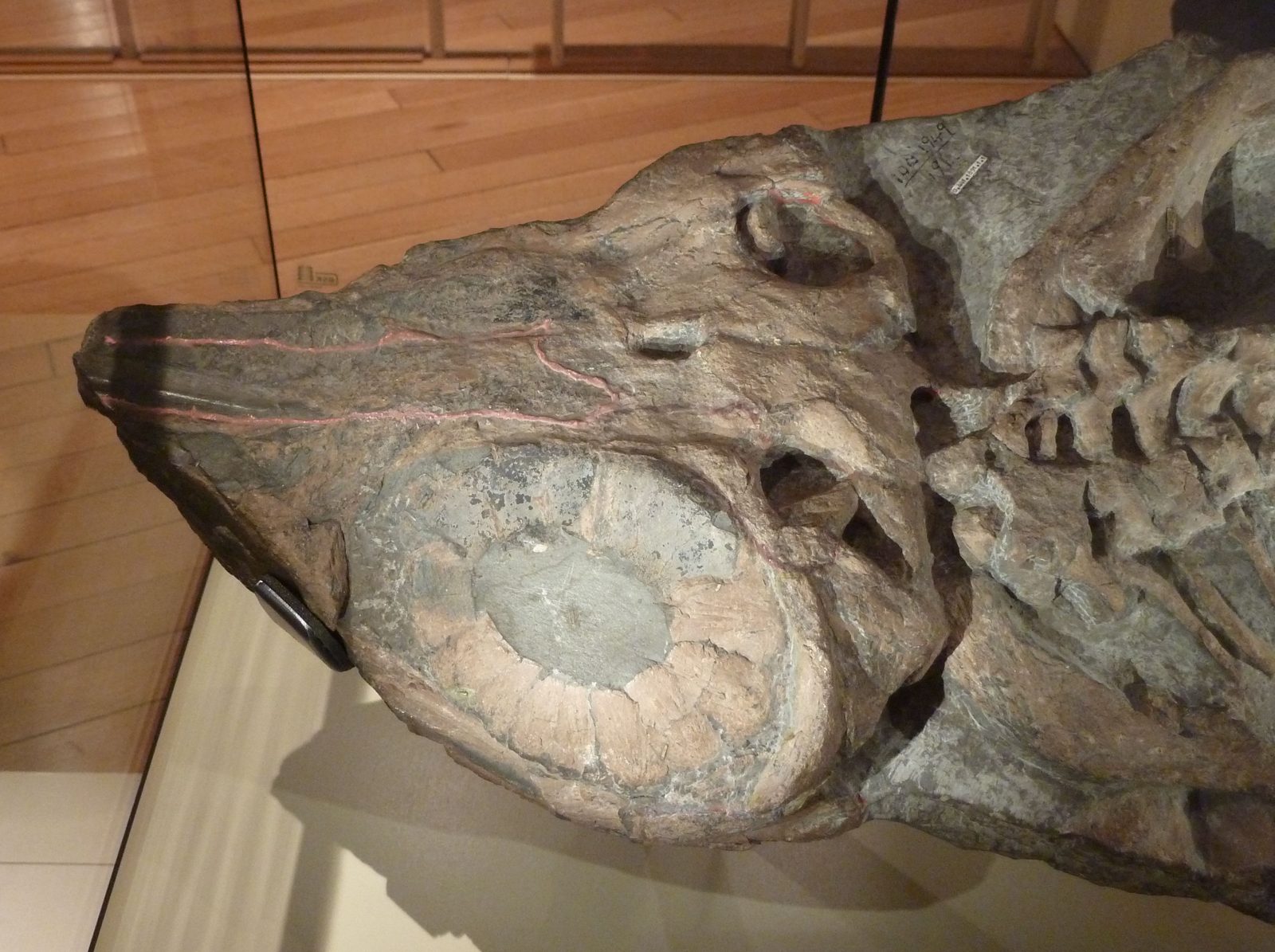
Image context: the cover uses a real museum photograph from Wikimedia Commons showing an ichthyosaur skull with its sclerotic ring preserved over the eye.[6] That is the right image for this article because the ring itself needs to stay visible as an anatomical object. The article is asking readers to look at the preserved circle before leaping to the behavior story built on top of it.
The ring is support, not the eyeball
The basic anatomical point is easy to lose because the fossil is so visually dramatic. The ring is not the eye itself. It is a set of skeletal elements within the sclera that helps define and support the eye opening.[3][4] In living squamates, Yamashita and Tsuihiji show that the ring's internal and external diameters correlate tightly with the sizes of otherwise soft structures, which is exactly why paleontologists care about it.[3] Fossils rarely preserve lenses or retinal tissues, but they sometimes preserve the harder scaffold around them. That scaffold becomes a proxy.
The proxy, however, is not content-free. Yamashita and Tsuihiji emphasize extant sauropsids, excluding crocodiles and snakes, because the ring is part of a particular anatomical distribution rather than a universal vertebrate feature.[3] Pilgrim and Franz-Odendaal make the same point from a different angle. In their study of fossil and modern chondrichthyans, modern sharks carry continuous ocular support elements of varying tissue composition, while fossil sharks from the Devonian Cleveland Shale preserve a multi-unit ring more reminiscent of reptiles.[4] That is a strong reminder that "there is a ring" is only the beginning of the interpretation. The morphology has to stay attached to lineage.
This is the first boundary worth keeping. A large orbit by itself does not secure a large functional pupil, and a large ring by itself does not settle ecology. The ring helps because it gives paleontology a more exact internal frame than the orbit alone. It does not remove the need for comparison, and it does not erase anatomical differences among major vertebrate groups.[3][4]
The method works by comparison, not by direct translation
The best-known use of sclerotic rings in fossil vertebrates is not a claim about bone for bone's sake. It is a comparative statistical method. Schmitz and Motani's 2011 Science paper compared scleral ring and orbit morphology in fossil archosaurs against living animals and concluded that Mesozoic archosaurs occupied all major diel activity categories: diurnal, nocturnal, and cathemeral.[1] That result mattered because it pushed against the old shortcut in which dinosaurs owned the day and mammals inherited the night. Eye structure suggested a messier and more interesting temporal ecology.[1]
What that paper did not do was turn every fossil ring into a behavioral label by itself. The inference depended on ring size relative to the orbit, comparison with extant species, and classification within a probabilistic framework.[1] Angielczyk and Schmitz extended the same logic into non-mammalian synapsids in 2014 and again found a spread across major diel patterns, including nocturnality long before crown mammals.[2] The method was powerful precisely because it treated hard-tissue eye geometry as a bounded input into a comparative model, not as a dramatic standalone clue.[2]
This is the second boundary worth keeping. A sclerotic ring does not tell paleontologists what an animal "liked to do." It helps them test whether the preserved eye geometry fits the light demands of day, night, or mixed activity when calibrated against living forms.[1][2][3] The answer is strongest when the ring is well preserved, the orbit is measurable, and the relevant modern comparison set is appropriate. It gets weaker as soon as those conditions loosen.
Ichthyosaurs show why aperture size and preservation limits matter
Ichthyosaurs are where public imagination usually outruns the method. The eyes are famously huge, and ophthalmosaurines in particular turned large-eyed marine reptiles into a deep-time cliché. Fischer and colleagues are useful here because they slow the story down.[5] In their work on Leninia stellans and ophthalmosaurine skull shape, they argue that a large sclerotic aperture appears widespread within Ophthalmosaurinae and that this conservatism likely reflects similar ecological niches across the clade's long history.[5] That is already a strong claim, but it is narrower than the folklore. It is about comparative aperture size and clade-level ecology, not about a magical proof of one exact diving depth.
The same paper is valuable because of its restraint. Fischer and colleagues explicitly say that minimum f-number cannot yet be satisfactorily calculated in ichthyosaurs and criticize more subjective ways of reconstructing eyeball placement or shape from crushed material.[5] They therefore fall back to a simpler and safer comparison: absolute sclerotic aperture as a proxy for dim-light capability, while avoiding stronger claims than the fossils can bear.[5] That is excellent paleontological discipline. The ring remains informative, but only after the tempting parts of the story are cut back.
Ichthyosaurs therefore show both why sclerotic rings matter and why they need policing. In some lineages the aperture really was enormous, large enough to make dim-light vision a serious ecological hypothesis.[5] But the same spectacular preservation that makes the fossils famous also exposes the limits of reconstruction. Crushed skulls, uncertain eyeball shape, ontogenetic stage, and interspecific differences all push against overconfidence.[5] The ring remains evidence, just not unlimited evidence.
What the ring can say, and what it cannot
The secure conclusion is already rich enough. Sclerotic rings are valuable because they preserve a hard internal boundary in the orbit that correlates, at least in the right living comparisons, with soft eye structures and therefore with visual performance.[1][2][3] They help paleontologists say more than "big socket, big eye" and less than "this animal definitely hunted at midnight." That middle ground is exactly where good fossil inference belongs.
The same fossils also define the limits. Ring morphology is lineage-sensitive.[3][4] Behavioral inference is comparative and probabilistic, not direct.[1][2] Exceptional giant apertures in ichthyosaurs point toward dim-light visual capacity, but even there the best recent work keeps reconstruction bounded by what the preserved skull can actually support.[5] When readers hold onto those boundaries, the ring becomes more interesting, not less. It stops being a spooky fossil ornament and becomes what paleontology needs it to be: a durable, partial, and surprisingly disciplined witness to how ancient vertebrates saw their worlds.
Sources
- Lars Schmitz and Ryosuke Motani, "Nocturnality in Dinosaurs Inferred from Scleral Ring and Orbit Morphology," Science 332, no. 6030 (2011).
- Kenneth D. Angielczyk and Lars Schmitz, "Nocturnality in synapsids predates the origin of mammals by over 100 million years," Proceedings of the Royal Society B 281, no. 1793 (2014).
- Masaya Yamashita and Tatsuya Tsuihiji, "The relationship between hard and soft tissue structures of the eye in extant lizards," Journal of Morphology 283, no. 9 (2022).
- Brettney L. Pilgrim and Tamara A. Franz-Odendaal, "A comparative study of the ocular skeleton of fossil and modern chondrichthyans," Journal of Anatomy 214, no. 6 (2009).
- Valentin Fischer, Maxim S. Arkhangelsky, Gleb N. Uspensky, Ilya M. Stenshin, and Pascal Godefroit, "A new Lower Cretaceous ichthyosaur from Russia reveals skull shape conservatism within Ophthalmosaurinae," Geological Magazine 151, no. 1 (2014).
- Wikimedia Commons, "File:Ichthyosaur skull with sclerotic ring, New Walk Museum.jpg" - file page for the real museum photograph used as the article image.