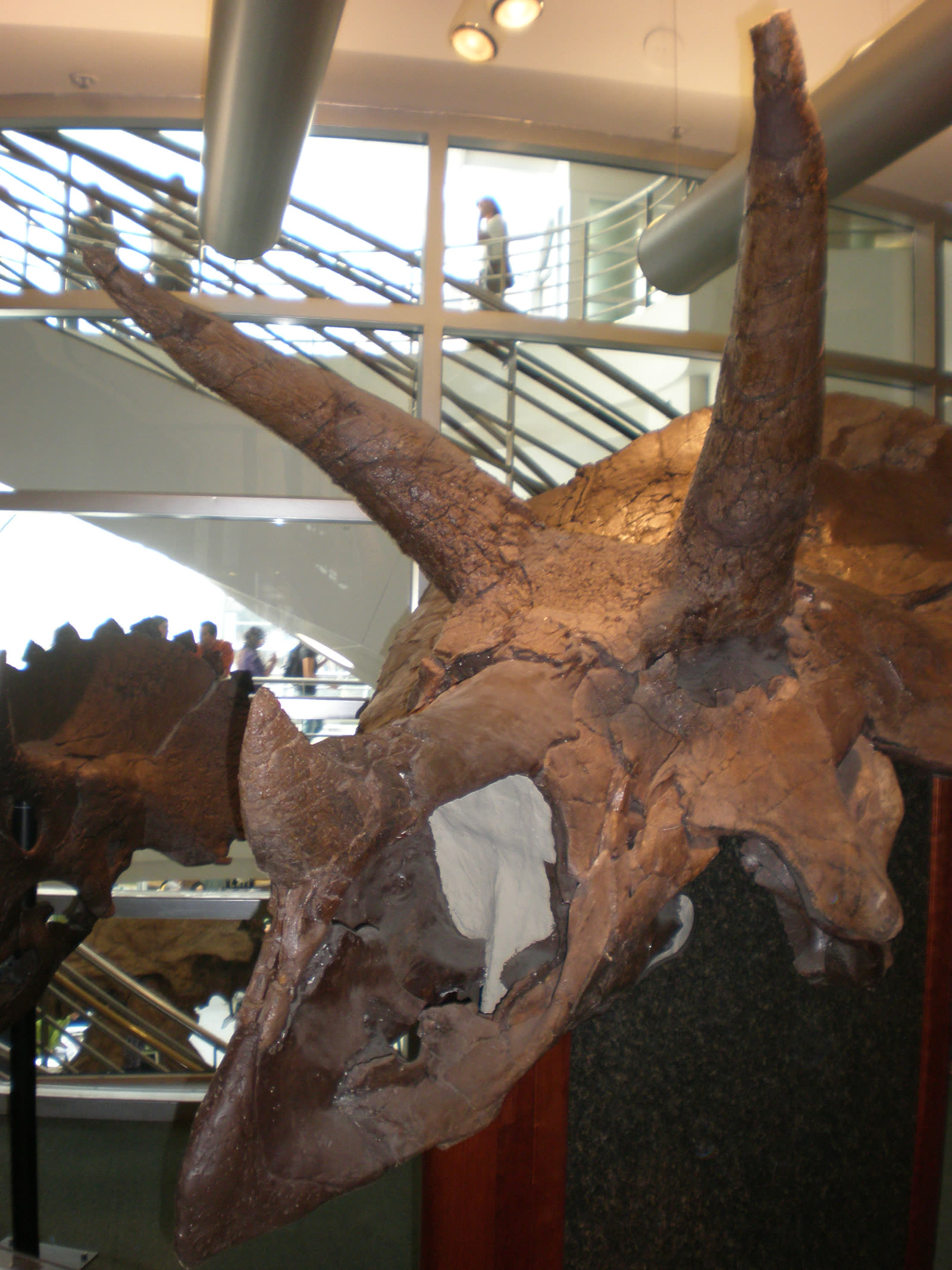
Triceratops is usually introduced as a verdict before it is introduced as an animal. The verdict says three horns, a bony shield, and a permanent place opposite Tyrannosaurus in every late-Cretaceous showdown. That version is memorable, but it blurs the thing that made the dinosaur distinctive in the first place. Triceratops was not simply a large quadruped with extra hardware attached to the front. It was a ceratopsid whose whole profile is organized around the face: beak, tooth batteries, horns, frill, and the growth changes that kept rewriting that face through life.[1][2][3][5]
That is why the strongest species profile begins in the skull rather than in the body outline. The late-Cretaceous North American animal now grouped as Triceratops horridus and Triceratops prorsus carried a sharp cropping beak, stacked shearing teeth, two large brow horns, a smaller nasal horn, and a solid frill that stayed visually dominant even while its exact meaning remained debated.[1][4][5] Some of that equipment almost certainly helped in defense and combat. Some of it also belonged to feeding and social display. Once those functions are kept together, Triceratops stops looking like a dinosaur tank and starts looking like a heavily specialized facial machine.
Image context: the cover uses a real museum photograph of an adult Triceratops horridus skull on display at the University of California Museum of Paleontology, via Wikimedia Commons.[6] That choice matters because the article's main claim begins in visible structure. The hooked beak, the stacked tooth row behind it, the long brow horn, and the solid frill are not separate curiosities. They are parts of one working front end.
The profile starts with a changing skull, not a fixed mascot
The history of discovery already points in that direction. The Natural History Museum notes that Othniel Charles Marsh's first find in 1887 was only a pair of horn cores, which he initially took for a giant bison before more complete remains forced the three-horned dinosaur into view.[1] That mistaken beginning matters because it reminds us how much of Triceratops identity resides in cranial parts. The face was legible before the body was.
Later collecting made the problem richer rather than simpler. Museums accumulated skulls in different shapes and sizes, and what first looked like a parade of separate species gradually compressed into a smaller, more defensible set.[1] Longrich and Field's 2012 ontogeny study treated the famous Triceratops-Torosaurus argument as a test case in how horned-dinosaur faces change with maturity.[5] Whether one follows every taxonomic conclusion in that debate or not, the paper makes one point impossible to miss: skull form in late chasmosaurines is developmentally mobile. Ornament appears, the skull roof fuses, the surface texture changes, and the horns become longer, more massive, and more strongly curved as individuals mature.[5]
That is the right boundary to keep in mind when reading Triceratops. A museum mount encourages the eye to think in finished adult icons. The fossil record encourages the opposite habit. The head is a growth surface as well as a taxonomic surface. Any profile that treats horn length, frill proportions, and facial ruggedness as fixed from youth to adulthood will flatten the animal almost as badly as the old tank myth does.[1][5]
Beak first, then blades
Feeding is the clearest reason the face became so elaborate. The Natural History Museum's summary keeps the basic outline plain: Triceratops had a sharp beak for clipping vegetation and rows of teeth at the back of the jaws that formed shearing surfaces for processing tough plant matter.[1] That already separates it from a generic reptilian bite. The front of the mouth gathered and cropped. The back of the mouth sliced.
Ostrom's 1964 jaw-mechanics study remains important because it treated that slicing system as an engineering problem rather than as a decorative fossil detail.[2] The point was not simply that Triceratops had many teeth. It was that jaw movement and occlusal geometry had to work together for those teeth to matter. The face therefore carried two linked tasks at once: securing plant material with the beak and then driving it into a disciplined cutting battery behind the rostrum.[1][2]
Erickson and colleagues pushed that picture much further in 2015.[3] Their dental study showed that Triceratops teeth contained a complex tissue architecture and wore during feeding in a way that created recessed fullers on the chewing surfaces, reducing friction as the animal sliced vegetation.[3] That result changes the tone of the profile. The dental battery was not a pile of replacement teeth waiting to be used up. It was a self-maintaining cutting system whose wear pattern actively improved function.[3]
Once that is in view, the face stops being a set of separate headlines. The beak is not one story and the teeth another. The horns did not sit on top of a boring herbivore mouth. The mouth itself was among the most technically interesting parts of the animal. Triceratops remained famous because of the horns, but it stayed evolutionarily successful because the whole front end could gather, slice, and recycle tough plant material efficiently.[1][2][3]
Horns and frill were social hardware before they became a tank myth
The horns still matter, just not in the crude way popular iconography prefers. In life they would have been longer and sharper than the bare fossil cores suggest because they were sheathed in keratin.[1] That alone should make readers slightly suspicious of toy-like reconstructions that treat the exposed bone as the whole signal. The living animal's face would have presented a more extended and visually emphatic front than many skeleton-only images imply.[1]
What did those horns do? Farke's 2009 pathology study gives a careful answer.[4] By comparing rates of lesions on cranial bones in Triceratops and Centrosaurus, the paper found a higher incidence of squamosal lesions in Triceratops, consistent with face-to-face horn use in combat.[4] That is real evidence, and it deserves to stay in the profile. But it is narrower than the myth. It supports horn-related fighting behavior within the clade. It does not prove that every frill was a shield first, or that the dinosaur's entire identity can be reduced to jousting.
Longrich and Field's ontogeny work helps put that combat evidence in scale.[5] Because ornament changed so strongly with maturity, the horns and frill also belonged to social signaling and developmental display. They were structures whose visual presence intensified as the animal aged.[5] The adult face therefore makes more sense as multipurpose hardware: combat-capable, visually assertive, taxonomically informative, and impossible to detach from life stage.
That is the better use for the word "weapon" here. A weapon in Triceratops was not an isolated spear mounted on a bland herbivore. It was one outcome of a facial complex that also had to feed, grow, signal, and stabilize identity within a crowded late-Cretaceous fauna.[1][3][4][5]
What should stay fixed in memory
The safest modern picture of Triceratops is therefore more integrated and more bounded than the mascot version. It was a latest-Cretaceous ceratopsid represented by two accepted species in most public summaries, and it carried one of the most specialized faces in dinosaur evolution: cropping beak in front, slicing dental batteries behind, large brow horns above, and a broad solid frill closing the silhouette.[1][2][3][5]
The useful uncertainty should stay visible as well. Horns almost certainly served more than one purpose. The frill was not only a shield. Growth altered the face enough to complicate taxonomy. Combat evidence is persuasive, but it is not license to turn every skull into a medieval duel scene.[4][5] These are not weaknesses in the profile. They are the reason the animal remains scientifically alive.
If one memory hook has to survive, let it be this: Triceratops was not memorable merely because it had three horns. It was memorable because evolution turned the entire face into a coordinated system for cropping, slicing, signaling, and, when necessary, colliding.
Sources
- Natural History Museum, "Triceratops" - overview of discovery history, the two commonly recognized species, keratin-covered horns, and the beak-plus-shearing-teeth feeding setup.
- John H. Ostrom, "A functional analysis of jaw mechanics in the dinosaur Triceratops," Postilla 88 (1964) - classic mechanical reading of the jaws and occlusion.
- Gregory M. Erickson et al., "Wear biomechanics in the slicing dentition of the giant horned dinosaur Triceratops," Science Advances 1, no. 5 (2015) - dental tissue complexity, self-wear, and fuller formation in the tooth battery.
- Andrew A. Farke et al., "Evidence of Combat in Triceratops," PLOS ONE 4, no. 1 (2009) - pathology patterns consistent with horn-related intraspecific combat.
- Nicholas R. Longrich and Daniel J. Field, "Torosaurus Is Not Triceratops: Ontogeny in Chasmosaurine Ceratopsids as a Case Study in Dinosaur Taxonomy," PLOS ONE 7, no. 2 (2012) - growth-stage change, skull fusion, and the taxonomic implications of facial development.
- Wikimedia Commons, "File:Adult Triceratops horridus skull UCMP 1.JPG" - file page for the real museum skull photograph used as the article image.