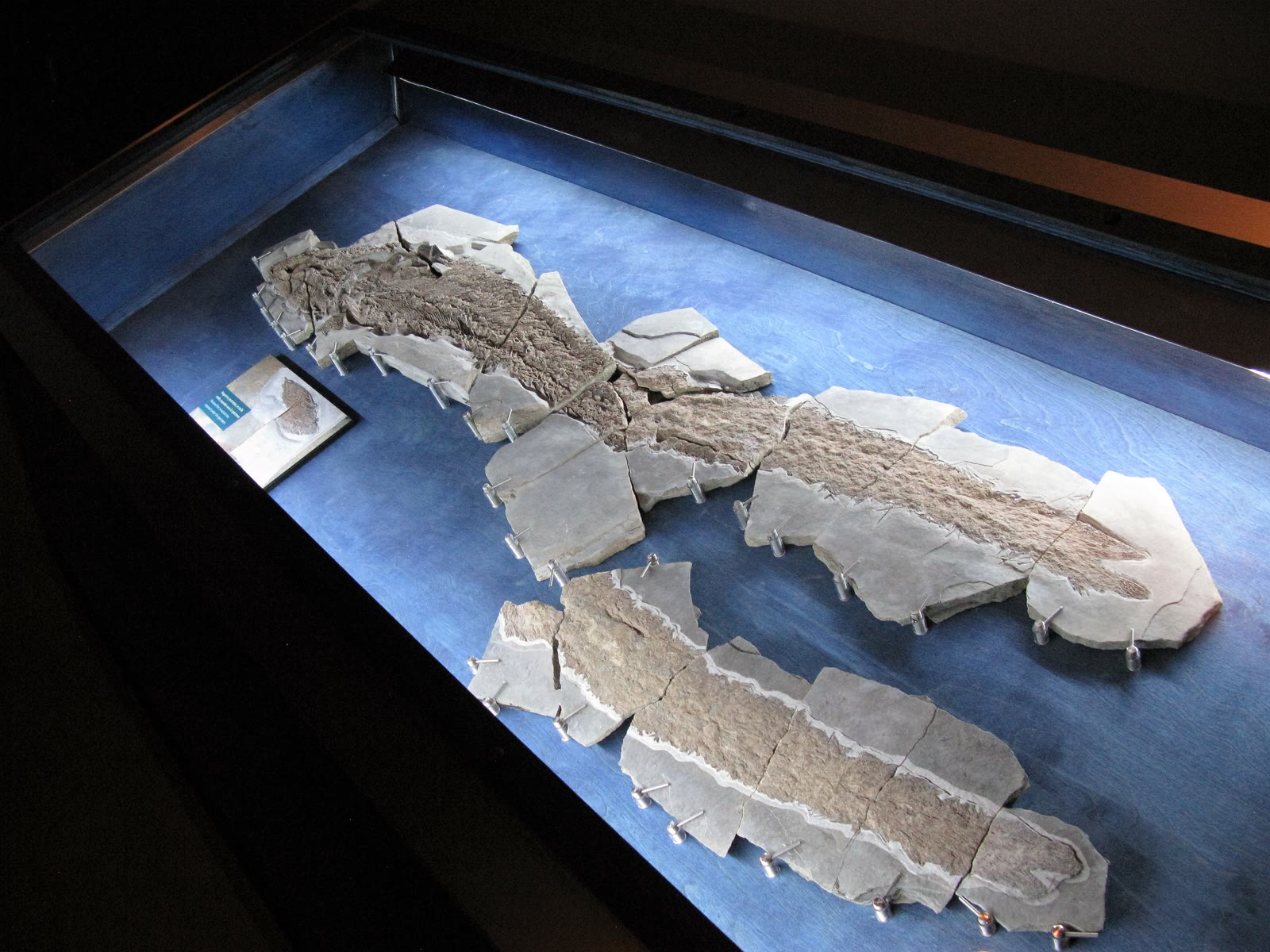
Elpistostege is easy to flatten into a headline about a fish with fingers. That summary catches attention and loses the strongest point. The 2020 Nature paper did not describe a finished hand hiding inside a land animal. It described a 1.57-metre articulated elpistostegalian fish from Upper Devonian Canada whose pectoral fin preserved the clearest late-Devonian version yet known of the inner pattern that tetrapod hands would later make explicit: humerus, radius, ulna, several rows of radials, two distal rows organized as digits and putative digits, and fin rays still extending beyond them.[1] The important sequence is not "fingers appeared." It is that the endoskeletal hand pattern appeared before the outer fin fringe disappeared.[1]
That is why Elpistostege deserves a fossil-find close reading rather than a slogan. The strongest claim in the evidence is not that this animal had already crossed onto land. The strongest claim is narrower and better: the bony architecture later associated with the vertebrate hand was assembled inside a still recognizably aquatic fin.[1][3]
The long history of the taxon matters here. In 1985, Schultze and Arsenault described Elpistostege as a panderichthyid fish from the Escuminac Formation of Quebec and already treated it as a close relative of tetrapods.[2] The later exhibition built around the articulated specimen at Quebec institutions shows why that older placement became newly important: the better fossil did not overturn the old intuition so much as harden it with more anatomy.[4] What had once been a strategically placed taxon became a specimen that could carry a much stricter argument.
The fossil matters because it keeps the outer fin and the inner hand together
The abstract of the 2020 paper is unusually clear about what changed. High-energy CT showed four proximodistal rows of radials, with branched carpals in two of those rows and two distal rows organized as digits and putative digits.[1] Then comes the decisive clause: despite that tetrapod-like skeletal pattern, the fin still retained lepidotrichia, the dermal fin rays that belong to a finned fish rather than a modern hand.[1]
That coexistence is the whole story. If the distal radials had looked digit-like only after fin rays vanished, the transition would read like a cleaner replacement. Elpistostege makes the sequence messier and more informative. The inner scaffold becomes hand-like while the outer margin is still visibly a fin.[1] Evolutionary novelty here does not arrive as a sudden erasure of the old structure. It arrives by building a new skeletal logic inside it.
This is also why the specimen is stronger than a general "missing link" label. The line between fish and tetrapod is being blurred at the level of anatomical layers, not merely at the level of category names.[1] A viewer looking only at the silhouette would still see a fish. A paleontologist looking into the fin sees the deeper issue: some of the bones that matter most for the later vertebrate hand are already being organized before the fin stops being a fin.
Panderichthys had reopened the digits question; Elpistostege makes the arrangement harder to ignore
The 2020 paper did not appear out of nowhere. In 2008, Boisvert, Mark-Kurik, and Ahlberg redescribed the pectoral fin of Panderichthys and argued that digits were not tetrapod novelties in the old absolute sense, but derived from pre-existing distal radials in sarcopterygian fish.[3] That was already a major shift, because it reopened the question of where the hand begins.
Elpistostege matters because it pushes that argument into a more explicit and more publicly legible fossil. The 2020 authors call its pectoral pattern the most tetrapod-like arrangement of bones yet found in a pectoral fin, while still insisting on the continued presence of fin rays beyond the radials.[1] That combination matters more than any one bone name. It tightens the evolutionary sequence: the inner architecture associated with digits can be present before the dermal fringe is shed.
This is exactly the kind of result paleontology is best at when the specimen quality cooperates. It does not produce the full finished answer in one move. It removes one cleaner but weaker answer and replaces it with a more constrained order of changes. In this case the order becomes harder to evade: distal endoskeletal complexity first, loss of the fin fringe later.[1][3]
The find does not give you a modern hand. It gives you a buried hand pattern.
That boundary matters. The Nature paper does not say that Elpistostege possessed a modern tetrapod hand, or that the fish had already solved terrestrial locomotion.[1] The animal remained aquatic, and the fin remained a fin in outward construction because fin rays were still present beyond the distal endoskeleton.[1] The real inference is subtler. What later vertebrates would externalize as a hand had an earlier phase as a skeletal pattern buried within an aquatic appendage.[1]
That distinction helps avoid two common mistakes. One is underclaiming, by treating the fossil as just another transitional mascot. The other is overclaiming, by turning it into a fish that had already become a land vertebrate in all but name. The specimen does something better than either. It lets us say that the vertebrate hand did not begin when a fin simply stopped being a fin. It began when the deeper bony order changed enough that the future hand could already be read inside a still-functional fish appendage.[1][3]
The locality context reinforces that interpretation rather than weakening it. The museum framing around the specimen points back to Miguasha and the cliffs of the Gaspé Peninsula, a Devonian setting already famous for preserving fish close to the tetrapod threshold.[4] Elpistostege does not sit alone at that threshold, but it occupies it with unusual clarity. It preserves the kind of anatomy that lets the argument move from poster language to structural sequence.
Why this fossil still holds the middle of the story
There are older fish, there are other near-tetrapods, and there are true early tetrapods with digits more plainly exposed. Elpistostege still matters because it keeps the middle visible. The specimen is not important because it erases uncertainty. It is important because it narrows the uncertainty to a stricter problem: how much of the hand evolved before the fin edge disappeared?[1][3]
The answer from this fossil is strong enough to change the way the transition is pictured. By 2020, the best-supported reading was no longer a simple march from paddle to hand. It was a layered transformation in which an aquatic appendage could retain fin rays while already carrying the most tetrapod-like pectoral endoskeleton yet seen in a fish.[1] That is a better result than a slogan. It gives deep time an actual order of assembly.
Sources
- Richard Cloutier, Alice M. Clement, Michael S. Y. Lee, et al., "Elpistostege and the origin of the vertebrate hand." Nature 579, 549-554 (2020).
- Hans-Peter Schultze and Miguel Arsenault, "The panderichthyid fish Elpistostege: a close relative of tetrapods?" Palaeontology 28, part 2, 293-309 (1985).
- Catherine A. Boisvert, Eva Mark-Kurik, and Per E. Ahlberg, "The pectoral fin of Panderichthys and the origin of digits." Nature 456, 636-638 (2008).
- Musee de la nature et des sciences de Sherbrooke, "Elpi: Our origins 375 million years ago" - exhibition page describing Elpistostege watsoni from the cliffs of Miguasha.
- Wikimedia Commons file page for the display photograph used as the article image, "File:Elpistostege watsoni.jpg".