When people say sauropod bones were "hollow," the phrase usually does two bad kinds of compression at once. It turns a complicated anatomical signal into a cartoon, and it makes the signal sound self-explanatory. Sauropod vertebrae were not empty tubes in the ordinary sense.[1][2] They were bones organized around laminae, fossae, foramina, and internal chambers that paleontologists interpret as traces of pneumatic diverticula linked to an air-sac system.[1][2][4] That distinction matters because the scientific value lies not in one catchy adjective but in the distribution of those structures through the skeleton and in what that distribution lets us infer about breathing, mass reduction, and neck design.
The strongest 2026 reading is therefore narrower and better. Sauropod pneumaticity is real, evolutionarily patterned, and mechanically important, but it is not a perfect stencil of the living soft tissues.[1][2][5] The vertebrae preserve a durable skeletal record of where diverticula invaded bone. They do not preserve the entire respiratory apparatus as a finished mold. Good paleontology keeps those two facts together.
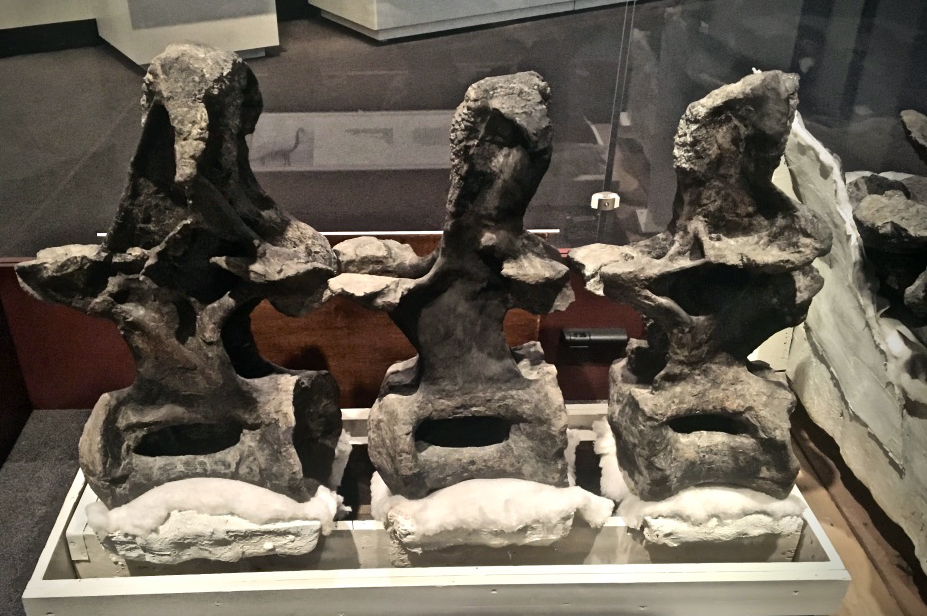
Image context: the cover uses a real Wikimedia Commons photograph of the Brachiosaurus holotype dorsal vertebrae in the Field Museum.[6] It belongs here because this article is about visible osteological evidence. The photograph keeps attention on the vertebrae themselves instead of on a full-body silhouette that can make the respiratory argument feel more certain than the bones allow.
1) Pneumaticity starts as a pattern of structures, not as a slogan about emptiness
The first step is to slow down and name the evidence correctly. In the classic 2003 papers, Mathew Wedel emphasized that sauropod vertebrae carry several different kinds of pneumatic features, not one uniform "hollow" condition.[1][2] External surfaces can show fossae, which are bowl-like depressions, or foramina, which open into deeper internal spaces. Inside the vertebrae, those spaces can organize as larger camerae or as smaller, more intricate camellae.[2] The point of that vocabulary is not pedantry. Different structures imply different patterns of invasion and different levels of architectural complexity.
That complexity is one reason sauropod vertebrae look so unlike the dense, conservative blocks people may expect from animals of extreme size. Laminae subdivide the outer surface into windows and supports, while internal chambers remove mass from the centrum and neural arch without turning the bone into a weak shell.[1][2] Pneumaticity therefore belongs to a design logic. Bone stays where stress paths matter, and air occupies volume that would otherwise add weight.
This is also why the evidence has to be read taxon by taxon and region by region. Wedel's evolutionary survey argued that basal sauropods mostly show pneumatic fossae, whereas more derived forms developed more elaborate internal chamber systems, including polycamerate and camellate conditions.[2] A vertebra with a simple deep fossa and a vertebra riddled internally with many small chambers are not doing the same anatomical job at the same level of refinement, even if both belong under the broad heading of pneumaticity.
2) The distribution through the spine is what makes the respiratory inference serious
One hole in one bone would not justify much. The larger inference comes from pattern. Wedel's Paleobiology paper argues that the evolutionary spread of pneumaticity through sauropod vertebral columns parallels the ontogenetic sequence seen in birds closely enough to support an air-sac interpretation.[1] In birds, cervical air-sac diverticula pneumatize the cervical and anterior thoracic vertebrae, while abdominal air sacs pneumatize more posterior vertebrae and the synsacrum.[1] Sauropods show a comparable logic at fossil scale: presacral pneumatization is widespread, sacral pneumatization becomes common in neosauropods, and proximal caudal pneumatization appears in some lineages such as diplodocids and titanosaurs.[1][2]
That is the point where the article stops being about decorative vertebral texture and becomes a respiratory argument. If the neck and front of the trunk alone were involved, cervical air sacs would be the conservative inference.[1][2] Once sacral and some caudal vertebrae enter the picture, a broader thoracoabdominal system becomes much more plausible.[1][5] Pneumaticity is still only an osteological correlate, but it is a correlate with distributional discipline.
The discipline has limits, and that is important too. Wedel and Taylor's 2013 PLOS ONE paper on Giraffatitan and Apatosaurus showed that caudal pneumaticity can be irregular, with apneumatic gaps separating pneumatic caudals from other pneumatic regions.[5] Those hiatuses matter because they complicate any simplistic map from one invaded bone to one single air-sac boundary. Their conclusion is the useful one: pneumatic diverticula were probably more broadly distributed in the living body than the bones alone reveal.[5] Absence of bony trace is therefore not a clean proof of absence in soft tissue.
3) The mechanical payoff was real, especially in the neck
Once the respiratory inference is on the table, the next question is why vertebral invasion mattered mechanically. The CT-based comparison by Daniela Schwarz and Guido Fritsch is especially useful here because it keeps the answer quantitative.[3] In the cervical vertebrae of Brachiosaurus brancai and Dicraeosaurus, the authors reconstructed internal pneumatic structures and estimated how much mass those diverticula removed from the neck. Their result was not symbolic. In Brachiosaurus, cervical pneumatization made the neck up to 25 percent lighter than it would have been without those pneumatic spaces; in Dicraeosaurus, the reduction was only about 6 percent.[3]
That contrast is one of the best reasons not to reduce sauropod pneumaticity to a yes-or-no trait. Different sauropods carried different internal architectures and therefore harvested different mechanical benefits from them.[2][3] Brachiosaurus had semicamellate cervical vertebrae with large camerae surrounded by smaller chambers, while Dicraeosaurus showed a more reduced pattern without the same internal elaboration.[3] The result is not just taxonomic difference. It is a different degree of mass-saving in animals solving different neck problems.
This is also where the famous size of sauropods becomes easier to think about. A giant neck is not only a reach advantage. It is a suspended load that has to be carried, balanced, and ventilated. Pneumatic vertebrae helped with the load side of that problem by taking mass out of the most distal and mechanically costly parts of the body without removing the bony struts that kept the system coherent.[1][3][4]
4) Long necks make the air-sac story biologically important, not just anatomically interesting
Taylor and Wedel's 2013 PeerJ synthesis on sauropod neck length is valuable because it places pneumaticity inside a broader engineering package.[4] They argue that the record-long sauropod necks depended on several linked conditions at once: a stable quadrupedal base, a relatively small and lightly built head, numerous and elongate cervical vertebrae, distinctive cervical architecture, and an efficient air-sac-based respiratory system.[4] Remove any one of those components and the neck becomes harder to evolve or harder to use.
Pneumaticity matters twice in that package. First, it reduces skeletal mass directly. Taylor and Wedel summarize that many neosauropod presacral vertebrae had air-space proportions in the range of roughly 0.50 to 0.70, putting them in the same general lightness regime as many pneumatic bird bones.[4] Second, the implied air-sac system helps with the dead-space problem created by extremely long tracheal pathways.[1][4] A fifteen-meter neck is not just a support challenge. It is a ventilation challenge. That is why Wedel's earlier physiology paper treated air sacs as useful not only for mass reduction but also for overcoming respiratory dead space and possibly for thermoregulatory advantages as well.[1]
The important thing is not to turn that into a lazy claim that sauropods were simply giant birds in reptile skin. The evidence does not justify that shortcut.[1][5] What it does justify is narrower: sauropod gigantism and neck elongation make more sense when the vertebrae are read as parts of an air-filled system rather than as ordinary solid blocks.
5) What pneumaticity can settle, and what it still cannot
The cleanest conclusion is that pneumaticity gives paleontology a strong but partial access route to soft tissue. It can show that diverticula invaded bone, that invasion became more elaborate in some lineages than in others, and the mechanical payoff could be substantial.[1][2][3] It can also support the inference that cervical air sacs were widespread in sauropods and that abdominal air sacs were probably present in at least some neosauropods.[1][2]
What it cannot do by itself is produce a full lung diagram for every taxon, settle every ventilatory detail, or guarantee that every uninvaded vertebra lay outside the diverticular system.[1][5] The hiatus paper is especially useful on that last point because it shows that living anatomy can outrun skeletal trace.[5] That is not a weakness in the evidence. It is a reminder that bones preserve only the durable edge of a larger biological system.
That is why sauropod pneumaticity still matters. It is one of the clearest places in paleontology where anatomy, method, and physiological inference lock together without collapsing into certainty theater. The vertebrae really were air-filled in a meaningful sense. They just were not simple. Once that complexity stays in view, the giant-neck problem stops looking like a miracle and starts looking like an engineered solution written into stone.[1][2][3][4][5]
Sources
- Mathew J. Wedel, "Vertebral pneumaticity, air sacs, and the physiology of sauropod dinosaurs," Paleobiology 29, no. 2 (2003).
- Mathew J. Wedel, "The evolution of vertebral pneumaticity in sauropod dinosaurs," Journal of Vertebrate Paleontology 23, no. 2 (2003) - author-hosted PDF of the original article.
- Daniela Schwarz and Guido Fritsch, "Pneumatic structures in the cervical vertebrae of the Late Jurassic Tendaguru sauropods Brachiosaurus brancai and Dicraeosaurus," Eclogae Geologicae Helvetiae 99 (2006).
- Michael P. Taylor and Mathew J. Wedel, "Why sauropods had long necks; and why giraffes have short necks," PeerJ 1:e36 (2013).
- Mathew J. Wedel and Michael P. Taylor, "Caudal Pneumaticity and Pneumatic Hiatuses in the Sauropod Dinosaurs Giraffatitan and Apatosaurus," PLOS ONE 8, no. 10 (2013).
- Wikimedia Commons, "File:Brachiosaurus holotype dorsal vertebrae.jpg" - source page for the vertebral photograph used as the article image.