Desmostylus is usually introduced as a prehistoric curiosity: a heavy-bodied North Pacific mammal with teeth that look like a bundle of stone columns.[1][3] That description is memorable and incomplete. The stronger species profile begins with the fact that the animal keeps resisting the familiar templates people want to force onto it. It is not best understood as a shaggy hippo that wandered into shallow water, and it is not best understood as a crude early dugong whose limbs had not yet become proper flippers.[3][4][5][6] The evidence points somewhere narrower and more interesting: an aquatic herbivore with a specialized tooth battery, a forceful skull, and forelimbs that still mattered enough to keep shoreline movement in the anatomical picture.[1][2][4][5][6]
That tension is exactly why Desmostylus still matters in 2026. The genus sits inside Desmostylidae, a clade now recovered as monophyletic even while desmostylian relationships to other mammals remain debated.[3] Its fossils ring the North Pacific, and the best-known specimens come from Japan and the Pacific coast of North America.[1][2][3][4] Yet the core scientific problem has not changed much since the animal was named. Every new source seems to sharpen one part of the picture while refusing to flatten the whole thing into a single sentence. The teeth look highly specialized. The limbs look neither fully terrestrial nor simply sirenian. The habitat signals point into water, but often toward estuarine and freshwater margins rather than a straightforward marine life.[1][4][5][6]
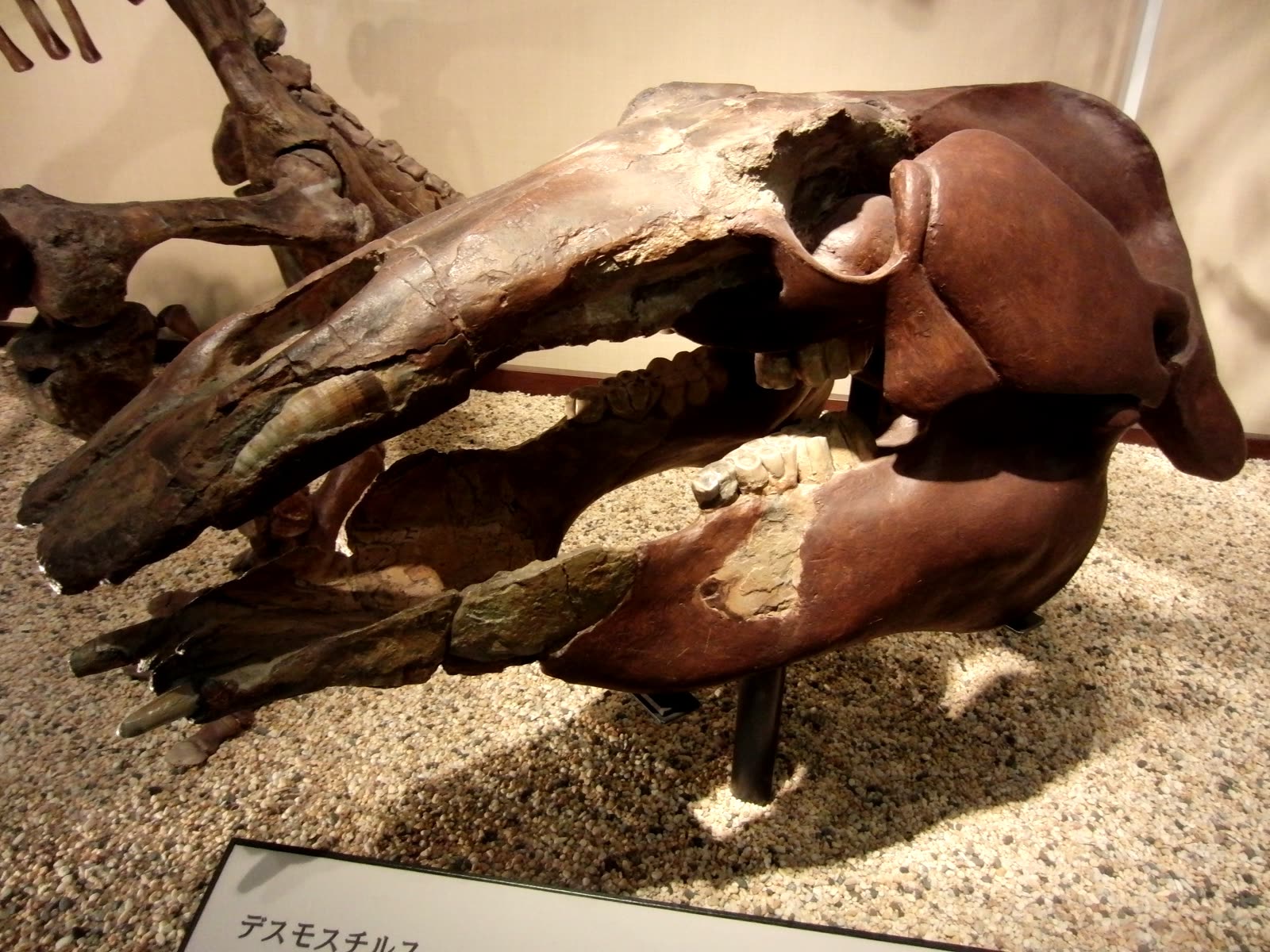
Image context: the cover uses a real Wikimedia Commons photograph of the holotype skull of Desmostylus japonicus on display at the National Museum of Nature and Science in Tokyo.[7] It belongs here because this profile is about design coherence. The skull shows, in one view, how much of the animal's identity is concentrated in its face and dentition rather than in any borrowed analogy to living mammals.
1) The teeth made Desmostylus durable before the rest of the body became clear
The easiest place to start is the tooth row, because the genus itself was named from it.[1][3] Desmostylids are characterized by high-crowned, bundled columnar teeth, and Desmostylus carries that architecture in its most famous form.[1][3] The teeth do not behave like ordinary browsing molars. They present the mouth as a set of tightly organized pillars, built to take pressure and abrasion in a way that immediately separates the animal from better-known marine herbivores.[1][5]
The 2023 Smithsonian-led study on an uncatalogued California tooth makes that point stronger by stretching the design backward in time.[1] Matsui and Pyenson described a Desmostylus molar from the earliest Miocene Skooner Gulch Formation of northern California and argued that the specimen is among the oldest described records of the genus.[1] More important than the age alone is what the tooth shows. It keeps primitive cuspules around the crown, yet it already carries unmistakable desmostylid thickness of enamel and the bundled columnar organization associated with Desmostylus.[1] In other words, the feeding hardware did not appear as a late flourish after the lineage was already ecologically settled. It was present early enough that the paper argues the specialized columnar form persisted for more than 15 million years.[1]
That matters because a species profile can go wrong by treating bizarre teeth as decorative weirdness. Here the teeth are structural evidence. They tell us that Desmostylus was not simply a generalized shoreline mammal dabbling in aquatic plants when conditions allowed.[1][5] It had a long-lived, highly specific dental solution, one that likely handled abrasive aquatic vegetation and repeated heavy contact better than the chewing system of a generic browser would have.[1][5]
2) The skull reads as a powerful cropping head, not as a museum oddity
The 2004 Hokkaido skull paper by Uno and Kimura is useful because it keeps the head anatomical rather than folkloric.[2] Their specimen of Desmostylus hesperus, GSJ-F7745, came from the late Middle Miocene Tachikaraushinai Formation and preserved a nearly complete skull and mandible of a juvenile individual.[2] The paper describes a high, narrow rostrum, vertically swollen nasals, no upper incisors or canines, a very deep zygomatic process of the squamosal, and a jaw built around a long diastema and powerful cheek-tooth area.[2]
That is a lot of structure to compress into one skull, and it points to a head designed for forceful food handling. A narrow rostrum and big cheek region together do not prove one exact feeding motion. Paleontology does not get to watch the animal chew.[2][5] What they do give us is a stable architectural message: front-end selectivity feeding into strong posterior processing. The skull of Desmostylus does not look improvised. It looks committed.
This is why the holotype skull of D. japonicus remains so valuable as an image anchor.[2][7] The profile's real center is not "look how strange this extinct mammal was." The center is that skull shape, jaw depth, and tooth geometry were working together. The animal had already solved the problem of being Desmostylus in the head before we settle every detail of its locomotion.
3) The forelimb kept the shoreline in the story
If the teeth and skull make Desmostylus easy to recognize, the humerus explains why it keeps resisting easy ecological comparison. Matsui's 2017 comparative study of desmostylian humeri argues that the humerus of Desmostylus differs markedly from those of other desmostylians, especially in the intertubercular groove, tubercle configuration, and the development of the humeral crest.[4] In Desmostylus, the intertubercular groove sits behind the humeral head, it is wider and shallower than in other desmostylians, the lesser tubercle is not strongly knobby, and the humeral crest extends distally beyond the proximal half of the shaft.[4]
Those details matter because they block two lazy reconstructions at once. One is the picture of Desmostylus as a land mammal that merely happened to forage in wetlands. The other is the picture of Desmostylus as a nearly finished flippered marine mammal whose limbs had stopped carrying serious mechanical information.[4][6] The humerus belongs to neither extreme. It keeps muscle leverage, shoulder architecture, and forelimb power in view.
That does not mean the animal was mostly walking on land. Bone inner-structure evidence pushes against that simplification. Hayashi and colleagues' 2013 PLOS ONE study found that desmostylians as a whole had achieved an essentially aquatic way of life, and that Desmostylus in particular differed from other members of the clade by showing a more spongy inner organization associated with hydrodynamic buoyancy control in more active swimmers.[6] The paper interprets Desmostylus as a more active swimmer with a peculiar habitat and feeding strategy inside Desmostylia, while relatives such as Paleoparadoxia and Behemotops better fit slower shallow-water habits.[6]
Put together, limb shape and bone microanatomy produce a useful compromise. Desmostylus was strongly aquatic, but its forelimb never became uninteresting. The shoreline remained mechanically present in the body.
4) The habitat signal points toward water, but not toward one simple marine script
The ecological turning point comes from stable isotopes. Clementz, Hoppe, and Koch compared enamel chemistry of Desmostylus with co-occurring terrestrial and marine mammals from middle Miocene California and recovered a striking mix of signals.[5] Carbon isotopes suggested a diet dominated by aquatic vegetation. Low oxygen-isotope variability suggested that the animal spent a large amount of time in water. But strontium isotopes looked more like terrestrial mammals than marine ones, which led the authors to argue that Desmostylus spent considerable time foraging in estuarine or freshwater settings.[5]
This is where the species profile becomes much sharper than the old "marine mammal" label. The isotopes do not give us live footage, and they do not erase geographic or species-level variation across the genus.[5] What they do is make a straightforward open-coast analogue feel inadequate. Desmostylus appears strongest as an aquatic herbivore of edges: river mouths, estuaries, sheltered coastal systems, and freshwater-influenced habitats where plant resources and water time could stay high without requiring the animal to behave like a full marine grazer of the sirenian kind.[5][6]
That reading also explains why the animal keeps feeling anatomically awkward in productive ways. The teeth are too specialized for a casual generalist. The humerus is too informative to dismiss as a leftover terrestrial relic. The isotopes pull away from simple seawater residence. The result is not confusion. The result is a better bounded ecological picture.
5) Desmostylus matters because it preserves a real mammalian experiment, not a failed approximation of another one
The 2019 desmostylian phylogeny by Matsui and Tsuihiji is helpful here because it narrows internal relationships without pretending the bigger mammal tree is solved.[3] Their larger character matrix supported the monophyly of Desmostylidae and the paraphyly of traditional Paleoparadoxiidae, while also noting that Desmostylia itself still sits in a contested position among major mammalian groups.[3] That uncertainty can look frustrating from a distance. In practice it makes the genus more interesting. Desmostylus was not merely converging poorly on a sea cow, a hippo, or a seal. It belonged to a lineage with its own coherent body plan and its own North Pacific history.[3][4][6]
That is the right place to end the species profile. Desmostylus matters because its oddness is organized. Columnar teeth, a forceful skull, a distinctive humerus, an aquatic body, and edge-water isotope signals all point in the same general direction without collapsing into a familiar living analogue.[1][2][4][5][6] The animal lived in water, fed as a specialist, and kept the shoreline in its bones. That combination is exactly what makes it one of paleontology's best reminders that mammalian aquatic life did not evolve only once in one approved shape.
Sources
- Kumiko Matsui and Nicholas D. Pyenson, "New evidence for the antiquity of Desmostylus (Desmostylia) from the Skooner Gulch Formation of California." Royal Society Open Science 10 (2023).
- Hikaru Uno and Masaichi Kimura, "Reinterpretation of some cranial structures of Desmostylus hesperus (Mammalia: Desmostylia): a new specimen from the Middle Miocene Tachikaraushinai Formation, Hokkaido, Japan." Paleontological Research 8, no. 1 (2004).
- Kumiko Matsui and Takanobu Tsuihiji, "The phylogeny of desmostylians revisited: proposal of new clades based on robust phylogenetic hypotheses." PeerJ 7 (2019).
- Kumiko Matsui, "How can we reliably identify a taxon based on humeral morphology? Comparative morphology of desmostylian humeri." PeerJ 5 (2017).
- Mark T. Clementz, Kathryn A. Hoppe, and Paul L. Koch, "A paleoecological paradox: the habitat and dietary preferences of the extinct tethythere Desmostylus, inferred from stable isotope analysis." Paleobiology 29, no. 4 (2003).
- Shoji Hayashi and colleagues, "Bone Inner Structure Suggests Increasing Aquatic Adaptations in Desmostylia (Mammalia, Afrotheria)." PLOS ONE 8, no. 4 (2013).
- Wikimedia Commons, "File:Desmostylus Skull.jpg" - source page for the holotype skull photograph used as the article image.