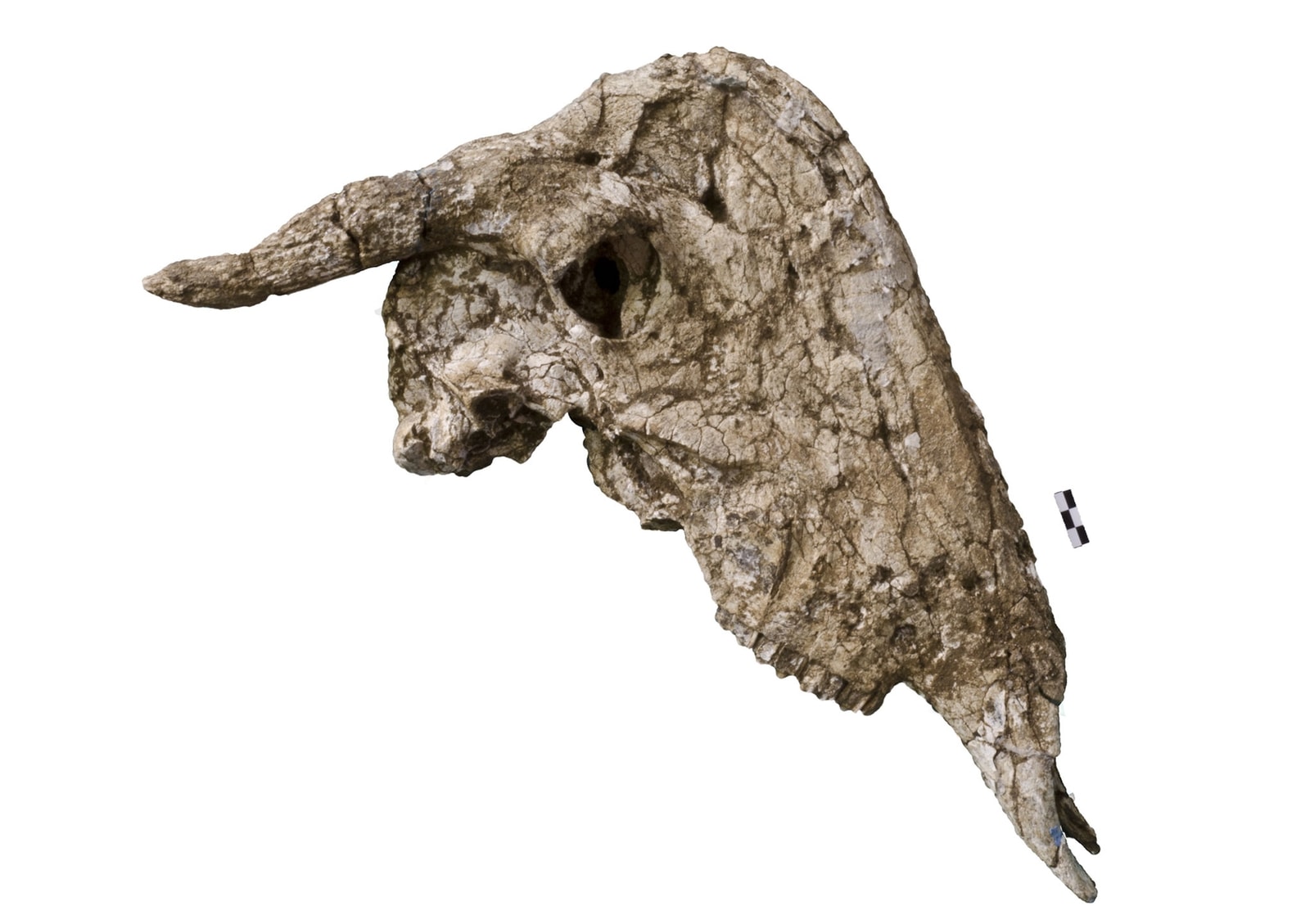
The most revealing part of a Rusingoryx skull is a space. Above the muzzle, bone rises into a conspicuous dome. Inside it, the nasal airway follows an enlarged, winding route. The structure invites an acoustic question: could an animal's nose help shape the sound of a herd?[3]
These remains come from Bovid Hill on Rusinga Island, in Kenya's Lake Victoria. The bonebed belongs to the late Pleistocene, with a published age of 68,000 ± 5,000 years. Its occupants lived vastly closer to our own time than the crested dinosaurs their skulls would eventually bring to mind.[2][3] Yet recovering their voices requires a longer chain of reasoning than recovering their outlines.
A face restored to its skull
Rusingoryx atopocranion entered the scientific literature in 1984 through a partial cranium missing much of its face. That absence caused a basic mistake: the specimen was oriented incorrectly. Researchers inferred a shortened face and a proboscis, a trunk-like structure. The name atopocranion, meaning strange skull, survived the interpretation.[1]
Its identity also shifted. For a time, researchers placed it within the extinct bovid genus Megalotragus. New material supported recognizing Rusingoryx separately, an assessment reinforced by the more complete Bovid Hill skulls.[1]
The episode explains why an intact face can change more than an illustration. A fragment offers several possible ways to assemble an animal. Better specimens constrain those possibilities by preserving the connections between parts. Here, the missing connections had concealed an anatomy more unusual than the proposed reconstruction.
The wider excavation gave the skulls company. Researchers could associate cranial and limb material in a deposit within the Wasiriya Beds, giving this animal a more substantial skeletal record than isolated teeth and horn cores alone could provide.[1]
Following the air
Haley O'Brien and colleagues investigated the new skull material in a 2016 Current Biology study. Their sample included juveniles and adults; CT imaging exposed the internal architecture without cutting through the fossils. The comparison that emerged was with lambeosaurine hadrosaurs, dinosaurs whose hollow head crests also housed nasal passages.[3]
This is convergence: distantly related mammals and dinosaurs independently evolved similar structures around their nasal airways.[3]
Function required another step. In an interview accompanying the research, O'Brien explained that the skull bones were too thin to make the dome a convincing head-butting weapon. Its internal arrangement also weakened the idea that the enlargement mainly improved the conditioning of inhaled air.[6]
The acoustic interpretation combined the scanned anatomy with models of resonance. As coauthor Christian Tryon described the work, the reconstructed passages suggested low-frequency resonance, potentially useful to animals communicating across open country.[4] A cavity can influence which frequencies a call emphasizes; its outline alone cannot tell us when an animal called, what the call meant, or who answered.
Reports of the research raised the possibility of sounds approaching infrasound. That remains a hypothesis built from anatomy and modeling.[4] Soft tissues of the vocal apparatus are missing, so the fossil cannot supply the exact voice.[6] The defensible result is narrower and still arresting: an extinct mammal possessed an unusual structure consistent with modifying its calls.
Reading the ground around the head
Bovid Hill also preserves evidence of human attention. Kirsten Jenkins and colleagues' 2017 analysis described stone artifacts, cut-marked bones and an assemblage dominated by animals in their prime years. They interpreted the deposit as evidence of mass exploitation, probably involving initial carcass processing beside a channel.[2]
Cut marks record carcass processing. The age profile, species concentration and channel setting together support the authors' proposal that hunters exploited a herd's vulnerability around water.[2]
Flowing water later altered the deposit.[2] The excavated arrangement combines ancient activity with subsequent movement of remains. Reconstructing the hunt requires accounting for that disturbance; reconstructing the herd's calls demands a different kind of evidence altogether.
A moving herd, an unfinished sound
Evidence outside the skull gives the proposed voice an ecological setting. Kris Kovarovic and colleagues' 2021 study found limb anatomy strongly associated with open habitats, including exceptionally short toe bones compared with living African bovids.[1]
In 2023, Kaedan O'Brien and colleagues examined successive samples of tooth enamel from four Rusingoryx individuals. Strontium isotope values differed from those expected at the places where the fossils were found; three teeth also recorded marked fluctuations along their growth sequences. The authors interpreted the patterns as evidence of movement between geologically different areas.[5]
That supports migration, but it does not draw a unique route. Several landscapes can share similar isotope values, and the study involved only four animals. Carbon isotope measurements added another complication: these predominantly grazing animals also consumed browse, with diets varying over the period recorded by their teeth.[5]
A skull, then, sits within a life reconstructed at several scales. Its internal passages suggest an acoustic capacity. Limbs indicate the kinds of ground the animal was adapted to cross. Enamel carries evidence of movement during an individual's lifetime. The ecological findings make long-distance communication a plausible use for the dome, without independently proving its sound.[4][5]
Look again at the raised bone above the muzzle. The hollow beneath it survives. The herd's voice does not. The interest lies in how far that surviving space lets us listen—and exactly where the evidence falls silent.
Sources
- Kovarovic, Faith, Jenkins, Tryon and Peppe, “Ecomorphology and ecology of the grassland specialist, Rusingoryx atopocranion…” Quaternary Research (2021)—naming history, geological context and limb anatomy.
- Jenkins and colleagues, “Evaluating the potential for tactical hunting in the Middle Stone Age…” Journal of Human Evolution (2017)—dating and site formation; institutional abstract.
- The Leakey Foundation, research report on Rusingoryx nasal anatomy (February 17, 2016)—researcher statements and link to the original Current Biology paper.
- Peter Reuell, “Similar designs, 100 million years apart,” Harvard Gazette (July 20, 2016)—interview with study coauthor Christian Tryon about CT imaging and acoustic modeling.
- O'Brien, Podkovyroff, Fernandez, Tryon, Ashioya and Faith, “Migratory behavior in the enigmatic Late Pleistocene bovid Rusingoryx atopocranion,” Frontiers in Environmental Archaeology (2023)—serial enamel isotope evidence and its geographic limits.
- Riley Black, “Ice Age Beast Honked Like a Dinosaur,” National Geographic (February 4, 2016)—Haley O'Brien's fossil photograph and interview explaining functional alternatives and missing soft tissues.