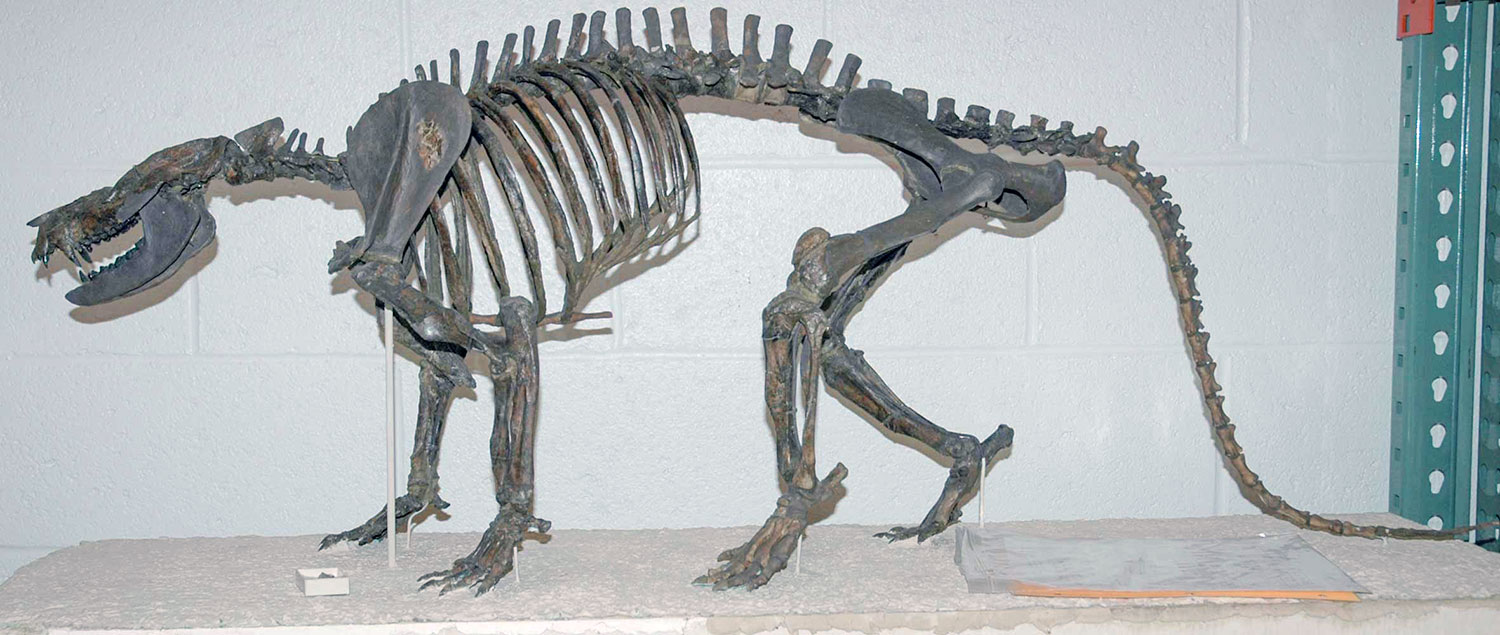
Start at the feet. Beneath the rib cage of the mounted Ectoconus, the toes spread across the museum platform. There are five on each foot, ending in small hoof-like tips. Above them sits a substantial skeleton; behind it, a long tail extends the animal's silhouette. Paleontologist Thomas Williamson's photographs make those proportions unusually easy to see.[2]
The temptation is to search that silhouette for a familiar animal. Yet Ectoconus becomes more interesting when the comparison slows down. Its feet, teeth and limbs belong to an early Paleocene herbivore with its own combination of features. Reading them together gives the animal a life beyond its usual supporting role in the story of mammals taking over after the dinosaurs.
A name attached to many teeth
Ectoconus ditrigonus belongs to the extinct family Periptychidae. Its remains are common in the early Paleocene deposits of New Mexico's San Juan Basin, including the Nacimiento Formation. The genus also occurs in Utah, Wyoming and Colorado. These are mammals of the Puercan, an interval near the beginning of the Paleocene.[1]
Older museum literature can make the animal seem more diverse than it was. In 2004, Spencer Lucas and Peter Kondrashov reviewed its teeth and reduced four named species to two. The supposedly larger, more robust E. majusculus fell within the variation of E. ditrigonus. They retained the smaller E. symbolus, folding another name into that species.[1]
The teeth also supply a useful physical introduction. Ectoconus had rounded molar cusps, more pronounced in this respect than those of its relative Periptychus. Such surfaces offer contact areas for crushing food. They help establish what the mouth could do, without supplying a list of the plants the animal actually ate.[1][2]
Weight carried close to the ground
A nearly complete skeleton, AMNH 16500, allows comparisons that isolated teeth cannot. In a 2018 anatomical study, Sarah Shelley and colleagues estimated its body mass at about 100 kilograms from the circumferences of the upper arm and thigh bones. That is an estimate for a particular specimen using a scaling relationship, rather than a measured weight or a species-wide average.[3]
The same study documented short, stout proportions farther down the forelimb. Compared with Periptychus, Ectoconus had a shorter forearm relative to its upper arm and shorter, broader palm bones. Its hand was compact relative to the limb above it.[3]
These proportions make the museum mount's broad stance worth lingering over. A body needs support at every step, and the anatomy directs attention toward how weight passed through the limbs. Still, the mounted pose is an interpretation assembled from bones. It cannot preserve a walking speed, a turning radius or the moment when an animal shifted its weight to reach food.
What an ankle can tell us
Living mammals provide one way to investigate those missing movements. In 2021, Shelley, Stephen Brusatte and Thomas Williamson compared ankle-bone measurements across living and extinct mammals, including Ectoconus. The study asked whether shapes associated with different ways of moving today could help interpret Paleocene species.[4]
The ancient animals proved awkward fits. Many had unusually robust ankles, and their combinations of features extended beyond those of the living comparison animals. The researchers considered whether similarities to modern ground dwellers and occasional diggers reflected comparable behavior, or whether heavy construction produced anatomical resemblance without the same habits.[4]
That distinction limits how confidently we can animate Ectoconus. A statistical resemblance is useful evidence, but it does not turn a skeleton into a record of digging. The authors explicitly recommended reading their classifications alongside anatomical comparisons and previous research. Their stronger general result was that Paleocene mammals already possessed considerable variety in the structures involved in locomotion.[4]
The world that could feed it
The early Paleocene began after the mass extinction roughly 66 million years ago. A large herbivore entering that world needed vegetation as well as space. Research at Corral Bluffs in Colorado has recovered mammal fossils alongside plant evidence, giving the surrounding ecological recovery a chronology.[5]
The Denver Museum of Nature & Science describes a succession from fern-dominated recovery vegetation to forests dominated by palms, followed by increasing forest diversity. By about 300,000 years after the extinction, a wider variety of trees accompanied larger herbivorous mammals. Legumes appear in the local record around 700,000 years after the event.[5]
This is environmental context, not an Ectoconus menu. Finding an edible plant in an ancient ecosystem does not prove that a particular mammal consumed it. The more useful connection is that the opportunities available to plant eaters changed as vegetation recovered. A heavy animal's prospects depended on what grew around it, as well as on the mechanics of its feet and mouth.[5]
The familiar label “condylarth,” often applied to Ectoconus and similar mammals, can obscure that individuality. It gathers together early mammals with ungulate-like features, but does not describe a single natural evolutionary group. It cannot by itself establish Ectoconus as an ancestor of a familiar hoofed animal.[3]
Return to the mount and the broad toes have become more informative. They belong to an animal whose construction is recoverable in detail, even where its daily routine remains uncertain. That is enough to give it a distinct presence in the Paleocene: a substantial plant eater putting weight through a compact set of bones, in a world whose forests were still changing.
Sources
- Lucas and Kondrashov, taxonomic revision of Ectoconus. New Mexico Museum of Natural History and Science Bulletin 26 (2004), pp. 33–43 — species, teeth and distribution.
- Thomas Williamson, “Early Paleocene Mammals of the San Juan Basin” — a researcher's illustrated account, including photographs of the Ectoconus mount, skull and feet.
- Shelley, Williamson and Brusatte, comparative osteology of Periptychus carinidens. PLOS ONE (2018) — Ectoconus measurements, mass estimate and the limits of “Condylarthra.”
- Shelley, Brusatte and Williamson, quantitative assessment of Paleocene mammal ankle morphology and locomotion. Proceedings of the Royal Society B (2021) — anatomical comparisons and limits of behavioral inference.
- Denver Museum of Nature & Science, “Rise of the Mammals” — the Corral Bluffs research team's account of plant and mammal recovery during the first million years after the extinction.