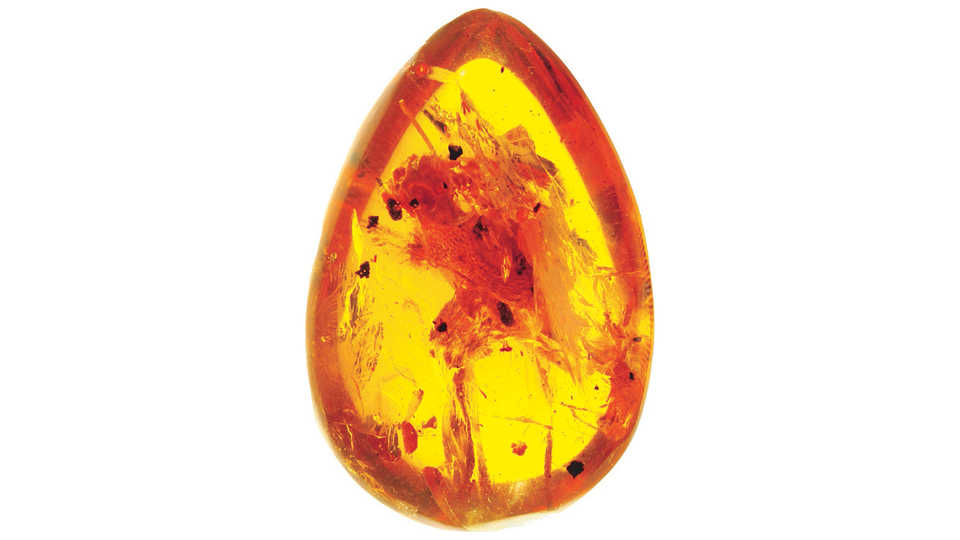
A tiny animal sealed in Myanmar amber entered the scientific literature in 2016 as a possible early relative of chameleons. Its large eye sockets and elongated tongue-supporting bone made the comparison persuasive. The researchers were studying a remarkable assemblage from around 99 million years ago, when tropical forests were leaving few other traces of their small vertebrates.[4]
Four years later, the juvenile appeared in a different family portrait. A study of better-preserved material assigned it to Yaksha perettii, an albanerpetontid amphibian. The tongue remained extraordinary; the ancestry changed.[1] That correction opens a much longer story about an amphibian branch with no living members, whose history cannot be reconstructed simply by choosing the closest-looking animal alive today.
A family assembled from small bones
Albanerpetontids had a broadly salamander-like body, but their skeletons carried a distinctive combination of features. The two halves of the lower jaw met through an interlocking joint. Their teeth could have three small points, and the front of the backbone formed an unusually elaborate connection to the skull. These details helped distinguish the group even when a fossil consisted of little more than a jaw or part of the skull roof.[2]
That fragmentary record extends well before the amber forest. In 2003, James Gardner, Susan Evans and Denise Sigogneau-Russell described Anoualerpeton, including a species from Middle Jurassic England and another from Early Cretaceous Morocco. Differences in jaws and skull-roof bones supplied evidence for both membership in the family and separation within it.[3]
The Moroccan material also carried a geographical consequence: it documented the family on the African side of the ancient continental arrangement. The authors treated it as a minimum age for the group's presence there. A first known occurrence establishes that animals had arrived by a particular time; it does not necessarily identify their arrival.[3]
Read this way, the scattered bones preserve a branching history across places and ages. They are less spectacular than an intact animal in amber, but they prevent that animal from becoming an isolated curiosity.
The resemblance that crossed a family boundary
The 2016 interpretation of the amber juvenile shows how compelling a functional resemblance can become. The study placed it near chameleons using a combination of characters, with its tongue apparatus especially striking. Such a placement also made the specimen potentially useful for estimating the antiquity of a living reptile lineage.[4]
The 2020 Yaksha study supplied a more complete comparison. Its material included an articulated adult skull preserved in three dimensions, the juvenile and a separate partial skeleton. Crucially, an elongated hyoid element—a bone associated with the throat and tongue—remained embedded at its tip in a preserved tongue pad. The authors interpreted the arrangement as evidence for rapid tongue projection and ambush feeding on small invertebrates.[1]
Bone and soft tissue are the preserved observations. The launch mechanism and hunting behavior are reconstructions from them. No fossil measures the tongue's speed. The strong resemblance to a chameleon's feeding apparatus now supports a comparison of function across separate branches of vertebrate evolution.[1]
This changes the question a reader should ask of the fossil. Instead of treating every familiar feature as an address on a family tree, we can ask which features establish relationships and which reveal similar solutions to feeding. A persuasive ecological analogy can survive the rejection of an ancestral connection.
More anatomy, less certainty about neat names
The wider relationships remain difficult. In their 2018 study of Japanese material, Ryoko Matsumoto and Susan Evans reviewed placements near salamanders, near the frog–salamander branch, and outside the group containing living amphibians. Incomplete specimens and disagreement about amphibian origins both contributed to the uncertainty. Recognizing albanerpetontids as a distinctive group is easier than locating their exact attachment to the rest of the tree.[2]
Even names inside the family continue to change. A 2026 study by Alexandre Guillaume and colleagues described Nabia civiscientrix from Late Jurassic Portugal. The analysis combined 468 bones from the Lourinhã Formation with thousands of remains from the Guimarota beds. Material previously associated with Celtedens required another look, partly because skull-roof shapes used in identification could vary within a species.[5]
The new diagnosis drew on a combination of skull, neck and pelvic features. The authors urged researchers to revisit unsorted collections for bones beyond the skull. That recommendation has a practical consequence for evolutionary history: a family tree built mostly from the easiest fragments to recognize may change when other parts of the animal become identifiable.[5]
A disappearance surprisingly close to us
The lineage survived far beyond the Cretaceous. Early Pleistocene deposits at Rivoli Veronese in northern Italy yielded Albanerpeton pannonicum alongside frogs, salamanders, lizards and snakes. Andrea Villa, Hugues-Alexandre Blain and Massimo Delfino's 2018 analysis treated these as the youngest known remains of the group.[6]
The associated animals helped reconstruct a humid, forested landscape with water bodies. That environmental interpretation supported a preference for moist conditions in Albanerpeton. It describes a setting occupied near the end of the known record; it cannot, by itself, explain the lineage's eventual extinction or establish the habitat of every Jurassic relative.[6]
The Italian remains give the amber skull a different perspective. This was a member of a durable and varied amphibian family, preserved midway through a history reaching from the Jurassic into the early Pleistocene. Its projectile tongue reveals one remarkable specialization. Its relatives reveal how much of amphibian evolution disappeared before anyone could study the living animals.
Sources
- Juan D. Daza et al., “Enigmatic amphibians in mid-Cretaceous amber were chameleon-like ballistic feeders,” Science 370 (2020)—Yaksha anatomy, juvenile reassignment and feeding interpretation; accepted manuscript.
- Ryoko Matsumoto and Susan E. Evans, “The first record of albanerpetontid amphibians (Amphibia: Albanerpetontidae) from East Asia,” PLOS ONE 13 (2018)—diagnostic anatomy and competing relationship hypotheses.
- James D. Gardner, Susan E. Evans and Denise Sigogneau-Russell, “New albanerpetontid amphibians from the Early Cretaceous of Morocco and Middle Jurassic of England,” Acta Palaeontologica Polonica 48 (2003)—Anoualerpeton and its geographical implications.
- Juan D. Daza et al., “Mid-Cretaceous amber fossils illuminate the past diversity of tropical lizards,” Science Advances 2 (2016)—the original chameleon interpretation, subsequently revised.
- Alexandre R. D. Guillaume et al., “New albanerpetontid species (Lissamphibia) from the Late Jurassic of Portugal,” Journal of Systematic Palaeontology 24 (2026)—Nabia, anatomical variation and collection sampling; accepted manuscript.
- Andrea Villa, Hugues-Alexandre Blain and Massimo Delfino, “The Early Pleistocene herpetofauna of Rivoli Veronese (Northern Italy) as evidence for humid and forested glacial phases in the Gelasian of Southern Alps,” Palaeogeography, Palaeoclimatology, Palaeoecology 490 (2018)—late survival and environmental reconstruction.
- California Academy of Sciences, “4 Standout Species Described in 2020,” section “Stuck in time”—photograph of Yaksha in amber, credited to Adolf Peretti and the Peretti Museum Foundation.