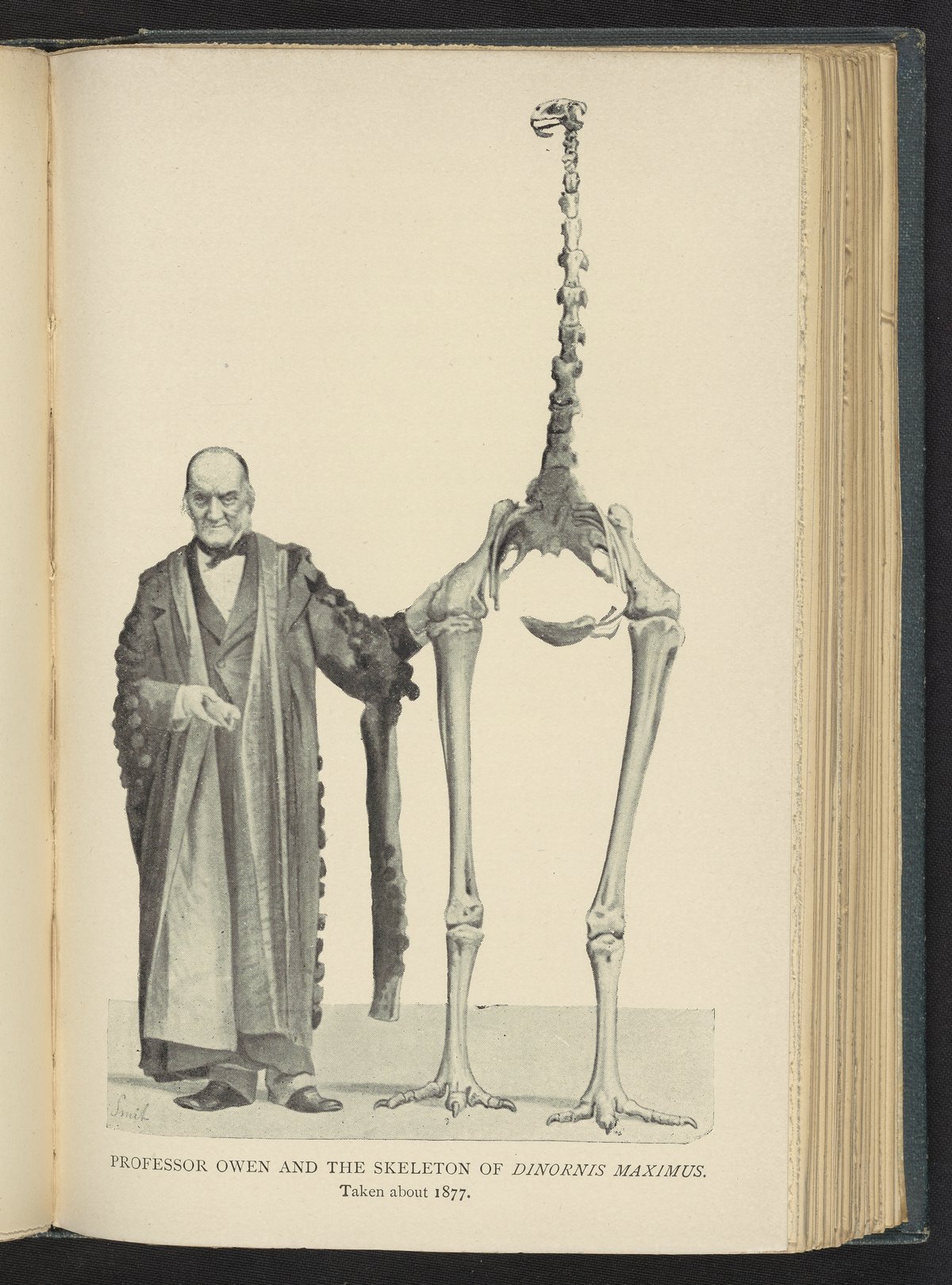
In an 1877 photograph, Richard Owen stands beside a mounted giant moa as if posing with an argument made of bone. The bird towers over him. Its long legs carry a deep body; the neck rises to a small skull; no useful wing interrupts the silhouette. The photograph predates continental-drift theory, but the anatomy would later seem to fit one of evolution's neatest geographic stories. Ostriches in Africa, rheas in South America, emus and cassowaries in Australasia, kiwi and moa in New Zealand, and elephant birds in Madagascar looked like stranded heirs of one flightless ancestor, divided when Gondwana broke apart.[1][3][8]
The skeleton is still a moa. The family story around it has changed.
Those birds belong to the broader palaeognath branch, one of the two great living divisions of birds. The traditional “ratites” shared a raft-like breastbone without the large keel that anchors the main flight muscles, reduced wings and pectoral apparatus, and legs built for life on the ground. Yet genetic trees repeatedly place the flying tinamous of Central and South America inside the assemblage of flightless forms. Moa are closer to tinamous than to kiwi; kiwi, in turn, are close to Madagascar's elephant birds.[2][3][4] Ratites did not simply inherit one finished flightless body. Several lineages arrived at versions of it separately.
This revision is larger than rearranging names. It changes how those birds reached southern continents and islands, why their skeletons resemble one another, and what fossils should be asked to test. Ancient DNA supplies the branches, embryology exposes different construction sequences, comparative genomics finds convergence in the switches around developmental genes, and a late Paleocene–earliest Eocene breastbone adds fossil evidence for aerobic flight near the beginning of the story.[2][5][6][7]
When anatomy looked like ancestry
“Ratite” began as a useful anatomical category. A flying bird's sternum usually carries a pronounced keel for the pectoral muscles. In an ostrich, rhea, emu, cassowary, kiwi, or moa, the breastbone is flatter, while the shoulder and forelimb are reduced to different degrees. Large bodies and powerful hind limbs complete an instantly recognizable ground-bird plan.[1][2]
Shared structure often does record shared inheritance. Here, however, the most conspicuous similarities are also consequences of abandoning the same demanding activity. Once a lineage no longer has to launch and remain airborne, selection and development can reduce expensive flight musculature, reshape the sternum and shoulder, and redirect growth toward a terrestrial body. If those changes happen repeatedly, separately flightless palaeognath branches can become more alike precisely in the features that early classifiers trusted most.[2][5]
Geography made the anatomical grouping even more persuasive. Put the large flightless birds on a map and they appear to trace the southern fragments of Gondwana. A single flightless ancestor carried apart by continental breakup offered an elegant mechanism: no ocean crossing was required of birds that could not fly. But molecular divergence estimates place much of crown-palaeognath diversification too late for that simple vicariance model, and the branching order joins birds across oceans in combinations the map alone would not predict.[3][7]
The old account therefore had the direction reversed. Present-day flightlessness cannot explain how the ancestors arrived. For at least several lineages, the evidence instead favors arrival by volant ancestors before flight was lost.
A flying tinamou breaks the old ratite grouping
The decisive disruption came from characters that a running lifestyle does not readily remodel: DNA sequences and rare genomic insertions. A 2008 analysis of 20 unlinked nuclear loci placed flying tinamous among the flightless palaeognaths rather than just outside a single ratite branch. On that topology, the authors inferred at least three independent losses of flight; asking tinamous to lose and then re-evolve the entire flight apparatus was the less plausible alternative.[1]
Moa ancient DNA made the result harder to dismiss. In 2014, researchers assembled 1,448 nuclear loci—nearly one million base pairs—from little bush moa, tinamous, emu, ostrich, and outgroups. The little bush moa consistently grouped with tinamous. Eight independent CR1 retroposon insertions supported the same relationship: molecular events rare enough to act like shared archival stamps. When the researchers mapped skeletal characters onto that tree, many supposed ratite hallmarks became convergences associated with running and flight loss rather than proof of one exclusively flightless clan.[2]
Later work added nuclear fragments from extinct elephant birds and combined genomic and morphological evidence with fossil palaeognaths. It recovered an ancestral palaeognath that was probably small—roughly 3.5 to 5 kilograms—and capable of flight, not an ostrich-sized pedestrian already marooned on Gondwana.[3] The exact ancestral animal is not preserved for inspection, and an inferred ancestor is not a named fossil species. The reconstruction matters because it sets a testable starting state: dispersive bird first, repeated terrestrial giants later.
Not every internal branch is equally simple. A 2019 whole-genome study analyzed 20,850 noncoding loci, more than 41 million aligned base pairs, plus thousands of CR1 insertions. It strongly upheld tinamous within the traditional ratite assemblage, but it also found that rapid early splits left extensive incomplete lineage sorting—ancestral genetic variants persisting across successive divergences. For some relationships, the most common individual gene tree was not the best-supported species tree.[4] The repeated-flight-loss framework is robust; the precise order of every early split still requires models that can handle a rapid radiation rather than count genes as independent votes.
Similar wings reached the ground by different routes
If ostriches and emus inherited flightlessness from one recent flightless ancestor, their wings might be expected to shrink through broadly similar developmental changes. Embryos offer a way to watch the structures diverge before adult use and body size obscure the process.
A 2017 comparison followed wing growth in ostrich and emu embryos alongside flying tinamous and chickens. Emu wings grew exceptionally slowly. Ostrich embryonic wing growth, by contrast, remained within the range measured in the flying birds. The researchers interpreted those trajectories as distinct heterochronic routes—changes in developmental timing—behind flight loss in ostriches and in the emu–cassowary branch.[5]
The result does not mean an ostrich wing is secretly flight-ready. Adult ostriches have large, behaviorally useful wings, but their mass and flight apparatus cannot generate powered flight. The developmental evidence makes a narrower point: two flightless bodies did not arrive by replaying the same reduction sequence. Convergence describes a similar functional destination, not identical construction.
Moa push that distinction further. Their forelimb reduction became more extreme than the visible wings of ostriches, rheas, emus, cassowaries, or kiwi. Yet moa's closest living relatives in the molecular tree are tinamous, the only palaeognaths still capable of flight.[2][4] The contrast is almost a controlled warning against reading a ladder into anatomy: the flying and most thoroughly wing-reduced conditions can sit on neighboring branches.
Regulatory change converged without one broken part
Repeated flight loss raises a molecular question. Did evolution disable the same protein-coding genes each time, or could different lineages tune the developmental system through its regulatory controls?
In 2019, a team compared 11 newly sequenced palaeognath genomes, including an extinct moa genome, with developmental and epigenomic data. Across 284,001 conserved noncoding elements, they identified 2,355 independent accelerations on flightless branches. Many of the changing regions were associated with developmental pathways and with enhancer activity in the growing forelimb. Convergence was stronger in these regulatory regions than in protein-coding genes.[6]
That pattern fits what the embryos show. A wing is not one component that can be switched off without affecting the rest of the body. It is a timed system of bones, muscles, feathers, nerves, and attachment surfaces. Altering when and where developmental genes are expressed gives evolution many routes toward a smaller or differently proportioned forelimb. Separately flightless palaeognath lineages could therefore arrive at reduced flight apparatus through overlapping regulatory neighborhoods without sharing one ancestral “flightless mutation.”[5][6]
The study does not assign each accelerated element a complete anatomical effect, and an association near limb-development genes is not a one-to-one causal map. Its strength lies at the landscape scale: repeated phenotypic change left a repeated regulatory signature, while the detailed routes remained lineage-specific.
Lithornis adds aerobic flight to the fossil record
Genomes can infer a flying ancestor, but they cannot show how that ancestor's breastbone carried flight muscle. For that, the lineage needs a fossil.
Lithornithids were small to medium-sized birds living across the Northern Hemisphere during the Paleogene and are commonly, though not universally, placed on the palaeognath stem. An unusually undistorted sternum of Lithornis promiscuus, specimen USNM 336535 from the late Paleocene–earliest Eocene Willwood Formation of Wyoming, preserves the structure in three dimensions. Its estimated stratigraphic range is about 59.2 to 56 million years ago—after the end-Cretaceous extinction, but near the early expansion of modern bird lineages.[7]
In 2025, researchers compared that sternum with a broad sample of living bird breastbones using three-dimensional geometric morphometrics. The most detailed models could not reliably distinguish among every flight style, so the authors did not claim to know whether Lithornis mostly flapped continuously or mixed flapping with gliding. A simpler model separating short-burst fliers from aerobic, non-burst fliers classified living birds with 88 percent accuracy. Across every resampled run, Lithornis fell on the aerobic side, far from the burst-flight geometry of living tinamous.[7]
That is a carefully bounded but important result. One sternum does not prove that Lithornis was the direct ancestor of moa, kiwi, or ostriches, and the functional analysis followed rather than tested its probable stem-palaeognath placement. It does not identify a particular ocean crossing. It supports the inference that one probable stem-group palaeognath had sternum geometry compatible with aerobic flight and resembling that of birds capable of substantial dispersal. The fossil makes the journey anatomically plausible without pretending to recover its itinerary.[7]
It also explains why living tinamous are an imperfect model for the ancestral condition. Tinamous can fly, but usually in brief, anaerobic bursts. If Lithornis carried a more general aerobic flight apparatus, early palaeognaths may have dispersed far more effectively than their sole living flying representatives suggest. Descendant populations could reach separated landmasses first, then lose flight and enlarge independently as terrestrial opportunities opened.[3][7]
The repeated body is the evidence
The revised lineage does not make the ratite form superficial. A keel-less sternum, reduced pectoral apparatus, powerful legs, altered development, and regulatory change are substantial biological commitments. Their recurrence shows how strongly the same functional shift can channel anatomy.
Nor does the new tree reduce biogeography to “they simply flew there.” Routes, dates, wind, island chains, extinct populations, and unsampled fossils still matter. Ancient DNA is available only for the recent edge of deep time, while the earliest members of major southern lineages remain sparse. Incomplete lineage sorting makes some short branches difficult even with whole genomes.[3][4][7]
What has changed is the default direction of explanation. The continents did not need to carry one giant flightless bird family apart. A dispersal-first model now fits the evidence: small flying palaeognaths could reach separated landmasses, with separate descendants later surrendering flight through distinct developmental routes and sometimes enlarging into the ostrich, emu, moa, and elephant-bird forms that made common ancestry look obvious. The sequence is not documented for every branch, but the old museum silhouette is no longer treated as one inheritance; it is a repeated evolutionary result.
Owen's moa mount still towers in the photograph. Now it stands for a better kind of lineage story: skeleton, embryo, genome, and fossil sternum disagreeing just enough to reveal that evolution can build the same answer more than once.
Sources
- John Harshman et al., “Phylogenomic evidence for multiple losses of flight in ratite birds,” Proceedings of the National Academy of Sciences 105 (2008)—the 20-locus nuclear analysis placing tinamous among flightless palaeognath lineages and inferring repeated flight loss.
- Allan J. Baker et al., “Genomic support for a moa–tinamou clade and adaptive morphological convergence in flightless ratites,” Molecular Biology and Evolution 31 (2014)—the ancient-moa phylogenomic data, CR1 insertions, and remapping of skeletal characters as convergence.
- Takahiro Yonezawa et al., “Phylogenomics and morphology of extinct paleognaths reveal the origin and evolution of the ratites,” Current Biology 27 (2017)—elephant-bird nuclear fragments, fossil integration, ancestral body-size reconstruction, and the likely volant palaeognath starting condition.
- Alison Cloutier et al., “Whole-genome analyses resolve the phylogeny of flightless birds (Palaeognathae) in the presence of an empirical anomaly zone,” Systematic Biology 68 (2019)—20,850 loci, retroelement support, and the incomplete-lineage-sorting boundary on early splits.
- Cynthia Faux and Daniel J. Field, “Distinct developmental pathways underlie independent losses of flight in ratites,” Biology Letters 13 (2017)—the comparison of ostrich, emu, tinamou, and chicken embryonic wing-growth trajectories.
- Timothy B. Sackton et al., “Convergent regulatory evolution and loss of flight in paleognathous birds,” Science 364 (2019)—the palaeognath genome, enhancer, and conserved-noncoding-element analysis linking repeated flight loss primarily to regulatory evolution.
- Klara Widrig et al., “Quantitative analysis of stem-palaeognath flight capabilities sheds light on ratite dispersal and flight loss,” Biology Letters 21 (2025)—the three-dimensional sternum analysis treating Lithornis promiscuus as a probable stem palaeognath and supporting aerobic flight while bounding exact flight-style and route claims.
- Science History Institute Digital Collections, “Portrait of Richard Owen with skeleton of the giant moa”—catalog and public-domain provenance page for the 1877 archival photograph used as the cover image.