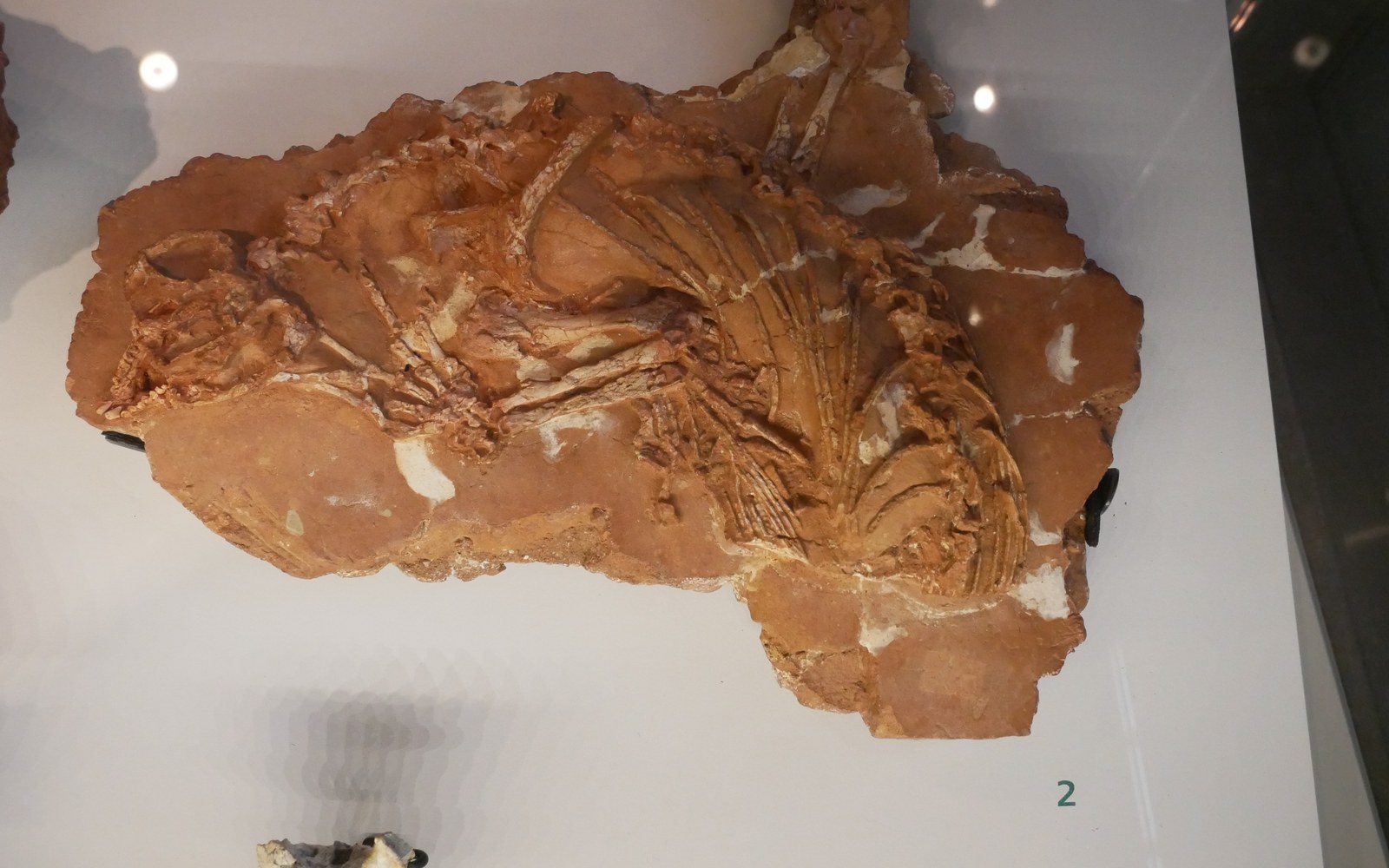
The cover fossil looks almost folded into its slab: skull at the left, spine curled around the ribs, slender limbs and long digits crossing the red rock. It is ROM VP 80979, an articulated Suminia getmanovi specimen at the Royal Ontario Museum and one of the skeletons measured in modern anatomical comparisons.[6][7]
The animal itself is easy to misplace. The large eye socket, short snout, and neat row of leaf-shaped teeth can suggest a lizard; the deep evolutionary address lies on the synapsid branch that also contains mammals. Suminia was neither. It was a small anomodont, part of an extinct radiation of non-mammalian synapsids that became the dominant herbivores of many Permian and Triassic landscapes.[1][6]
Its lasting interest comes from joining two functional systems that rarely survive together so early in the terrestrial fossil record. The skull records precise oral processing: front teeth were suited to crop vegetation, while the back teeth met in a shearing stroke as the lower jaw moved upward and rearward. The rest of the skeleton records a body suited to gripping and clinging: long hands and feet, divergent first digits, curved claws, slender limbs, and a long tail. A 2025 study added a third line of evidence inside the limbs, where unusually thin bone walls resemble the light architecture seen in living climbers.[2][3][4][6]
That combination makes a stronger profile than the once-common label “first tree-climbing vertebrate.” Since that priority claim appeared in 2009, the early Permian Ascendonanus and late Carboniferous Eoscansor have been proposed as potentially older arboreal tetrapods, although their limb-bone microanatomy remains unstudied. Priority is now contested; an anatomical argument can still be inspected bone by bone.[6]
A crowded slab made one small animal unusually legible
Suminia was named in 1994 from the Kotel'nich fossil beds along the Vyatka River in European Russia. The age of those beds is still correlated differently by different authors—either late Middle Permian or early Late Permian—but the animal lived roughly 260 million years ago, well before dinosaurs.[1][3][6]
Most basal anomodonts are represented by a skull, a partial skeleton, or a handful of individuals. Suminia is the exception. More than 70 specimens are now known, many articulated or nearly complete.[6] The most spectacular piece of that record, PIN 2212/116, is an 80-by-120-centimeter block carrying at least 15 individuals. Together they preserve almost every region of a body about half a meter long, from the short, high skull to the far end of the tail.[3][4]
The slab looks intimate, but it is not a family portrait. Several skeletons point in a similar direction, and later taphonomic work found that their orientation was unlikely to be random. Water flow at the place of death—or a short interval of transport before burial—could have aligned the carcasses and winnowed away some bones from incomplete specimens. Their articulation and lack of extensive weathering or scavenging still indicate rapid burial; their physical association does not, by itself, demonstrate flocking, nesting, or social life.[3][5]
That boundary is useful. The block is extraordinary because it turns one species into a comparative sample, not because it freezes a behavior that the sediment may have rearranged.
The jaw was a food processor, not just a plant eater's badge
The particularly clear skull PIN 2212/62 displays the feeding apparatus at its most readable. Suminia had a complete marginal tooth row rather than the beak and paired tusks familiar from later dicynodont anomodonts. The crowns were flattened from side to side, broadened at the base, and coarsely serrated along their front and rear edges. Larger teeth at the front could detach pieces of vegetation; closely packed posterior teeth did the finer work.[1][2]
Tooth shape alone cannot prove diet. The decisive evidence is contact. Upper and lower posterior teeth carry complementary wear facets made by precise tooth-to-tooth occlusion, not merely by grit or food rubbing randomly across a crown. Fine, roughly parallel striations preserve the direction of motion. During the power stroke, the lower teeth first rose along the inner faces of the uppers while retracting; the movement then became almost parallel to the tooth row. The result was a longitudinal shear rather than a simple vertical chop or a mammal-like side-to-side grind.[2]
This matters because Suminia combined an expanded region for jaw-adductor muscles with a sliding articulation that permitted fore-and-aft movement, then connected that architecture to a full set of precisely occluding teeth. Its posterior crowns could reduce high-fiber plant tissue into smaller particles before swallowing, a mechanical step that can increase the rate of digestion.[1][2]
The fossil does not preserve lunch. Small coprolites from the same sediments contain abundant leaf fragments and are compatible in size with Suminia, but no gut contents tie one plant directly to one skeleton.[3] “High-fiber herbivore” is strongly supported by the whole feeding system. A menu of particular leaves remains an ecological inference.
The hands are persuasive because they are not primate hands
Popular accounts sometimes give Suminia an “opposable thumb.” The fossil supports a more exact description. The first digit diverges from the others in both the hand and foot, improving the ability to close an extremity around an irregular support. The hand itself makes up about 40 percent of the forelimb. Long penultimate finger and toe bones, mobile terminal joints, and strongly curved, laterally compressed claws add clinging power to that grasp.[3][4]
Those traits belong to a whole-body arrangement. The limbs are elongated and slender. The neck is relatively long. More than 50 caudal vertebrae form an unusually long tail that may have helped with balance or gripping. Comparative measurements placed the finger proportions among the recurring solutions used by living arboreal vertebrates, while the combination of a divergent first digit and curved claws supplies discrete anatomical support.[3][4][6]
None of this turns Suminia into a Permian primate. Its sprawling limb posture, joint geometry, and synapsid skeleton were its own. Nor was it found wrapped around a branch. “Arboreal” is a functional reconstruction built from several correlated features; the potentially prehensile tail is less secure than the evidence from the hands, feet, and claws.[3][4][6]
The distinction improves the animal. Evolution did not have to invent a modern hand in order to open a vertical habitat. It assembled enough grip, reach, and body control from a very different starting anatomy.
Thin bone walls added an independent test
For years the climbing case rested almost entirely on outward form. In 2025, researchers cut and imaged five isolated limb bones catalogued as KPM 20/99. Bone proportions and histology showed that the sample came from at least two late-juvenile to early-subadult individuals, not one conveniently complete animal. The sections also revealed a microanatomy unlike that of every other anomodont yet sampled.[6]
Typical anomodont limb bones have relatively thick cortices and medullary cavities crossed by abundant internal struts. In the sampled Suminia elements, relative bone-wall thickness stayed below 18 percent, and the open central cavity was almost free of trabeculae. The tissues were still well vascularized and recorded fairly rapid juvenile growth; the thin walls were already present before skeletal maturity.[6]
Studies of living mustelids have found that scansorial species tend to have thinner-walled, less compact long bones than terrestrial or aquatic relatives. That comparison makes the new result consistent with climbing. It does not make a histological cross-section into a habitat detector. The models applied in the 2025 study did not include an arboreal category and classified Suminia as terrestrial rather than aquatic; those models cannot distinguish a tree-climber directly from other land animals using these measurements alone.[6]
The microstructure is therefore valuable precisely as corroboration. An arboreal hypothesis predicts the thinner cortices and wider medullary cavities observed in comparative studies of climbers; Suminia supplies both independently of its grasping anatomy. Each line has limits, but the lines do not depend on the same observation.[6]
A herbivore above ground changes the map of a Permian ecosystem
Kotel'nich was not an empty red plain with one peculiar animal in it. Its floodplain deposits contain roots, plant material, and evidence of tree-like vegetation rising more than 2.5 meters, potentially opening forage above large ground-dwelling herbivores. Herbivores dominate the recorded vertebrate fauna, from heavy pareiasaurs to anomodonts, while predators are much less numerous.[3][5]
A small climber with a high-fiber shearing system could divide that plant resource vertically. It did not need to compete with a large browser for every mouthful if its grip placed leaves within reach that the browser could not exploit. Height could also offer refuge from ground predators, although escape behavior is a plausible benefit rather than a preserved fact.[3]
This is where the skull and hands become more informative together than apart. The postcranium supports branch access but not diet; the dentition supports plant processing but not feeding height. Suminia combines access and processing in one body, making early canopy use an ecological argument rather than a pose borrowed from an illustration.
The durable portrait is not a proto-mammal practicing for squirrels, and it is not a reptile that happened to grow a thumb. Suminia getmanovi was a small Permian anomodont with a precisely wearing tooth row, a rearward shearing stroke, extremities configured to grasp and cling, and limb bones unexpectedly light relative to other sampled anomodonts. The crowded slab documents its anatomy; wear and joints explain its feeding; hands, feet, claws, tail, and bone walls converge on climbing. The branches themselves are gone, but the animal still carries the mechanical bill for living among them.
Sources
- Natalia Rybczynski, “Cranial anatomy and phylogenetic position of Suminia getmanovi, a basal anomodont (Amniota: Therapsida) from the Late Permian of Eastern Europe,” Zoological Journal of the Linnean Society 130 (2000)—the three-dimensional skull description, sliding jaw joint, and phylogenetic placement.
- Natalia Rybczynski and Robert R. Reisz, “Earliest evidence for efficient oral processing in a terrestrial herbivore,” Nature 411 (2001)—the tooth-wear, occlusion, and shearing-power-stroke analysis.
- Jörg Fröbisch and Robert R. Reisz, “The Late Permian herbivore Suminia and the early evolution of arboreality in terrestrial vertebrate ecosystems,” Proceedings of the Royal Society B 276 (2009)—the articulated skeleton block, comparative digit proportions, climbing inference, and ecosystem context.
- Jörg Fröbisch and Robert R. Reisz, “The postcranial anatomy of Suminia getmanovi (Synapsida: Anomodontia), the earliest known arboreal tetrapod,” Zoological Journal of the Linnean Society 162 (2011)—the detailed vertebral, limb, hand, foot, and tail anatomy.
- Michael J. Benton et al., “Preservation of exceptional vertebrate assemblages in Middle Permian fluviolacustrine mudstones of Kotel'nich, Russia: stratigraphy, sedimentology, and taphonomy,” Palaeogeography, Palaeoclimatology, Palaeoecology 319–320 (2012)—the depositional setting and current-alignment interpretation of the multi-individual slab.
- Saskia Nieke, Jörg Fröbisch, and Aurore Canoville, “Bone microstructure of the basal anomodont Suminia getmanovi supports its arboreal lifestyle,” Scientific Reports 15 (2025)—the thin cortical walls, open medullary cavities, growth evidence, and explicit limits of available lifestyle models.
- Wikimedia Commons, “File:Suminia ROM.jpg”—source and license page for Skye McDavid's photograph of articulated specimen ROM VP 80979 at the Royal Ontario Museum, used as the cover image.