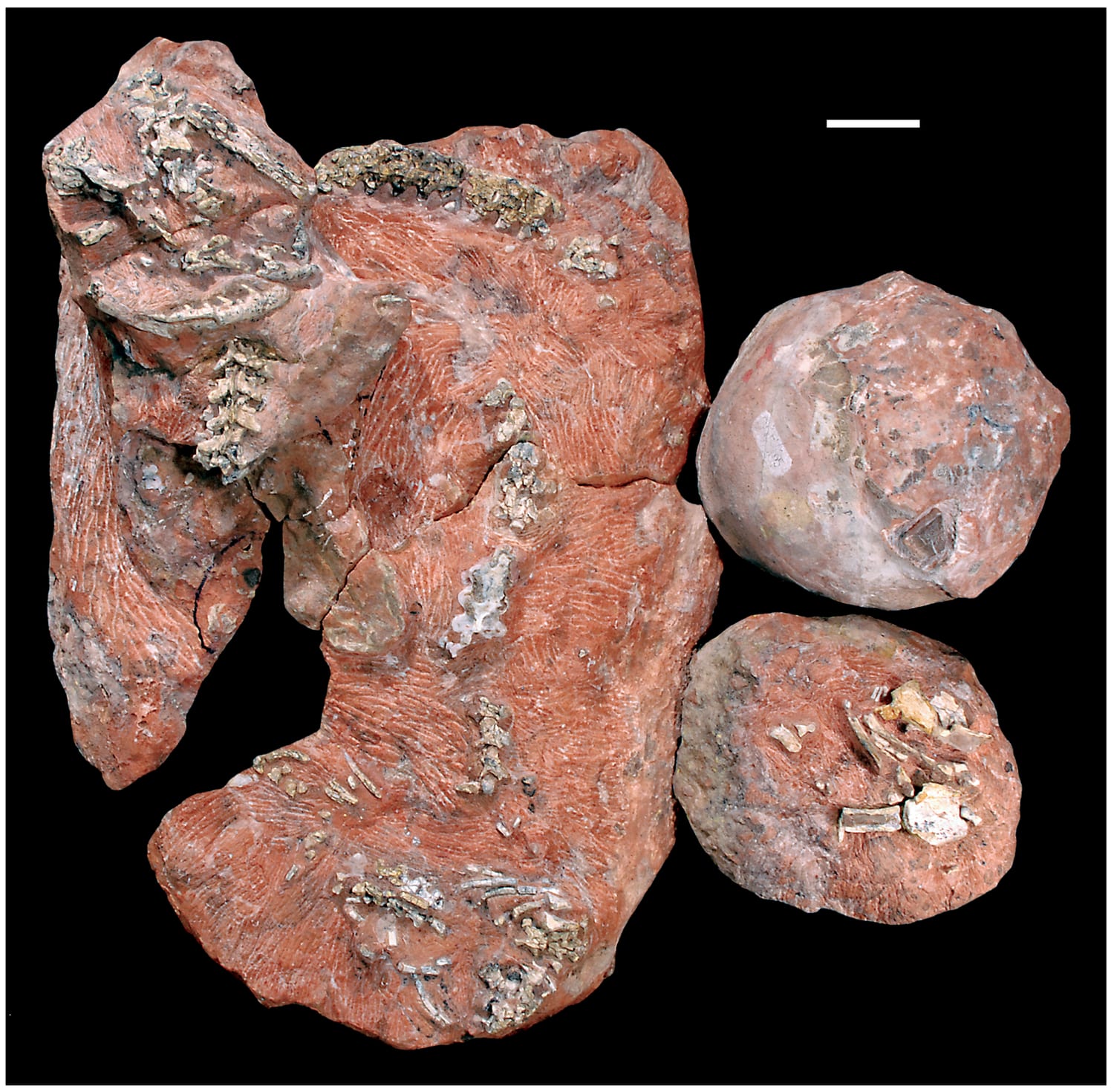
The photograph does not surrender its drama at first glance. Against black, rose-colored sandstone blocks look like pieces of a broken floor. Pale vertebrae cross their surfaces in interrupted chains. A nearly spherical egg occupies the right side; smaller bones gather below it. Near the center, another egg has collapsed into shell and stone. Only after the eye follows the vertebrae into a coil does the arrangement become legible: a snake lies around the crushed egg, its skull resting on the uppermost loop, while the partial skeleton of a newly hatched sauropod lies close by.[1]
If this were a painted reconstruction, the story would arrive finished. A snake has entered a dinosaur nest and is about to feed. Because it is a fossil, that scene has to be earned feature by feature.
The specimen comes from the latest Cretaceous Lameta Formation near Dholi Dungri in Gujarat, western India. It joins a 3.5-meter snake, a partial clutch of titanosaur eggs and a roughly half-meter hatchling in one burial assemblage. The snake was named Sanajeh indicus: “ancient gape” for its feeding apparatus and a reference to the Indian subcontinent for its provenance.[1] The block is exceptional not because stone somehow recorded an attack like a camera. It is exceptional because posture, articulation, sediment and repetition all point toward the same behavior—while stopping just before direct evidence of a bite.
The block was discovered twice
Dhananjay Mohabey collected the fossil in 1984 while surveying dinosaur eggs in Gujarat. He recognized eggs and the bones of a sauropod hatchling, already an unusual association. The snake remained visually submerged in the matrix. When Jeffrey Wilson examined the specimen in 2001, a chain of interlocking vertebrae gave it away: the zygosphene–zygantrum joints were characteristic of a snake spine.[4]
That delay is part of the fossil’s meaning. Discovery did not end when the rock left the ground. After government clearance allowed the blocks to travel temporarily to the University of Michigan in 2004, preparator William Sanders spent more than a year removing matrix. Formic acid weakened the calcareous cement; an air scribe and needles exposed delicate bones. Separate pieces collected from the site could then be fitted back into the larger arrangement.[3][4]
The 2010 description catalogued the six associated blocks as GSI/GC/2901–2906 and included all of them in the holotype. A later revision corrected that formal assignment: the Sanajeh holotype is restricted to 2901–2903 and 2906, while 2904 and 2905 are the associated titanosaur hatchling and egg rather than parts of the snake specimen. The snake material includes a nearly complete skull and lower jaws plus 72 precloacal vertebrae and ribs preserved in five articulated sections.[1][3] The originals belong to the Geological Survey of India; a cast of the assembled block set is catalogued as UMMP 14265 at the University of Michigan Museum of Paleontology.[5] Those identifiers matter. The famous “scene” is not a free-floating story but a documented association whose blocks, preparation history and replicas can be revisited.
Read the inventory before the scene
The safest close reading begins with what is physically present.
The snake’s skull is about 95 millimeters long. Its vertebral column curves clockwise around three sides of the crushed egg labelled Egg 3 in the original paper, and the skull rests on the highest loop. The assemblage contains three eggs assigned to the egg-taxon Megaloolithus dhoridungriensis: Egg 3, an intact egg visible in the photograph and a second intact egg left at the locality. Comparable Dholi Dungri clutches contained six to 12 eggs. Extensive soil formation later erased any excavated nest structure, so “nesting ground” is more precise than imagining a neatly preserved bowl.[1]
At the lower right of the block lie articulated parts of the hatchling’s left front quarter: thorax, shoulder girdle and forelimb. Its incompletely ossified bones and sauropod features identify a very young animal. The original authors considered it almost certainly a titanosaur because titanosaurs are the only sauropod lineage known from uppermost Cretaceous rocks of the region. That does not identify its genus. Nor does the egg name identify an adult dinosaur species; an ootaxon classifies fossil eggs independently of the animal that laid them.[1]
The distinction prevents a familiar leap from “titanosaur hatchling” to a fully restored named giant. What the block preserves is narrower and more interesting: a vulnerable sauropod at the start of life, before the enormous adult body associated with its lineage had been built.
Four tests for a fossil behavior
The predation case rests on a bundle of evidence rather than the theatrical pose alone.
First is geometry. A transported snake could land near an egg by chance, but a skull poised on its own coil while the spine wraps around a crushed egg is a highly particular arrangement. The adjacent hatchling makes that geometry biologically suggestive.[1]
Second is preservation. The snake, hatchling and broken egg remain articulated. Fine skull elements survived, while the intact eggs are comparatively undeformed. A current capable of sweeping unrelated carcasses together would normally disturb, separate or abrade more of this material. Their condition instead indicates little transport followed by rapid, deep burial.[1]
Third is sedimentary mechanism. The locality lay near a topographic high that could shed pulses of sediment during storms. Such a debris flow offers a plausible way to interrupt the animals, bury them quickly and lock their relative positions in place. It explains the snapshot-like preservation without requiring literal instantaneous fossilization.[1]
Fourth is repetition. The researchers reported at least three Sanajeh individuals associated with sauropod eggs within 25 square meters. One association can be an accident; several at the same nesting locality make routine use of that environment more plausible. The authors called the result an “ethofossil”—a preservation of behavior—and inferred that the snakes frequented nesting grounds to take hatchlings.[1]
None of the four points is decisive by itself. Together they make postmortem mixing increasingly expensive as an explanation: it must reproduce a purposeful-looking coil, retain articulation, match a rapid-burial setting and recur nearby.
A predator without the modern snake trick
Sanajeh was not simply an anaconda dropped into the Cretaceous. Modern wide-gaped snakes enlarge the feeding envelope through a suite of mobile skull joints, elongated elements and distensible soft tissues. The 2010 description found that Sanajeh lacked the specializations of both living wide-gaped snakes and dedicated egg eaters. Its jaw joint was not displaced far behind the braincase, and its rigid prey limit would have been smaller than a modern macrostomatan snake of comparable length.[1]
That anatomy rules out the most cartoonish version of the scene. The intact eggs were about 16 centimeters across and far exceeded the snake’s gape; Sanajeh was unlikely to swallow one whole. The half-meter hatchling was a different proposition. A long body and some mobility within the toothed palate could permit a sizeable meal even before the fully modern wide-gape system evolved.[1]
Further preparation and a second Sanajeh skull sharpened that evolutionary picture in 2022. The new material preserved a complete upper temporal bar—a lizard-like bridge of bone not known in living snakes—and a palatal apparatus capable of only limited movement. The study placed Sanajeh near the base of the broader snake lineage and argued that eating relatively large prey preceded the later origin of the extreme, unilateral wide-gape feeding seen in many living snakes.[3]
The second snake occurred with a hatchling or juvenile turtle at Dholi Dungri. That association does not put turtle bones inside a snake or prove another interrupted meal. It does broaden the local pattern: both known Sanajeh specimens were found beside young reptiles at the only reported Lameta locality where eggs and bones occur together.[3] The anatomy says the snake could handle more than tiny prey; the associations suggest where it went to find that prey.
The missing bite matters
There is no preserved strike, bite mark or hatchling bone inside the snake’s body. The crushed egg could be the one the hatchling exited, as the original authors inferred, but the shell does not preserve a labeled sequence of events. Sanajeh might have been waiting to seize the newborn, might have arrived after it emerged, or might have been using the nesting ground for another reason. An individual animal’s intent does not fossilize.
Michael Benton’s commentary accompanying the original paper judged hatchling predation the most likely account while naming the missing test plainly: juvenile dinosaur bones in the snake’s stomach would make the case more direct.[2] That standard does not demolish the interpretation. It ranks it. Gut contents would be direct dietary evidence; the Dholi Dungri block instead provides a strong contextual inference built from position, preservation, environment, recurrence and functional anatomy.
This is why the fossil deserves a close reading rather than a caption saying “snake caught eating dinosaur.” The popular wording compresses several different claims. That Sanajeh occupied a sauropod nesting ground is strongly supported. That it was capable of taking a hatchling is anatomically plausible. That nest predation best explains the repeated associations is a reasoned behavioral interpretation. That this individual had begun an attack at the instant of burial remains unobserved.
A giant’s smallest window
Adult titanosaurs made size their defining defense. Their hatchlings began around half a meter long, emerging from eggs that a 3.5-meter snake could circle but not gulp whole. The Dholi Dungri block captures that mismatch in reverse: the future giant is still small enough to be prey, while the predator’s jaws are mobile enough to matter but not yet built like those of many modern snakes.[1][3]
The photograph therefore preserves two transitions at once. One is ecological and lasts only a short part of an individual life—the dangerous interval between hatching and growing beyond the reach of many predators. The other is evolutionary and spans lineages—the acquisition of a snake skull able to transport large prey before the most extreme wide gape had appeared.
The attack inside the stone stops short of a bite. That gap is not a failure of the fossil. It is the space in which paleontology works: observation first, competing explanations next, and confidence earned by the number of independent details that survive.
Sources
- Jeffrey A. Wilson et al., “Predation upon Hatchling Dinosaurs by a New Snake from the Late Cretaceous of India,” PLOS Biology 8 (2010)—original description, specimen photograph, taphonomy, locality, anatomy and behavioral interpretation.
- Michael J. Benton, “Studying Function and Behavior in the Fossil Record,” PLOS Biology 8 (2010)—methods primer and independent statement of the evidentiary boundary around the proposed attack.
- Hussam Zaher et al., “The skull of Sanajeh indicus, a Cretaceous snake with an upper temporal bar, and the origin of ophidian wide-gaped feeding,” Zoological Journal of the Linnean Society 197 (2023)—new specimen, additional preparation and revised cranial and feeding interpretation.
- University of Michigan Museum of Paleontology, “The Snake that Ate the Dinosaur” (2014)—institutional account of the 1984 collection, 2001 recognition and laboratory preparation of the blocks.
- University of Michigan Online Repository of Fossils, “Specimen Data: UMMP VP 14265”—catalog record for the museum cast of GSI/GC/2901–2906 and associated CT data.