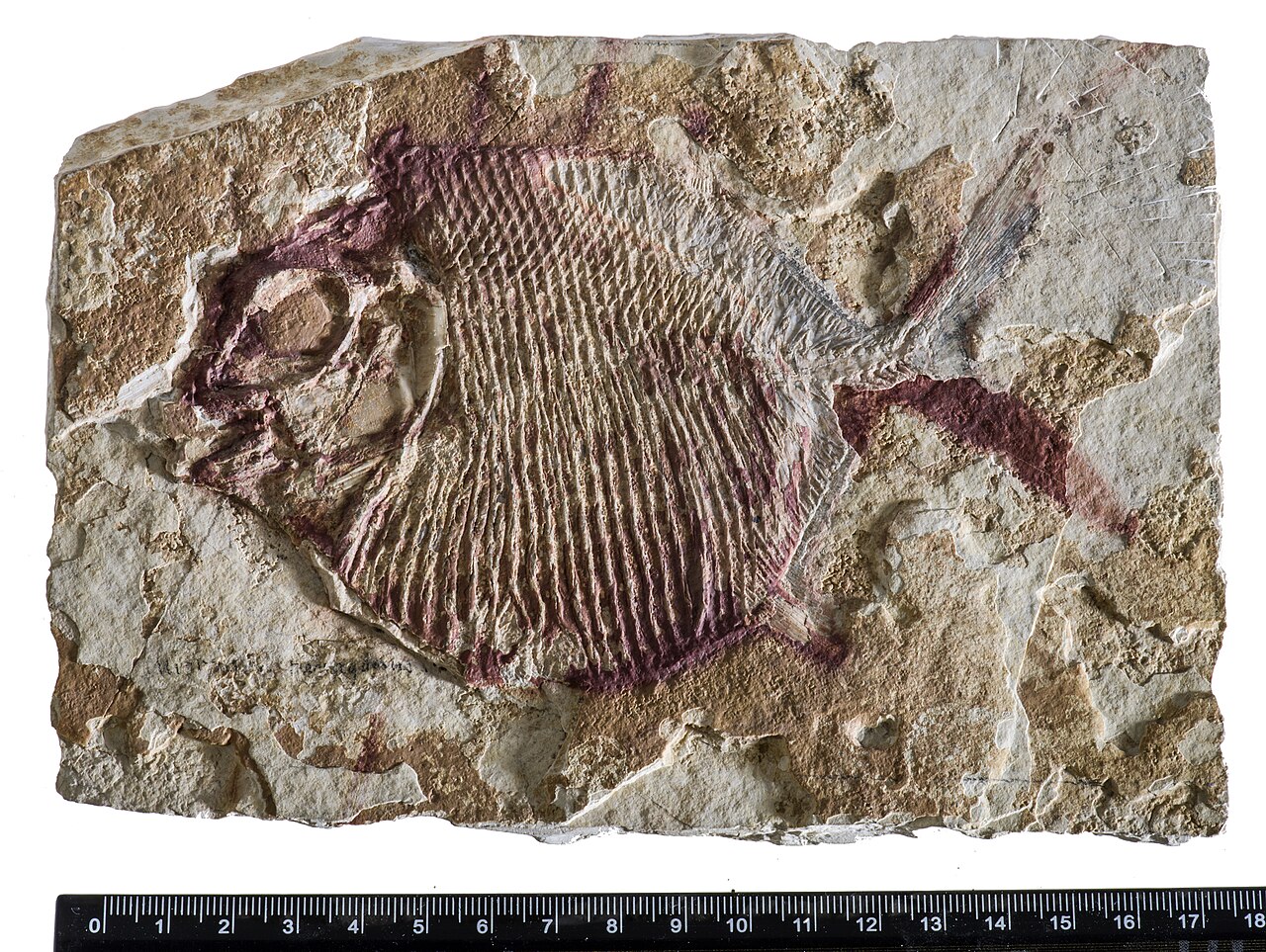
A pycnodont jaw can look as though someone has set pebbles into bone. Rounded teeth stand in close-packed rows, forming a surface quite unlike the pointed grin we tend to give prehistoric predators. Such teeth offer an obvious route into the animal's life: something hard could be trapped between them and broken.[1]
Yet these extinct ray-finned fishes deserve more than a label reading “shell crusher.” Pycnodontiformes persisted from the Late Triassic into the late Eocene, a fossil record spanning roughly 175 million years. They survived the end-Cretaceous extinction and continued into seas increasingly populated by the ancestors and relatives of familiar modern fishes.[2]
Their mouths tell a story of possibilities within an enduring design. To recover that story, we need to separate the equipment an animal possessed from the meals it actually ate.
Inside the mouth
In a typical pycnodont, feeding involved different sets of teeth. Those toward the front could be slender or chisel-like. Deeper inside, a bone in the roof of the mouth called the vomer carried a dental pavement, opposed by teeth on the paired prearticular bones of the lower jaw. The result combined an apparatus for taking hold of food with broad surfaces suited to processing it.[1]
Jürgen Kriwet's 2001 study reconstructed feeding through comparisons with living fishes, jaw anatomy and tooth wear. It proposed combinations of nipping, biting and suction. These are functional reconstructions: fossil bones constrain possible movements, while muscles and the timing of an actual feeding strike are harder to recover.[1]
The visible teeth are therefore the beginning of an explanation. Getting food into the mouth matters as much as what happens when the jaws close.
A body shape is not an address
Many pycnodonts had tall bodies compressed from side to side, an outline that invites comparison with a butterflyfish. But the group varied considerably in body and fin shape. In a 2005 reassessment, Francisco José Poyato-Ariza argued against turning the familiar silhouette into a standard portrait of every member.[4]
He made an equally useful distinction about teeth. A rounded or molar-like tooth is a description of form; calling it a crushing tooth assigns a function. That assignment may be persuasive, but it still needs support. When the functional label is treated as an observation, alternative uses can disappear before anyone has tested them.[4]
Habitat demands similar care. Pycnodonts are often associated with marine reefs, yet freshwater representatives are known. Finding one cannot, by itself, establish that a deposit formed beside a reef—or even in the sea. The sediment and the rest of the fossil community must help establish the setting.[4]
Sharing a seabed, dividing the menu
A more detailed picture emerges at Asfla in southeastern Morocco. Samuel Cooper and David Martill's 2020 study examined pycnodont material from the lower Turonian part of the Akrabou Formation, in the Late Cretaceous. They recognized five nominal species, including the newly named Neomesturus asflaensis and Paranursallia cavini. Here was a community with several versions of the dental apparatus.[5]
The differences matter. Larger, more robust teeth could cope with different prey from smaller ones. The authors proposed that variation in tooth size and shape helped these fishes divide food resources, allowing several forms to occupy the same broader environment. A seabed could offer many meals even to animals all loosely described as hard-prey feeders.[5]
But the Asfla material lacked associated stomach contents that would identify those meals directly. The researchers explicitly cautioned against assigning precise prey to each fish. Their proposed division of resources is an ecological explanation supported by anatomy, rather than a recovered menu. The uncertainty leaves a specific question for future specimens to answer.[5]
When the pavement became a blade
Other pycnodonts depart much further from the shell-crushing stereotype. In 2017, Romain Vullo and colleagues described unusual jaws from Morocco's Ouled Abdoun phosphate deposits, including the Paleogene species Serrasalmimus secans. Its teeth were compressed sideways and arranged to produce cutting edges. The researchers placed it within a newly recognized family, Serrasalmimidae.[6]
Across the forms they compared, fewer tooth rows and sharper crowns marked a shift from crushing toward slicing. The resemblance to piranha teeth is striking, although these are separate lineages. The comparison concerns a similar feeding solution, not a claim that pycnodonts were ancestral piranhas.[6]
Here, too, the specimen sets the limit. The family was described from isolated tooth-bearing bones, not complete bodies. Soft-bodied prey and fin biting were proposed as possible feeding strategies; the paper did not present a preserved attack. Its whole-animal illustration borrowed features from better-known relatives. A convincing jaw can support an argument about cutting without supplying the fish's entire appearance or daily behavior.[6]
A long success with an ending
Why did such adaptable fishes disappear? A 2021 analysis by John Cawley and colleagues compared body and jaw shapes across pycnodonts and other fish groups. It challenged a simple account in which rising spiny-rayed fishes outcompeted them: similar silhouettes did not necessarily mean equivalent feeding equipment or competition for the same food.[2]
The study instead linked pycnodont diversity to the availability of reefs and other structured habitats, suggesting that habitat loss contributed to their decline. This is a proposed explanation for a large-scale pattern, compatible with exceptions such as freshwater species. It does not establish a single cause for every disappearance.[2]
That makes the pebble-covered jaw a particularly rewarding fossil to linger over. Its apparent simplicity opens into questions about capture, processing, specialization and coexistence. Each additional specimen can sharpen the picture: a different tooth arrangement, a preserved meal, a fish in an unexpected setting. Pycnodonts become most interesting when we let those differences remain visible.
Sources
- Jürgen Kriwet, “Feeding mechanisms and ecology of pycnodont fishes (Neopterygii, Pycnodontiformes)” (2001)—jaw anatomy, functional reconstruction and dietary evidence.
- John J. Cawley and colleagues, “Rise and fall of Pycnodontiformes: Diversity, competition and extinction of a successful fish clade,” Ecology and Evolution (2021)—temporal range, comparative morphology and the habitat-loss hypothesis.
- Museum of Natural History, Neuchâtel, Gyrodus hexagonus FOS.451—specimen photograph and collection metadata, Wikimedia Commons.
- Francisco José Poyato-Ariza, “Pycnodont fishes: morphologic variation, ecomorphologic plasticity, and a new interpretation of their evolutionary history” (2005)—variation in bodies, dentitions and habitats.
- Samuel L. A. Cooper and David M. Martill, study of Asfla pycnodonts, Cretaceous Research (2020)—institutional manuscript, section 5.2.
- Romain Vullo and colleagues, “A unique Cretaceous–Paleogene lineage of piranha-jawed pycnodont fishes,” Scientific Reports (2017)—Serrasalmimus, isolated jaw material and inferred feeding strategies.