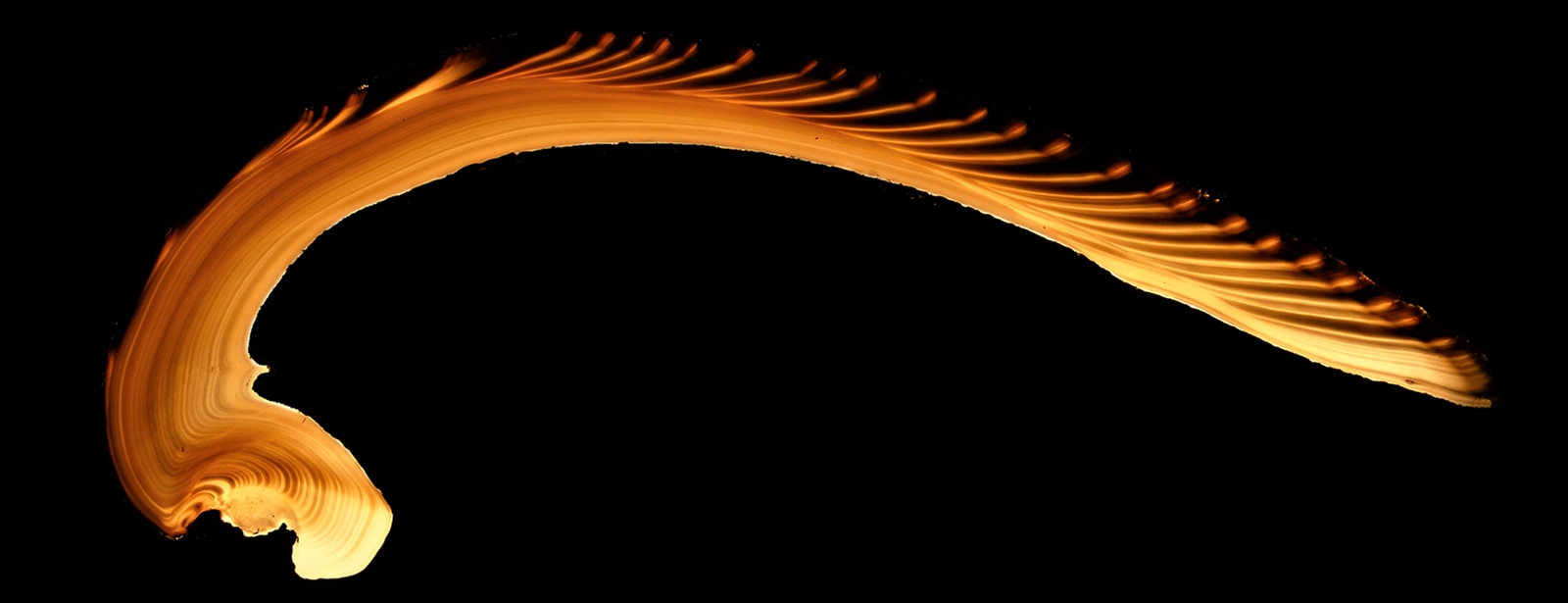
A thin slice of clam shell held against the light can look like a landscape: a steep ridge at the hinge, long slopes toward the margin, pale bands following the contours. The photograph above shows a modern Mercenaria campechiensis, a Florida Museum specimen. Cutting through the shell exposes an interior record that its outside conceals.[1]
Fossil shells can preserve comparable sequences. But their apparent regularity invites a mistake. A line is a physical feature; a day or a year is an interpretation. Sclerochronology—the study of time recorded in growing hard parts—begins by working out how the two correspond.[2]
That distinction can carry a researcher from a clam's growing season to Earth's ancient rotation. It also explains why a beautifully preserved shell may have nothing to say about the coldest weeks of its owner's life.
Make the bands visible
A bivalve extends its shell by adding material. Changes in deposition produce increments separated by lines, with patterns that can reflect annual seasons, tides or daily rhythms. Several rhythms may be nested inside one another. Before counting, the researcher needs to establish which scale is visible.[2]
Preparation helps expose that structure. A section cut across the growth lines can be polished for reflected-light inspection or made thin enough for transmitted light. Etching and staining can enhance differences between layers. Those treatments do not manufacture dates: they make the material distinctions easier to examine. The same boundary can look different under different illumination, so the rule cannot simply be “count the dark stripes.”[2]
The work resembles reading a manuscript whose punctuation survives but whose units must be reconstructed. A convincing calendar requires a second kind of evidence.
Give a line a duration
Oxygen-isotope measurements offer one check. Shell carbonate responds to both the temperature and isotope composition of the water in which it forms. Repeated seasonal swings can help identify annual cycles. Recovering a seasonal rhythm is a narrower claim than assigning every sample an exact water temperature; the latter needs additional assumptions about the ancient water.[1]
Living animals provide a way to test the correspondence. In a 2001 study, David Goodwin and colleagues compared two live-collected Chione cortezi shells from the northern Gulf of California with temperature records from the same site. They aligned daily increment widths with oxygen-isotope samples, allowing the shell record to be checked against measured conditions.[3]
For those individuals, deposition started in late March or early April and ended in late November or early December. Growth began above roughly 17°C and slowed or stopped above about 31°C. These were observed limits in a particular setting, not a universal timetable for clams.[3]
Even within one shell, a chemical sample represented different amounts of time. Some averaged more than three weeks; many others captured fewer than five days. Equal distances along a sampling track therefore need not represent equal durations. The animal decides how much shell is available for each interval.[3]
A Cretaceous day, counted cautiously
The extraordinary reach of this approach appears in Torreites sanchezi, an extinct rudist bivalve. Niels de Winter and colleagues studied specimen NHMM 2014 052 from Oman's Samhan Formation, of late Campanian age in the Late Cretaceous, more than 70 million years ago. Their 2020 paper examined exceptionally fine layering in its preserved outer shell.[4]
The team combined visible layer counts, repeating chemical signals and seasonal records. Laser sampling at 10-micrometer spacing resolved variation within laminae roughly 40 micrometers thick. After correcting for incomplete preservation, the combined estimate was 372 laminae per year, with a propagated uncertainty of 8.4. Interpreting these as daily layers yielded a day of about 23 hours and 31 minutes.[4]
The striking number comes from a chain of measurements and corrections, rather than an unqualified count of stripes. It constrains how many daily cycles fitted inside a year. That is a different question from determining the fossil's geological age, which comes from its stratigraphic context.[4]
The calendar can stop
A shell's most consequential feature may be an interval with no deposited material. In a 2003 study, Goodwin, Bernd Schöne and David Dettman modeled how changing growth rates and seasonal shutdowns affect oxygen-isotope records, then compared sampling strategies in a Chione cortezi shell.[5]
Their work separates two problems. Slow growth packs a longer stretch of time into less shell, so a sample can blend conditions that finer sampling might distinguish. A complete pause leaves no new carbonate for that interval. Greater analytical precision cannot recover an environmental measurement from material that was never deposited.[5]
The distinction matters when reconstructing ancient seasons. A reduced temperature range in successive parts of a shell can arise as its owner grows more slowly or records a shorter growing season. The water need not have become less seasonal. A change along one animal's shell is therefore not automatically a change in climate.[5]
There is something intimate about this limit. A shell is an environmental record made by a participant: an animal with its own tolerances, rhythms and interruptions. Reading it well means keeping that animal in view. The bands can tell us when growth happened. The spaces between our measurements may also contain time that growth left out.
Sources
- David K. Moss, Linda C. Ivany and Douglas S. Jones, “Fossil bivalves and the sclerochronological reawakening,” Paleobiology (2021)—annual calibration and the specimen photograph in figure 1.
- Bernd R. Schöne and Donna M. Surge, “Bivalve sclerochronology and geochemistry,” Treatise Online 46 (2012)—shell formation, periodic increments and preparation methods.
- David H. Goodwin and colleagues, study cross-calibrating daily increments, oxygen isotopes and temperature in Chione cortezi, PALAIOS 16 (2001), 387–398—author-hosted full text.
- Niels J. de Winter and colleagues, “Subdaily-Scale Chemical Variability in a Torreites Sanchezi Rudist Shell: Implications for Rudist Paleobiology and the Cretaceous Day-Night Cycle,” Paleoceanography and Paleoclimatology (2020)—institutional publication record.
- David H. Goodwin, Bernd R. Schöne and David L. Dettman, “Resolution and Fidelity of Oxygen Isotopes as Paleotemperature Proxies in Bivalve Mollusk Shells: Models and Observations,” PALAIOS 18 (2003), 110–125—author-hosted full text.