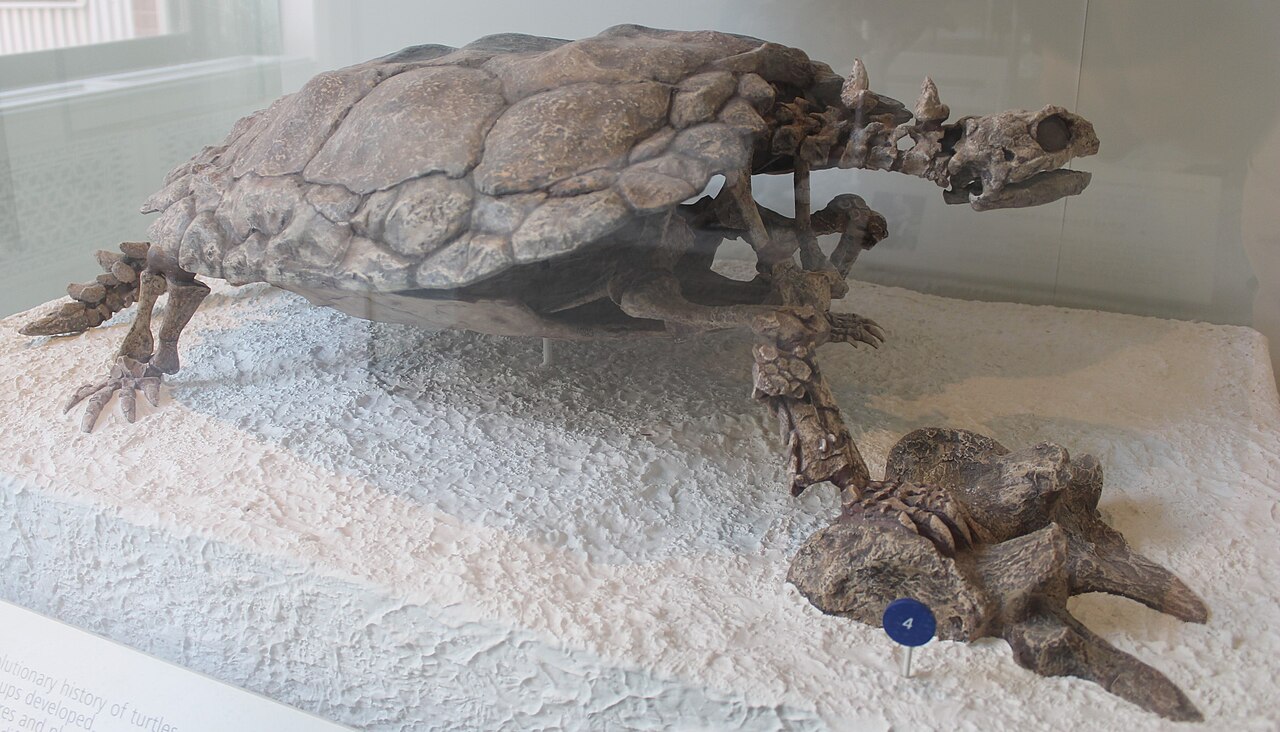
The shell catches the eye first. Then the armor keeps going: spikes around the neck, a long tail ending in a club. In the American Museum of Natural History's mounted Proganochelys, the familiar turtle outline spreads into something more bristling and less compact.[1][3]
Proganochelys quenstedtii lived during the Norian stage of the Late Triassic, more than 200 million years ago. This stem turtle lay outside the group containing living turtles and their last common ancestor. German fossils preserve much of its skeleton; specimen SMF 09-F2, from the Klettgau Formation at Frick in Switzerland, adds partially scattered remains found among Plateosaurus bones.[2] Its appeal extends beyond that company: this animal shows how much variety can fit around an already recognizable shell.
A shell with exposed edges
The upper shell, or carapace, connected to the lower plastron through bony bridges along the sides. Inside the mouth, however, the combination was unfamiliar. The jaw margins lacked teeth, while small teeth remained on bones of the palate. A familiar shell could enclose an unfamiliar mouth.[3]
Protection also extended into the skin. Bony elements called osteoderms covered parts of the neck, limbs and tail; those near the tail's end formed its club-like structure.[3] These are anatomical observations. Exactly how the animal deployed them against another animal requires a further argument. A club-shaped tail is enough to change the silhouette, but it does not preserve a blow being struck.
The Frick specimen offers a particularly useful correction to older reconstructions. Its neck was accompanied by two sets of spiked osteoderms. The authors found no additional sets, supporting a two-set arrangement proposed in earlier research rather than the four shown in a previous life reconstruction.[2] Even a familiar fossil animal can acquire too much armor on paper.
A sideways tuck
It is tempting to imagine all those neck spikes as compensation for a head that could never retreat. Research on mobility makes that picture more interesting.
Ingmar Werneburg and colleagues compared turtle necks and constructed a three-dimensional model of Proganochelys. Their 2015 study supported a sideways-and-downward bend that could bring the head beneath the shell. The complex double bend available to living turtles was absent. Neck armor would have supplemented this more limited shelter.[4]
The distinction changes the imagined animal. A neck can have useful protective movement without matching the full flexibility of its living relatives. “Could it retract?” compresses a range of motions into a yes-or-no question.
Some living turtles achieve exceptional mobility by partly dislocating joints between vertebral bodies. Fitting fossil bones neatly together therefore cannot reveal every motion an animal could perform.[4] The proposed tuck depends on comparison with living animals; no fossil catches it happening.
The ground beneath the shell
Was Proganochelys walking across dry ground or along the bottom of a pond? Shell shape alone offers a surprisingly poor answer.
In 2020, Laura Dziomber and colleagues compared three-dimensional shell shapes from 69 living turtle species and three fossil species. Habitat groups overlapped substantially. Proganochelys fell within an unspecialized region where shape could not confidently distinguish its ecology. The familiar shortcut—domed shell for land, flattened shell for water—was too crude for their results.[6]
A different line of evidence comes from within the bone. Torsten Scheyer and Martin Sander's 2007 study examined shell microstructure. Proganochelys shared with terrestrial turtles well-developed compact layers around a dense interior, with relatively limited vascularization of the compact bone. Aquatic turtles in their comparison tended toward reduced compact layers and more vascularized tissue.[5]
That resemblance supports a terrestrial interpretation. It also explains why a fragment can be informative even when it cannot supply a handsome museum mount: shell tissue can be compared where the limb bones needed for a different ecological test are missing.[5]
The two studies ask different questions. One tests whether the shell's outer geometry sorts animals by habitat; the other examines its internal construction. Weak discrimination in the first does not erase the evidence in the second. A convincing habitat reconstruction has to account for both.
An animal with a nose
The head adds another dimension. In 2018, Stephan Lautenschlager, Gabriel Ferreira and Ingmar Werneburg reconstructed internal spaces in Proganochelys skulls. A large nasal cavity and the proportions of structures associated with smell suggested that olfaction was important. Together with inner-ear anatomy, the findings supported a predominantly terrestrial animal.[7]
The authors also explained why those clues need care. Nasal space can serve functions besides smell, and a high ratio involving the olfactory bulbs can partly reflect small cerebral hemispheres. An endocast records the space inside a skull, with membranes and blood vessels potentially obscuring the brain's contours.[7] It cannot supply a precise account of what the turtle sensed on a particular afternoon.
The fossils nevertheless give this bristling animal a fuller presence: shelter beneath the shell's rim, a neck capable of some withdrawal, bone tissue consistent with terrestrial habits, and a head equipped to sample its surroundings. The museum mount draws attention to the armor. The research gradually restores the animal moving inside it.
Sources
- Jonathan Chen, “Proganochelys AMNH.jpg” (8 July 2024) — photograph of the AMNH 29383 skeletal mount, with image provenance and license.
- Torsten M. Scheyer and colleagues, “First evidence of Proganochelys quenstedtii (Testudinata) from the Plateosaurus bonebeds (Norian, Late Triassic) of Frick, Canton Aargau, Switzerland,” Swiss Journal of Palaeontology 141, 17 (2022) — locality, preservation and neck osteoderms.
- Rainer R. Schoch and Hans-Dieter Sues, “The origin of the turtle body plan: evidence from fossils and embryos,” Palaeontology 63 (2020), 375–393 — Proganochelys shell, palate and external armor.
- Ingmar Werneburg and colleagues, “Modeling neck mobility in fossil turtles,” Journal of Experimental Zoology Part B 324 (2015), 230–243; first published online in 2014 — inferred sideways head withdrawal and limits of skeletal mobility models.
- Torsten M. Scheyer and P. Martin Sander, “Shell bone histology indicates terrestrial palaeoecology of basal turtles,” Proceedings of the Royal Society B 274 (2007), 1885–1893 — comparative shell microstructure.
- Laura Dziomber, Walter G. Joyce and Christian Foth, “The ecomorphology of the shell of extant turtles and its applications for fossil turtles,” PeerJ 8 (2020), e10490 — shell-shape comparison and its ecological limits.
- Stephan Lautenschlager, Gabriel S. Ferreira and Ingmar Werneburg, “Sensory Evolution and Ecology of Early Turtles Revealed by Digital Endocranial Reconstructions,” Frontiers in Ecology and Evolution 6 (2018), article 7 — skull cavities, sensory inference and habitat.