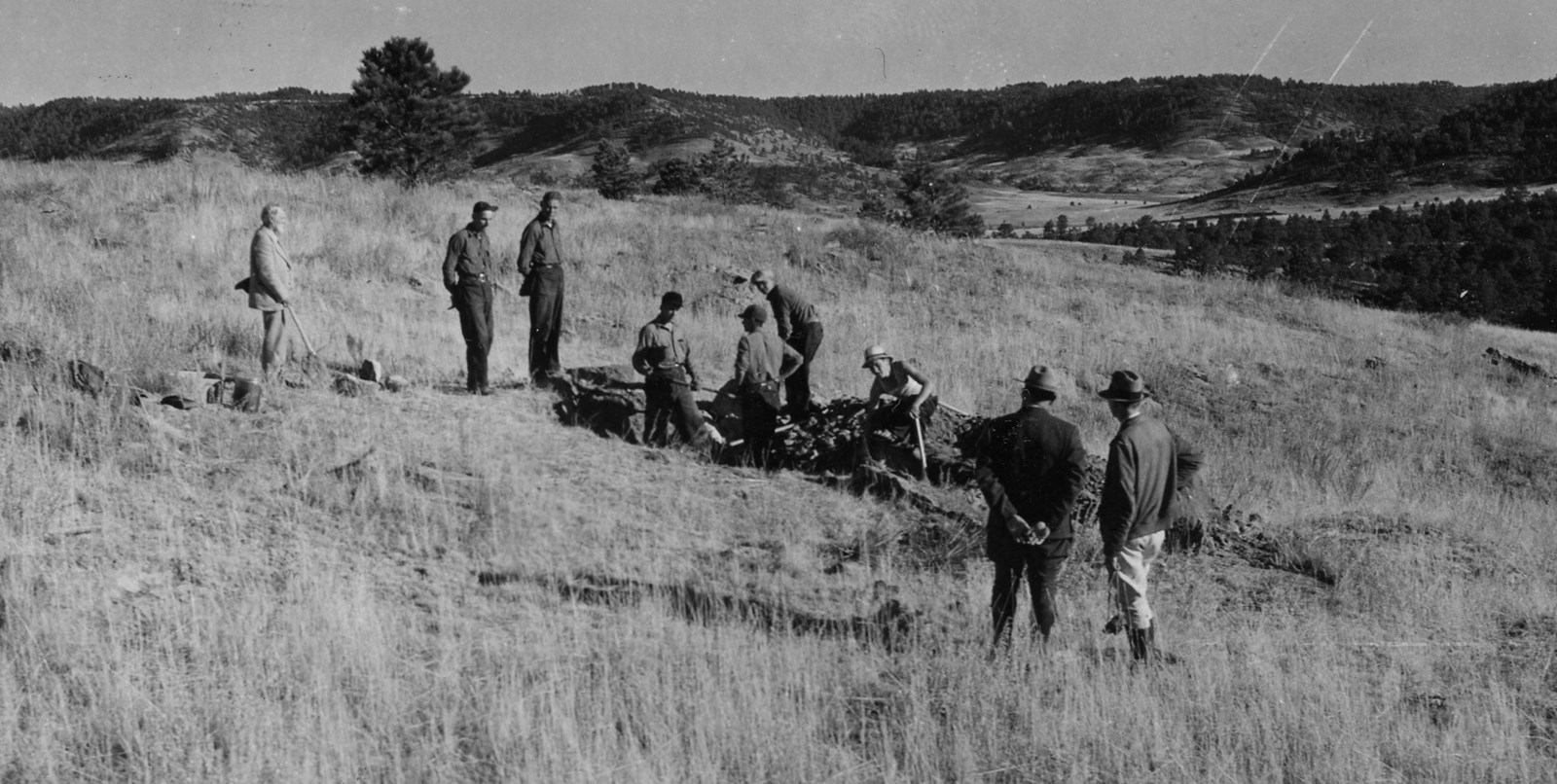
In October 1935, a Civilian Conservation Corps crew began digging at a national monument that seemed to have lost its reason for existing. Collectors had stripped the exposed fossil plants from Fossil Cycad, in South Dakota's Black Hills. Beneath the surface, the crew found more.[1]
The distinction between an empty-looking hillside and an exhausted fossil deposit runs through the site's history. Reading its excavation records alongside the surviving specimens reveals two different losses: plants removed from the ground, and confidence that the ground still deserved protection.
A plant worth cutting open
The monument's name preserves an old botanical confusion. Its celebrated fossils were cycadeoids, members of the extinct Bennettitales, rather than true cycads of the group still living today. Their outward resemblance helped obscure the distinction. The exceptional value of the South Dakota material lay in preserved anatomy, including reproductive structures, that allowed researchers to investigate the plants beyond their general silhouette.[2]
These are Early Cretaceous fossils, roughly 120 million years old. The locality lies near Minnekahta, west of Hot Springs; the historical geological mapping placed its plant-bearing rocks in the Lakota Formation.[2][5] The deep-time setting matters: these trunks document an extinct component of vegetation, rather than simply an ancient stand of a familiar living plant.
At Yale, paleobotanist George Reber Wieland found a way through the trunks' formidable hardness. As Peabody Museum curator Leo Hickey later described, Wieland adapted stonecutting techniques to slice them into slabs. Pieces were attached to glass and ground thin enough for the internal anatomy to become visible. Silica had preserved structures that an intact specimen concealed.[3]
That preparation changed what a fossil could answer. A bulky trunk could be admired as an object; a thin section let a researcher follow tissues through it. Collecting and preparing these plants produced a durable scientific resource. It also made the destination of each specimen consequential: moving a trunk into a laboratory could advance botanical knowledge while leaving its original locality with less to show.[3]
Protection without a keeper
President Warren G. Harding established the monument on October 21, 1922. Wieland had championed protection and acquired the land to help make it possible. Yet designation brought neither dedicated staff nor the facilities he wanted. Administration fell to nearby Wind Cave National Park, with no regular National Park Service presence at the fossil locality.[4]
The result was a gap between a boundary on paper and care on the ground. A visitor center remained a proposal. During the Depression, development competed with other priorities; later, World War II diverted attention again. In its centennial account, the National Park Service describes a monument whose surface resources were depleted while the institution responsible for them struggled to establish a practical presence.[4]
Even the depletion has an unresolved chronology. In their 2024 reassessment, Vincent Santucci, Justin Tweet and Tim Connors found no firm basis for deciding whether complete clearance of the surface occurred before or after designation. They also treated Wieland's precise responsibility as an open question. His substantial collecting and his advocacy for protection are documented; a tidy story assigning every missing fossil to one person is not.[5]
The trench answered a narrower question
The 1935 test excavation recovered more than a ton of fossils from depths of one to five feet. The tools included picks, drills and dynamite. Whatever the limitations of those methods, the result established that fossil-bearing ground survived beneath the depleted surface. An apparently barren visit had been an inadequate inventory.[1]
It did not follow that a successful visitor attraction could be created simply by digging another hole. Exposing fossils would generate another need for protection, preparation and interpretation. The excavation answered whether specimens remained; it could not supply a staff or resolve disagreements about investment. That is the practical force of the distinction: a scientific deposit and a functioning public monument require different kinds of evidence and work.[4]
Fossils after the monument
President Dwight D. Eisenhower signed the abolition legislation in August 1956; it took effect on September 1, 1957. The land passed to the Bureau of Land Management.[1] The administrative ending did not mark the geological one.
When Highway 18 was rerouted through the former monument in the early 1980s, excavation exposed further cycadeoids. The 2024 study recounts that fossils initially stockpiled by the road crew disappeared overnight. Later finds were secured, and specimens reached the South Dakota School of Mines and Technology. Buried material had survived both the earlier collecting and the monument's disappearance.[5]
The hillside therefore asks for a more careful reading than its institutional fate suggests. Fossils visible on a walk are a sample shaped by exposure and collection. A museum drawer, meanwhile, can preserve extraordinary anatomy without preserving the experience of encountering it in the rock. Fossil Cycad's history makes both records valuable—and shows how easily one was mistaken for the whole.
Sources
- National Park Service, “50 Nifty Finds #10: An Extinct Monument” (2023)—archival excavation photograph, 1935 fieldwork and the dates of abolition.
- Vincent Santucci and Cassi Knight, “Fossil Cycad National Monument,” National Park Service (2022)—locality, approximate fossil age, cycadeoid identity and anatomical significance.
- Leo Hickey, “Object lesson: Flowers in stone,” Yale Alumni Magazine (September/October 2008)—the Peabody curator's account of Wieland's sectioning technique and preserved plant anatomy.
- Vincent L. Santucci, “Centennial Commemoration for the Creation of Fossil Cycad National Monument,” National Park Service (2022)—establishment, staffing, development proposals and institutional priorities.
- Vincent L. Santucci, Justin S. Tweet and Tim Connors, “The price of neglect: Revisiting Fossil Cycad National Monument (1922–1957),” Parks Stewardship Forum 40(1), 271–283 (2024)—unresolved collection history, geological mapping and later highway discoveries; full article PDF.