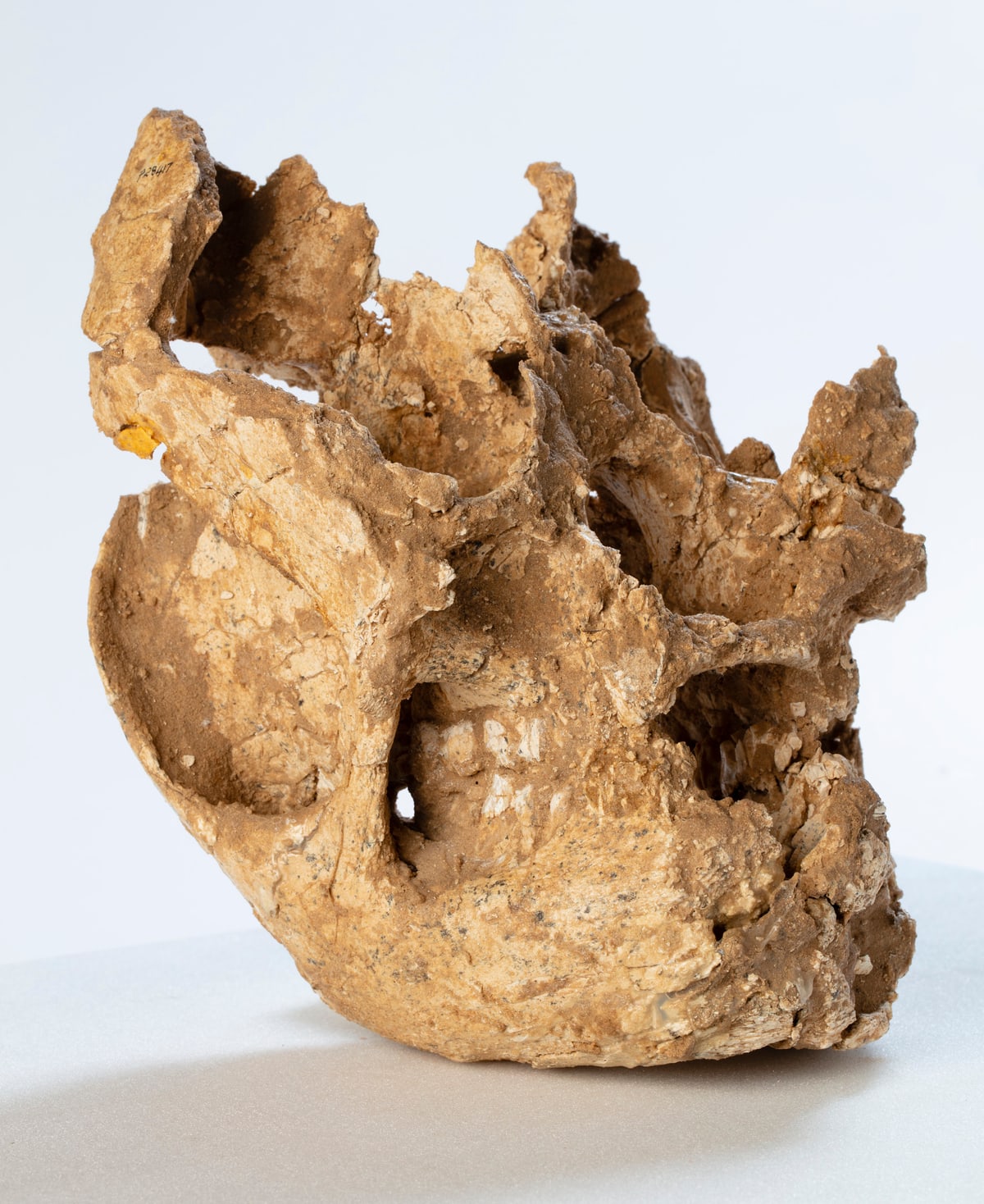
The face is the first surprise. Procoptodon goliah had a short, deep skull, a massive lower jaw and eyes directed partly forward. Below that compact head, long forelimbs ended in elongated, curved claws suited to drawing vegetation within reach. This Pleistocene Australian kangaroo carried a set of proportions that makes enlarging a modern red kangaroo a poor guide to its appearance.[2]
Its weight was extraordinary: a 2014 study used an estimate of about 240 kilograms, almost three times the mass of the largest living kangaroos. It belonged to the extinct sthenurines, a diverse group often called short-faced kangaroos.[5] Yet size alone explains little about how the animal spent a day. The more revealing questions begin at the mouth and continue down to the ground: what could it eat, and how did it move between meals?
A mouth for difficult leaves
The teeth divide the work unevenly. Small incisors occupy the front; farther back, complex molars carry extra folds of enamel. The heavily constructed jaws and long, mobile arms fit an animal gathering and processing tough vegetation. Each hind foot, meanwhile, was reduced to one functional toe. Even standing still, this was a distinctive kangaroo.[2]
Identifying a particular food takes more than recognizing a powerful jaw. In 2009, Gavin Prideaux and colleagues combined skull anatomy, microscopic tooth wear and stable isotopes in enamel to investigate the diet. The carbon signal indicated substantial consumption of plants using C4 photosynthesis. Many grasses use that pathway, but so do Australian saltbushes of the genus Atriplex. The team interpreted the combined evidence as a diet of tough chenopod leaves and stems, with saltbush a likely preference.[3]
The teeth help interpret the chemistry: a carbon signature shared by several plants cannot, by itself, identify a meal.
There is also a limit to the neatness of that menu. Samuel Arman’s doctoral thesis, in its revised December 2018 version, examined dental microwear textures from Victoria Fossil Cave at Naracoorte. Its P. goliah sample produced conflicting dietary signals across the measured variables; Arman suggested the small sample could be responsible.[4] The disagreement is useful: a profile should preserve uncertainty inside its reconstruction of a living animal.
The weight of one step
Feeding brings locomotion into focus. An animal gathering vegetation must reposition itself, often slowly. Its ordinary movements deserve as much attention as an imagined escape across open country.
Christine Janis, Karalyn Buttrill and Borja Figueirido argued in 2014 that sthenurines could have walked upright on alternating hind legs. Their case drew on the pelvis, enlarged hips and knees, and stabilized ankles: structures consistent with supporting the body on one leg at a time. A comparatively rigid lower back and specialized forelimbs also complicated the familiar slow kangaroo gait in which the tail acts as an additional support. Whether the largest forms abandoned hopping entirely remained unresolved.[5]
That is a reconstruction from anatomy. It does not give us a witnessed stride from P. goliah, but it explains why the fossil body deserves its own movement hypothesis.
A 2024 study by Peter Murphy and colleagues tested ankle bones with computer models of loading during different gaits. The sthenurines performed better in the simulated bipedal strides than in hopping. Crucially, the sampled Procoptodon was the smaller species P. browneorum, not P. goliah. The authors also acknowledged that their results could not eliminate hopping.[6] The study strengthens the comparative case for striding while leaving a gap between a relative’s modeled ankle and this giant’s entire repertoire.
A hop remains possible
In January 2026, Megan Jones, Katrina Jones and Robert Nudds approached the question through two potential mechanical limits: the strength of the elongated foot bones and the space available for ankle tendons. Their fossil dataset included P. goliah. They found that the giant kangaroos studied had foot bones capable of resisting modeled hopping loads and heel bones broad enough to accommodate sufficiently strong tendons.[7]
This reopens a possibility. The researchers suggested that hopping could have served for short bursts even where it was not the principal gait. Tendons themselves were inferred, and mechanical feasibility does not establish speed, endurance or how frequently an animal chose to hop.[7]
A reconstruction can therefore allow both an upright step and an occasional bound without pretending that either has been filmed. The relevant distinction is between movements an animal could withstand and movements it usually performed.
Return to the skull, and the giant becomes easier to imagine for reasons that have little to do with spectacle. The compact face, complicated molars and grasping arms put feeding at the center of its portrait. The limbs leave its journey between shrubs partly open. Procoptodon goliah emerges as a substantial browser with a distinctive body, whose teeth tell a clearer story than its missing footsteps.
Sources
- Rodney Start, Museums Victoria, “Procoptodon g skull 2.jpg” — photograph of specimen P 28417 and locality information, via Wikimedia Commons, CC BY-SA 4.0.
- Anne Musser, “Procoptodon goliah,” Australian Museum — skull, teeth, forelimbs, hind feet and Pleistocene context.
- Gavin J. Prideaux and colleagues, “Extinction implications of a chenopod browse diet for a giant Pleistocene kangaroo,” PNAS 106 (2009), 11646–11650 — Australian National University repository record.
- Samuel D. Arman, Diets of the Macropodidae inferred through Dental Microwear Texture Analysis, Flinders University doctoral thesis, revised December 2018 version — chapter 5, especially printed pages 172 and 180, on the inconclusive P. goliah sample.
- Christine M. Janis, Karalyn Buttrill and Borja Figueirido, “Locomotion in Extinct Giant Kangaroos: Were Sthenurines Hop-Less Monsters?” PLOS ONE 9 (2014), e109888 — body mass and the anatomical argument for bipedal striding.
- Peter J. Murphy and colleagues, “Finite element analysis of kangaroo astragali: A new angle on the ankle,” Journal of Morphology 285 (2024), e21707 — comparative gait simulations and their limits.
- Megan E. Jones, Katrina Jones and Robert L. Nudds, “Biomechanical limits of hopping in the hindlimbs of giant extinct kangaroos,” Scientific Reports 16 (2026), 1309 — foot strength, inferred tendon capacity and possible hopping.