The leaves had lost their shape. Inside a fossil bird from northeastern China, researchers found microscopic silica structures that plants had made within their tissues. Those durable particles carried evidence of a meal long after the greenery itself had disappeared. Their eater, Jeholornis, lived roughly 120 million years ago and combined teeth and a long bony tail with a capacity to feed among trees.[1]
The skeleton gives the animal an outline. The stomach residue gives it something to do. Reading the two together brings an early bird into focus as a consumer of particular plant parts, with feeding habits that cannot be settled by the presence of teeth.
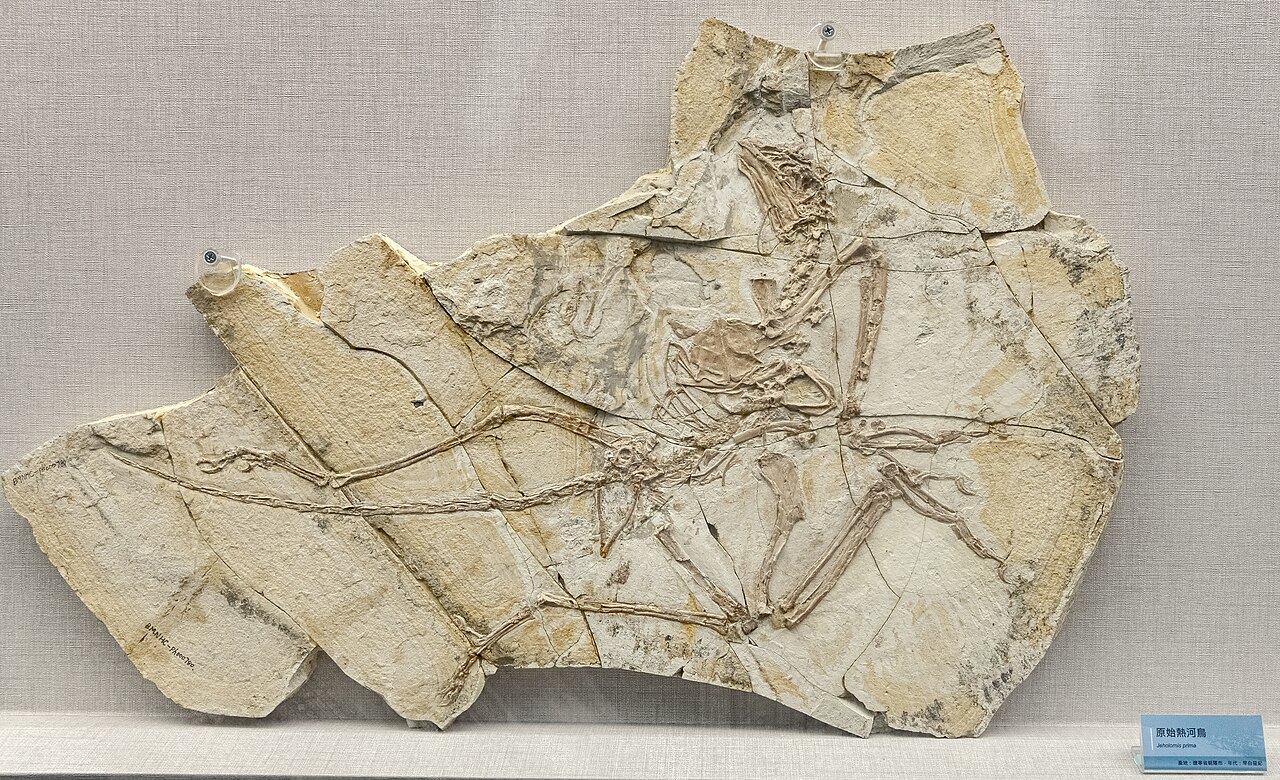
A bird with more than one anatomical story
When Zhonghe Zhou and Fucheng Zhang described Jeholornis prima in 2002, its tail was a conspicuous surprise. The animal came from the Jiufotang Formation of western Liaoning. Its elongated tail bones and associated structures recalled those of dromaeosaurid dinosaurs, adding another anatomical connection between birds and their dinosaur relatives. Yet features of the shoulder region and wrist indicated substantial flight capability.[2]
That combination matters when imagining the animal alive. A long skeletal tail did not make every other part of its body equally ancestral. Flight equipment, feeding structures and tail anatomy could change at different rates. Even the original paper’s title, which presented a seed-eating bird, left a question for later researchers: what exactly did a swallowed seed represent?[2][5]
Inside the rib cage
Yan Wu and colleagues approached a different individual, IVPP V14978, through its digestive residue. Their 2023 study examined a nearly complete, subadult Jeholornis from near Chaoyang. Material within the rib cage yielded 418 phytoliths: microscopic bodies of plant silica. Two samples from the surrounding rock yielded none. That contrast supports an origin inside the bird’s digestive tract rather than contamination from the sediment enclosing it.[4]
The researchers compared the particles with modern plant material. Most had blocky forms with wavy ridges; their closest matches came from magnoliid leaves. Magnoliids are a broad flowering-plant group, so the result does not identify a particular ancient tree species. Some particles remained unassigned. The proposed meal is therefore leaves, probably from magnoliids, with uncertainty preserved inside that identification.[4]
The neighboring rock is an essential part of the argument. Finding plant particles somewhere on a fossil slab would establish much less. Their position within the body, combined with the negative surrounding samples, connects them to this bird. Still, one stomach records a feeding episode; it cannot establish how often the animal chose leaves.[4]
A seed can travel with a different meal
Other Jeholornis fossils preserve intact seeds. In 2022, Han Hu and colleagues compared fossil skull anatomy and gut contents with those of living birds. Jaw shape argued against cracking seeds in the mouth, but could not by itself distinguish swallowing fruit from grinding seeds internally. The condition of the swallowed material supplied the next clue: the fossil seeds were whole and unabraded, supporting consumption of fleshy plant structures with seeds inside.[5]
Here, “fruit” includes fleshy structures produced by some non-flowering plants, as well as true fruits. The evidence therefore should not automatically become a scene of modern-looking berries. Nor does swallowing intact seeds prove that viable seeds later emerged and germinated elsewhere. Seed dispersal is a plausible ecological consequence, still beyond what these stomach contents directly show.[5]
The leaf evidence broadens that menu. It also illustrates why a dietary label should remain open to revision: the same genus can preserve different meals in different individuals. Those differences need explanation before they become a fixed feeding schedule.
What the jaw can add
The leaf study also compared lower-jaw shape with living birds. Jeholornis resembled several plant eaters, including the hoatzin, a living bird specialized for leaves. This anatomical comparison supports the interpretation of the stomach contents.[1] It does not supply a fossil hoatzin’s complete digestive system, or turn a resemblance into proof of identical behavior.
The researchers place these findings within the early development of relationships between birds and flowering plants: tree canopies offered leaves as well as reproductive structures to eat.[1] The significance lies in recovering one such interaction closely enough to examine it. A skeleton establishes that an animal existed; material enclosed by its ribs can reveal contact with another organism. Here, the forest enters the bird’s story through particles small enough to disappear from an ordinary museum view.
Sources
- Chinese Academy of Sciences, “Fossil Unveils Leaf Eating Among Earliest Birds,” August 1, 2023 — institutional account of the phytolith study, jaw comparison and ecological interpretation.
- Zhonghe Zhou and Fucheng Zhang, “A long-tailed, seed-eating bird from the Early Cretaceous of China,” Nature 418 (2002), 405–409 — original description, geological setting and flight-related anatomy.
- Y.-C. Tsai (Tiouraren), “Jeholornis prima NMNS.jpg,” Wikimedia Commons — photograph of BMNHC Ph780, collection and exhibition details, CC BY-SA 4.0.
- Yan Wu and colleagues, “Intra-gastric phytoliths provide evidence for folivory in basal avialans of the Early Cretaceous Jehol Biota,” Nature Communications 14 (2023), 4558 — IVPP V14978, phytolith identification and surrounding-sediment controls.
- Han Hu and colleagues, “Earliest evidence for fruit consumption and potential seed dispersal by birds,” eLife 11 (2022), e74751 — skull comparisons, intact seeds and limits of dietary inference.