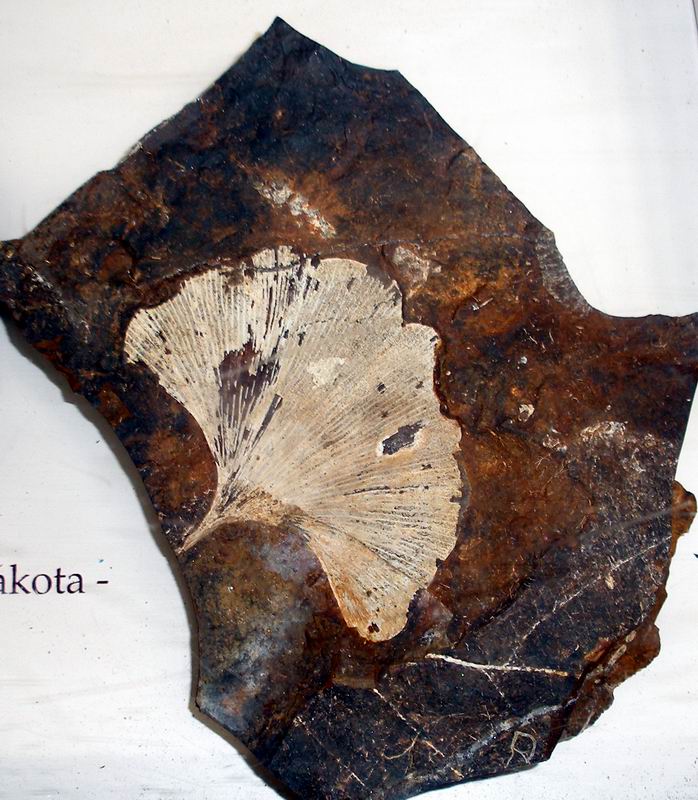
The leaf opens across the stone like a small fan. Its veins spread from a narrow base, and its outline is familiar enough to invite a comparison with a ginkgo growing along a city street. The photographed fossil comes from Almont, North Dakota, and is identified as Ginkgo cranei, a Late Paleocene species.[1]
That resemblance is a good beginning. To follow the tree's evolutionary history, however, look beyond the leaf. Fossils of the structures that held its seeds reveal a changing arrangement of stalks and attachments. They also show why the phrase “living fossil” needs an anatomical question beside it: which part of the plant has stayed similar, and since when?
Two kinds of stalk
On a living female Ginkgo biloba, a slender reproductive shoot usually ends in a pair of ovules, the structures that can develop into seeds. Each sits at the tip without a separate little stalk of its own. The main supporting stalk remains; the individual ovule stalk is absent. Botanists distinguish those two levels as the peduncle and pedicel.[2][6]
This distinction is easy to miss in a description saying that ginkgo has “stalked seeds.” It becomes decisive when comparing fossils. Losing the short attachment beneath each ovule changes the architecture even if the whole structure still hangs from a longer stalk.
Living ginkgo supplies a reference point, but it is the sole surviving species of a much more diverse lineage. Peter Crane's account of Jurassic plants from the Yima mine in Henan, China, describes several ways of packaging seeds behind recognizably ginkgo-like foliage. Yimaia carried clusters; Karkenia carried cone-like aggregations. Their shared family resemblance therefore conceals substantial reproductive variety.[2]
The Jurassic tree with individual attachments
Among those Yima fossils, about 170 million years old, Ginkgo yimaensis offers a particularly useful comparison. It had deeply divided leaves and seeds carried on individual stalks. The leaves resembled the more divided foliage that living ginkgo can produce on seedlings and sucker shoots, rather than requiring an entirely unfamiliar leaf design.[2]
The reproductive structures make the difference more explicit. Zhiyan Zhou's account for the International Organisation of Palaeobotany illustrates a G. yimaensis organ carrying three mature ovules. Across much of ginkgoalean evolution, he describes a tendency toward fewer, larger ovules and shorter individual stalks, eventually disappearing in some forms.[3]
“Reduction” here names a change in parts and their arrangement. It does not establish that every reduction made a plant more successful, or that all ginkgo relatives were moving toward today's tree. Zhou explicitly identifies an exception to the general ovule-number trend in the family containing Karkenia.[3]
Leaves alone would make this history harder to resolve. Their degree of division can vary within a species, while similar-looking leaves can belong to different plants. Reproductive anatomy adds distinctions that the fan-shaped outline cannot supply.[3]
A transition with overlapping forms
In 2003, Zhou and Shaolin Zheng reported an Early Cretaceous ginkgo from China's Yixian Formation. Its ovulate organs were substantially closer to the living arrangement than the older Jurassic type. The discovery narrowed a large gap in the record of reproductive structures and demonstrated that much of the modern architecture was already present during the age of dinosaurs.[4]
The species, Ginkgo apodes, lacked separate ovule stalks at maturity, although it bore more ovules than the usual living arrangement. This combination matters: the disappearance of the individual stalk and the reduction in ovule number need not be treated as one indivisible evolutionary event.[5]
A later discovery makes the sequence less tidy and more informative. In 2020, Sheng-Hui Deng, Xiao-Ju Yang and Zhou described Ginkgo pediculata from the Lower Cretaceous of Liaoning. Its mature seeds retained individual stalks. Older-looking and more modern-looking reproductive arrangements thus occur within the Early Cretaceous record of northeastern China.[5]
These plants come from different formations. Their broad overlap in geological time does not demonstrate that they occupied the same forest. It does show why arranging selected fossils by age cannot, by itself, establish a chain of direct ancestors. A form can persist while another branch acquires a different arrangement. The 2020 study interprets the record as a transition in which older and intermediate anatomies overlapped.[5]
What the Paleocene fossils add
Return to North Dakota, roughly 60 million years ago. The Ginkgo cranei material described by Zhou, Cheng Quan and Yu-Sheng Liu in 2012 comes from the Sentinel Butte Formation. Its reproductive organs have two collars directly attached to the main stalk, without individual pedicels. One carries a mature seed; the other bears a smaller, aborted ovule.[6]
The collar is a useful detail. An isolated seed would tell us much less about its former attachment. Preserving the supporting structure lets researchers compare the organization of the organ with living ginkgo, rather than merely compare seed outlines.
The authors also explain how they linked these reproductive fossils to the leaves. The organs were not found physically attached to foliage. Their attribution rests on close association, the absence of other ginkgoalean plants in the assemblage, and similarities in the preserved cuticle, including stomatal features.[6] That is a reasoned reconstruction assembled from separate remains.
The leaf in the photograph is therefore an invitation to investigate the rest of the plant. Following the ovule attachments reveals both change and persistence: individual stalks retained in some fossils, absent in others, and a modern arrangement established long before the present. Ginkgo's familiar outline survives that investigation. Its history becomes richer once the small structures behind the outline receive equal attention.
Sources
- Anders Sandberg, “Ginkgo cranei leaf fossil” (photograph, 2007), Wikimedia Commons — Almont, North Dakota, Late Paleocene; image provenance.
- Peter R. Crane, “An evolutionary and cultural biography of ginkgo.” Plants, People, Planet 1 (2019), 32–37; published online 2018 — living reproduction and Jurassic diversity.
- Zhiyan Zhou, “Gingko biloba – its ancestors and allies.” International Organisation of Palaeobotany — fossil reproductive organs, leaf-identification limits and evolutionary reduction.
- Zhiyan Zhou and Shaolin Zheng, “The missing link in Ginkgo evolution.” Nature 423 (2003), 821–822 — Early Cretaceous evidence for a substantially modern ovulate organ.
- Sheng-Hui Deng, Xiao-Ju Yang and Zhi-Yan Zhou, “A new Ginkgo from the Lower Cretaceous of Liaoning, Northeast China and its evolutionary implications.” Review of Palaeobotany and Palynology 283 (2020), 104315 — institutional full-text PDF describing G. pediculata and overlapping reproductive forms.
- Zhiyan Zhou, Cheng Quan and Yu-Sheng Liu, “Tertiary Ginkgo Ovulate Organs with Associated Leaves from North Dakota, U.S.A., and Their Evolutionary Significance.” International Journal of Plant Sciences 173 (2012), 67–80 — author-hosted full-text PDF; G. cranei attachments and evidence connecting separate organs.