Modern penguins are so visually tied to sea ice, black-and-white plumage, and dense krill-feeding colonies that the lineage can feel Antarctic from the beginning. The fossil record tells the story in another order. Penguins first appear as Paleocene wing-propelled divers in New Zealand, not as ready-made polar mascots.[1][2] Giant body size followed early in comparatively warm seas.[3] The shorter-billed, crown-group feeding world that now feels typical took shape later, and some of its best-supported ecological shifts are recent on deep-time scales.[4][5]
That reversal is the point of reading penguin evolution as lineage context rather than as a parade of famous species. The question is not when penguins became recognizable in the broadest sense. The question is which parts of the modern penguin package arrived first, which arrived late, and which belonged to stem experiments that no living penguin now carries.[1][2][4][5]
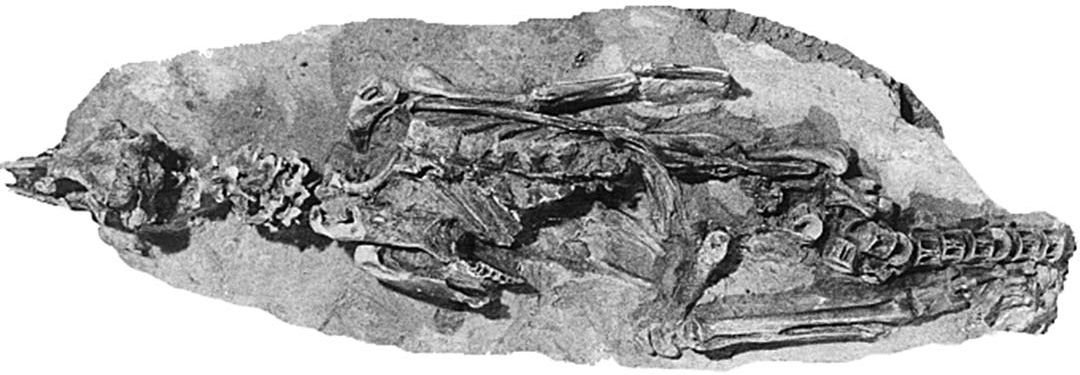
Image context: the cover uses a real photograph of the articulated Madrynornis mirandus skeleton before preparation.[7] It belongs here because the article ends with a later, more modern-looking penguin stage. The slab does not show the beginning of penguin history. It shows one of the points where the lineage has already moved much closer to living forms, which makes the earlier Paleocene record look even more structurally surprising.[6][7]
1) Penguins solved water before they solved ice
The oldest clear penguin-grade fossils already belong to birds committed to wing-propelled diving. The 2006 Molecular Biology and Evolution paper that described Waimanu treated the material as the oldest fossil penguins and emphasized a body that had already crossed a major functional threshold.[1] The wing was short relative to body size, the bones were flattened and broad in the way expected for wing-propelled diving, the humerus implied restricted elbow rotation, and the pelvis and legs already supported the upright stance associated with penguins.[1] This was not a volant seabird hovering at the edge of the clade. It was a stem penguin whose skeleton had already accepted life in the water.
That matters because it breaks a common visual shortcut. If modern penguins are read backward from Antarctica, it is easy to assume that cold adaptation and the classic flipper came bundled together. The older fossils show another sequence. First came a bird that had already given up ordinary flight and committed the forelimb to underwater propulsion.[1][2] The later polar stereotype is therefore an afterlife of the lineage, not its starting point.
The age anchors sharpen that conclusion. Waimanu sits only a few million years after the end-Cretaceous extinction, with the older species placed at about 61 Ma and the smaller species at roughly 58 Ma in the 2006 paper.[1] Penguins were therefore entering the Cenozoic early, and they were entering it as divers.
2) The first penguin flippers were still carrying traces of a bird wing
Early commitment to diving did not mean the flipper was already finished. The 2020 paper on the first complete wing of a Paleocene stem-group penguin from New Zealand is valuable because it narrows the early mechanics.[2] The fossil preserves a complete wing in a small stem penguin and documents an early stage in flipper evolution rather than a modern endpoint. The alular phalanx remained well developed, the distal phalanges were not yet flattened in the same way as those of living penguins, and the authors argued that the wing feathers probably remained differentiated into functional categories rather than being reduced to the short scale-like arrangement of modern species.[2]
That is a stronger evolutionary picture than the simpler statement that penguins became flightless. The wing had already been recruited for underwater work, but it had not yet been remodeled all the way into the stiff modern paddle.[1][2] Early penguin history is therefore best read as a stage of hydrodynamic commitment with incomplete anatomical closure. The lineage knew what the forelimb was for before it had finished turning that forelimb into the modern instrument.
This is also why the fossil record matters more than the living birds alone. A living penguin makes the flipper look inevitable. The Paleocene wing shows that inevitability is hindsight. The earliest known penguins still carried more visible traces of their avian inheritance inside an already aquatic system.[2]
3) Giant size arrived early, and it did not require an Antarctic setting
The second corrective is scale. Giant fossil penguins are often remembered as an eccentric side chapter, but the 2017 Nature Communications paper on Kumimanu biceae places giant size very near the front of the lineage.[3] The new species from the late Paleocene of New Zealand was described as larger than all other fossil penguins with substantial skeletal portions preserved, and its phylogenetic position implied that giant size arose multiple times in penguin evolution rather than once in a single neat radiation.[3]
That result changes the emotional map of penguin history. Giant penguins do not belong only to some later specialized southern experiment. They appear shortly after penguins became flightless divers at all.[3] In other words, the lineage was already exploring large marine body sizes before the crown group familiar from living penguins had fully sorted itself out.
The paper also makes a broader ecological suggestion worth keeping in view: the absence of very large penguins today likely relates to the Oligo-Miocene radiation of marine mammals.[3] That does not reduce giant penguins to victims of one single pressure. It does restore competition and marine ecosystem restructuring to the story. Penguins did not simply march toward the modern emperor scale as if history preferred moderation. The fossil record suggests a more extravagant early body-size field, later narrowed by changing ocean ecologies.[3][4]
4) Modern penguin feeding ecology is late, not primitive
This is where the living stereotype becomes most misleading. The 2022 total-evidence genomic study in Nature Communications combines genomes, fossils, morphology, and biogeography to stretch the penguin timeline beyond the recent crown radiation.[4] One of its clearest historical frames is temporal: crown penguins have only about a 15-20 Ma history, whereas there was an earlier interval of roughly 50 Ma during which only stem penguins existed.[4] That means much of penguin evolutionary experimentation sits outside the living radiation.
The same paper also states the ecological contrast directly: fossil evidence indicates that stem penguins focused primarily on larger prey such as fish and squid, while adaptations for capturing smaller planktonic prey arose as recently as the Pliocene.[4] That sentence alone should slow down any instinct to project modern krill-specialist ecology backward onto the whole clade. What now feels emblematic of penguins is historically late.
The 2020 Paleobiology study on bill disparity sharpens the feeding shift at the skull level.[5] Many stem penguins carried extremely elongated spear-like bills that exceeded two-thirds of skull length, while crown penguins tend toward shorter, more robust shapes tied to different feeding strategies.[5] The authors explicitly connect the stem-to-crown contrast to a major ecological transition. Long-beaked stem penguins and later crown forms were not simply body-size variants wearing the same head. They were reading prey differently.[5]
Seen together, these two studies do more than add detail. They make the lineage legible in stages: first diving commitment, then repeated size experimentation, then later crown ecological sorting.[4][5] Modern penguins are one surviving answer, not the original template.
5) Madrynornis helps show when the lineage starts to look more familiar again
This is where Madrynornis mirandus earns its place in the article. The 2007 Acta Palaeontologica Polonica paper described it from the early late Miocene of Patagonia and concluded that it was closely related to living taxa.[6] It also showed that Miocene penguins could carry a tarsometatarsal arrangement similar to living forms while retaining other proportions reminiscent of older extinct penguins.[6] That is exactly the kind of taxon a lineage essay needs. Madrynornis does not sit at the dramatic origin point. It sits where the lineage begins to look more recognizably modern again.
That later familiarity is why the cover image works.[7] The articulated skeleton does not advertise an outrageous giant or a primitive half-made diver. It shows a penguin body whose basic logic is easier for a modern reader to accept. Against that later frame, the Paleocene material becomes easier to understand historically. Penguins did not begin as polished versions of the birds now crossing Antarctic pack ice. They moved through a longer marine history in which the wing, bill, body size, and ecology were all still open to rearrangement.[1][2][3][4][5][6]
The best summary, then, is not that penguins evolved toward Antarctica as if the ice were their destiny. It is that penguins first became marine specialists, then explored large body size and distinctive stem ecologies, and only later yielded the shorter-billed crown radiation that makes the living family feel so coherent.[4][5][6] Ice came late. The water came first.
Sources
- Alan J. D. Tennyson, Craig M. Jones, Tatsuro Ando, and David Penny, "Early Penguin Fossils, Plus Mitochondrial Genomes, Calibrate Avian Evolution," Molecular Biology and Evolution 23, no. 6 (2006).
- Gerald Mayr, Vanesa L. De Pietri, Leigh Love, and colleagues, "First Complete Wing of a Stem Group Sphenisciform from the Paleocene of New Zealand Sheds Light on the Evolution of the Penguin Flipper," Diversity 12, no. 2 (2020).
- Gerald Mayr, R. Paul Scofield, Vanesa L. De Pietri, and colleagues, "A Paleocene penguin from New Zealand substantiates multiple origins of gigantism in fossil Sphenisciformes," Nature Communications 8, article 1927 (2017).
- Daniel T. Ksepka, Thomas J. Cole, John W. Thomas, and colleagues, "Genomic insights into the secondary aquatic transition of penguins," Nature Communications 13, article 3912 (2022).
- Julieta Acosta Hospitaleche and Daniel T. Ksepka, "Bill disparity and feeding strategies among fossil and modern penguins," Paleobiology 46, no. 2 (2020).
- Carolina Acosta Hospitaleche, Claudia Tambussi, Mariano Donato, and Mario Cozzuol, "A new Miocene penguin from Patagonia and its phylogenetic relationships," Acta Palaeontologica Polonica 52, no. 2 (2007).
- Wikimedia Commons, "File:Madrynornis.jpg" - file page for the fossil photograph used as the article image.