
The UA Museum of the North short "Thalattosaur: Racing the Tide," uploaded on October 17, 2013, is only four minutes and thirty-nine seconds long, but it does something many discovery videos do not. It keeps the fossil inside its field conditions.[1] The film is not built around a triumphant reveal after the science is finished. It is built around a narrow tidal window, a beach exposure that is underwater most of the year, and a skeleton that had to be cut out before the sea returned.[1][3] That makes it unusually useful for paleontology. Before Gunakadeit joseeae had a formal name, the video was already showing the harder part of the story: why this specimen existed as readable evidence at all.
The video's value increased on February 4, 2020, when Patrick Druckenmiller and colleagues formally described the fossil in Scientific Reports.[2] The Alaska skeleton stopped being merely a strange local marine reptile and became an articulated late-surviving thalattosauroid from the middle Norian Hound Island Volcanics.[2] The UAF news release, published the same day, made the public-facing point clearly: this was the most complete thalattosaur yet found in North America, and its anatomy forced a rethink of how the group was arranged on the family tree.[3]
That second layer matters because thalattosaurs are exactly the kind of Triassic reptiles that get flattened by familiarity. They are often introduced as one more early marine reptile experiment, somewhere between shoreline lizard and offshore specialist, then left there. The 2024 open-access review by Dylan Bastiaans makes the sharper reading possible. Gunakadeit was a relatively small early-diverging thalattosauroid, roughly 75 to 90 centimeters long, yet it appears among some of the youngest thalattosaur records worldwide.[4] In other words, the fossil is not valuable only because it is complete. It is valuable because it is temporally awkward. A body plan that looks comparatively early in the tree survives late enough to imply a long ghost lineage and a more irregular extinction history than a neat ladder of replacement would suggest.[2][4]
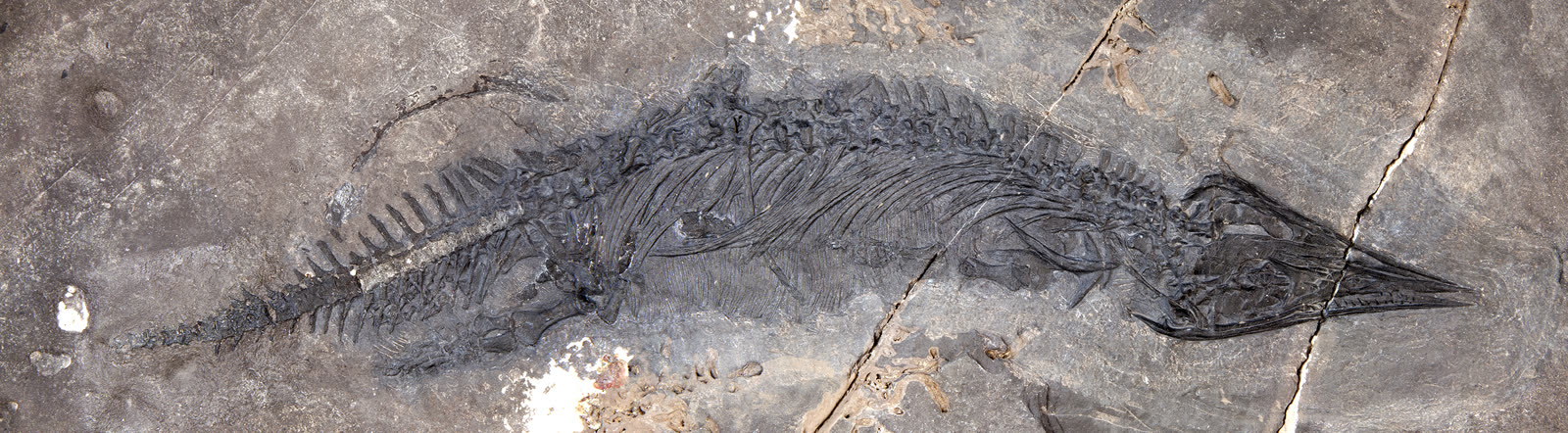
Image context: the cover uses the real fossil photograph from the University of Alaska news archive rather than paleoart or a coastline beauty shot. That choice matters here because the article's argument turns on specimen logic. The long narrow skull, the articulated trunk, and the already-eroded tail segment show why the film's tidal urgency and the later phylogenetic result belong in the same frame.[5]
Around 0:00-1:25, the film makes recovery conditions part of the evidence
The opening stretch is worth watching slowly because it prevents a common mistake. Fossils are often treated as if they simply waited in rock until a lucky person noticed them. The film shows a much narrower situation.[1] The specimen sat in the intertidal zone of Southeast Alaska, where exposure depended on extreme low tides and where recovery time was counted in hours rather than in leisurely field seasons.[1][3] The UAF news account adds the operational detail the short only sketches: geologist Jim Baichtal noticed the fossil on May 18, 2011; about a month later the team had only two days of unusually low tide to cut the skeleton free before the site submerged again.[3]
That context improves the paleontology because it changes what "good fortune" means. The Tlingit-derived name Gunakadeit carries the sense of a sea monster bringing good fortune to those who see it, and the fossil genuinely was lucky.[3] But the luck was not abstract. It was a meeting between coastal exposure, quick recognition, and rapid extraction. The video's title, "Racing the Tide," is not decorative language.[1] It is a literal statement about when the specimen was accessible.
This matters for interpretation because articulated marine reptiles are not evenly handed to us by the rock record. The discovery story explains why the fossil preserves a usable body plan at all.[1][3] Two thirds of the tail had already eroded away by the time it was found.[3][5] The right paleontological habit is therefore not to marvel that the fossil is incomplete. It is to notice how much information survived anyway.
Around 1:25-3:00, the pointed snout stops being a visual quirk and becomes an ecological clue
The middle of the film turns toward the skull, and this is where the later paper retroactively sharpens what the camera is showing.[1] In the video, museum staff can already tell they have something unusual because the snout is exceptionally long and pointed.[1] At the time of filming, that feature mainly reads as promise: perhaps a new species, perhaps a more specialized thalattosaur than anyone expected from Alaska.[1] By 2020, the description gave the feature a clearer job. The paper and the UAF release both frame the head as an adaptation for feeding in shallow marine settings, likely by probing into cracks and crevices for soft-bodied prey.[2][3]
The 2024 review extends that ecological picture in a useful way. Bastiaans notes that Gunakadeit had small, fairly uniform recurved teeth, that reported gut contents lacked shells, bones, and scales, and that its specialized hyoid apparatus may have supported suction feeding or enhanced chemosensing.[4] Those are not details the short can fully teach on its own. But they are exactly the sort of details that turn the film from a discovery clip into an annotated viewing. Once you know them, the skull in the video stops looking like a generic reptile head with an unusually narrow nose. It starts looking like a feeding system built for a particular shallow-water problem.
This is where the fossil becomes better than the usual early-marine-reptile stereotype. A lot of Triassic sea-reptile storytelling collapses into "returned to the water, became streamlined, ate fish." Gunakadeit resists that shortcut.[2][4] It appears to have been small, late, and specialized in a way that ties its survival to very particular coastal habitats. The UAF release even suggests that this specialization may have become a vulnerability once sea level and food conditions changed.[3] Whether or not one accepts every detail of that extinction scenario, the broad point is sound: the specimen belongs to an ecological niche, not a generic marine-reptile silhouette.
Around 3:00 to the end, the film's local adventure opens into a ghost-lineage problem
The short closes on the excitement of having found a possible new species, and that would already be enough for a museum audience.[1] The later phylogenetic result is what makes the film stronger in retrospect. Druckenmiller and colleagues did not place Gunakadeit at the flashy outer edge of thalattosaur evolution, where a late weird form might seem to belong. They recovered it as a relatively primitive thalattosauroid surviving far later than its position in the tree would lead you to expect.[2][3]
That is the real scientific payoff of this video. It lets you watch a fossil being removed from the rock before anyone knows that it will complicate extinction timing. The 2024 review makes the implication explicit: Gunakadeit's relationships to older North American and European forms require a ghost lineage stretching for more than twenty million years.[4] That is a strong corrective to tidy textbook storytelling. Clades do not always march from simple to specialized and then disappear in order. Sometimes an early-branching form persists quietly until a single specimen forces the timeline back open.
Seen that way, the film does two jobs at once. On one level it is a coastal recovery story about saws, tides, and a narrow field window.[1][3] On another, it is the prehistory of a phylogenetic surprise.[2][4] The specimen later named Gunakadeit joseeae does not simply add one more thalattosaur to a sparse list. It makes the list itself less orderly. A clade that already looked obscure now has to be read as longer-lived, more geographically connected, and more evolutionarily uneven than a casual summary would suggest.[2][4]
That is why this short still earns an embed in 2026. The film catches paleontology before the paper closes the case, and that timing is a strength rather than a weakness.[1] You can watch the fossil first as a field problem, then as an anatomical problem, and finally as an extinction-timeline problem. The tide is the hook, but the ghost lineage is the real ending.
Sources
- UA Museum of the North, "Thalattosaur: Racing the Tide," YouTube video, uploaded October 17, 2013.
- Patrick S. Druckenmiller, Neil P. Kelley, Eric T. Metz, and James Baichtal, "An articulated Late Triassic (Norian) thalattosauroid from Alaska and ecomorphology and extinction of Thalattosauria," Scientific Reports (2020).
- University of Alaska Fairbanks, "New thalattosaur species discovered in Southeast Alaska" (February 4, 2020).
- Dylan Bastiaans, "Thalattosauria in time and space: a review of thalattosaur spatiotemporal occurrences, presumed evolutionary relationships and current ecological hypotheses," Swiss Journal of Palaeontology (2024).
- University of Alaska Fairbanks archival fossil photograph used as the lead image for this article.