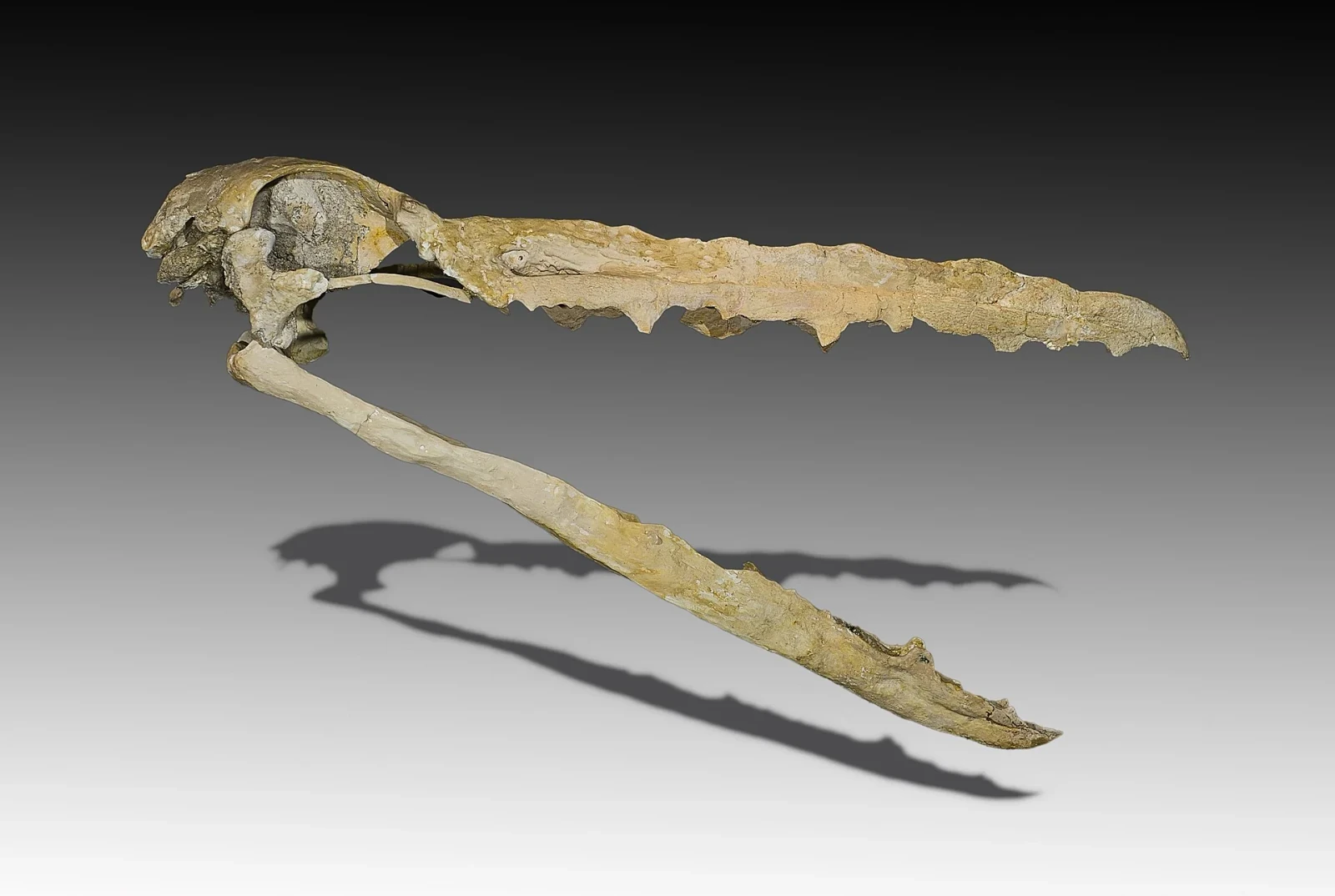
At first glance, the skull seems to reverse one of bird evolution's best-known changes. The beak is long and hooked, but its cutting edges are not smooth. Large spikes alternate with progressively smaller ones in a repeated series, producing a toothline that looks almost engineered for a mouth from an earlier age.
The resemblance is real. The teeth are not.
Pelagornithids—ocean-going birds known from the early Paleocene to about 2.5 million years ago—did not restore an ordinary row of enamel-and-dentine teeth. Their jawbones themselves grew outward into points. In life, those bony cores were probably enclosed by a hardened keratin beak. The result was a third construction: neither a plain avian bill nor the socketed dentition of a toothed Mesozoic bird.[1][2][8]
That construction is more than an anatomical novelty. The oldest known pelagornithid was also the smallest and less specialized for sustained soaring than its later relatives. It already had pseudoteeth. Giant wings therefore did not create the toothline; they enlarged a marine experiment that was already underway.[3] Read across the lineage, the known fossils preserve a minimum sequence: a new kind of gripping edge was present before immense bodies and highly specialized flight. An older discovery could extend that first appearance farther back.
Bone all the way to the point
The photographed skull belongs to Pelagornis mauretanicus, from the Ahl al Oughlam locality near Casablanca, Morocco. At roughly 2.5 million years old, this species sits at the latest known end of the pelagornithid record. Its 63-centimeter skull makes the repeated spacing easy to see: the tallest points stand apart, smaller points occupy the intervals, and still finer projections fill some of the remaining gaps.[1][9]
Microscopic anatomy supplies the decisive evidence. Researchers examined three jaw fragments of P. mauretanicus from Ahl al Oughlam that probably came from one individual. Thin sections and microtomography showed no enamel, dentine, cement or periodontal tissue. Nor was there a seam where a tooth had fused onto a jaw. Vascular canals and bone-remodeling units continued from the jaw into each projection, changing direction but not material. A pseudotooth was the jaw cortex growing outward.[1]
The larger points were not solid pegs. Internal resorption hollowed them as they developed; in one section, the cavity occupied as much as 60 percent of the point's area. Their walls were highly vascularized and mechanically less robust than a hard tooth crown. That anatomy, together with the lack of expected wear on bare bone, supports a protective covering by the rhamphotheca—the keratin sheath of the beak.[1]
That sheath is an inference. Keratin did not survive on the Moroccan skull. What survives is a bone surface that would have been unusually vulnerable if exposed. The safest reconstruction therefore adds a hardened covering without pretending to know its exact thickness, color or surface texture.
The same boundary applies to growth. Histology suggests that at least the smaller pseudoteeth formed relatively late, after much of the jaw had reached its circumference. The adult fossils do not provide a complete series from hatchling to mature bird, so the timing remains a model constrained by remodeling patterns, not a filmed developmental sequence.[1]
A borrowed instruction, not a returned tooth
If pseudoteeth were bone, why did they appear in regular, tooth-like ranks only along the cutting edges of the jaws? A 2018 developmental model proposed an answer more subtle than simple convergence.
True teeth arise through signaling between oral epithelium and underlying tooth-forming cells. Living birds no longer make mineralized teeth, but parts of the signaling machinery can persist. The model proposes that delayed hardening of the pelagornithid beak left the oral epithelium active long enough to send tooth-patterning signals. With no ordinary odontoblasts available to build dentine, osteoblasts at the jaw surface may have answered instead, producing serial bony points. Zones of inhibition around the first, largest points could then have spaced successively smaller ranks between them.[2]
This is a hypothesis about developmental deep homology, not evidence that a pseudotooth was a conventional tooth in disguise. The finished tissues remain categorically different: bone and keratin rather than dentine and enamel; outward continuity with the jaw rather than attachment in a socket; external accretion and internal resorption rather than tooth eruption and replacement.[1][2]
No fossil preserves the signaling molecules themselves. The model earns attention because it explains several facts at once—the restricted position, serial spacing, alternating sizes and late growth—but it remains testable reconstruction. Pelagornithids may have reused part of an old instruction set while manufacturing the structure from an entirely different tissue.
The points arrived before the wings became enormous
For much of their study, pelagornithids were known through large, scattered bones. That record made giant size seem almost inseparable from the family. Protodontopteryx ruthae changed the order of the story.
The animal comes from the Waipara Greensand of New Zealand and is about 61.5–62 million years old, within the early Paleocene. Its material is partial rather than a complete articulated body; the skull is the designated holotype, and associated limb bones are likely but not conclusively from the same individual. The skull preserves the characteristic jaw projections, while the referred postcranial bones retain a more compact construction. Its humerus is stouter than those of later pelagornithids, which the describing authors interpreted as less specialized for continuous soaring.[3]
Because Protodontopteryx is both the oldest known and the smallest known member of the family, it supplies a minimum sequence rather than a complete ancestor-descendant chain. Pseudoteeth were present before the lineage reached its most extreme wingspans. Their original selective setting cannot simply be read backward from a giant Pelagornis. Nor does one New Zealand fossil prove where the entire family originated; it makes a Southern Hemisphere origin plausible while leaving the unsampled record capable of changing that map.[3]
Gigantism followed quickly in geological terms. Isolated pelagornithid bones from Seymour Island show that giant forms had appeared around 50 million years ago and persisted in Antarctic seas for more than 10 million years. More moderately large pelagornithids, estimated at 3.5–4.5 meters across the wings, occupied part of the same Antarctic interval, so the record is not a tidy staircase from small to enormous. Estimates of 5–6-meter wingspans for the giants come from incomplete elements, including an enormous tarsometatarsus and a partial dentary, so the exact silhouettes are reconstructed. The size class is compelling; a named species and exact wingspan are not.[4]
This is lineage context doing useful work. A jaw innovation appears in a small early member. Giant size then evolves while the same basic feeding edge persists. The pseudoteeth were not a late ornament on a giant bird. They were part of the platform from which giants evolved.
Giant wings changed the problem
Later fossils show how far that platform could stretch. The late Miocene Pelagornis chilensis from the Bahía Inglesa Formation of Chile preserves most major limb bones in three dimensions. Its bony wing skeleton is the longest known in any bird; the original description estimated a wingspan of at least 5.2 meters and a body mass of roughly 16–29 kilograms.[5]
The late Oligocene Pelagornis sandersi from South Carolina is less complete but includes a skull and substantial postcranial material. Depending on how missing feather length is estimated, published wingspans range from about 6.1 to 7.4 meters; 6.4 meters is the commonly cited conservative value. Aerodynamic modeling found that its long, narrow wings could support efficient gliding, even as launch and sustained flapping became difficult at that scale.[6]
Those numbers do not turn flight behavior into direct evidence. Feathers are incompletely preserved, mass comes from skeletal proxies, and a model changes when its assumptions about wind, wing shape or muscle power change. The secure fossil claim is that later pelagornithids carried extremely elongated wings and reduced hind limbs. Models even disagree over the likely soaring regime: a 2022 analysis favored thermal and slope soaring for P. sandersi, more like a frigatebird using updrafts than an albatross exploiting wind shear near the sea surface.[10] The exact flight style remains a biomechanical interpretation, not a trackway in the sky.[5][6][10]
Feeding is less settled still. A hooked bill, mobile lower jaw and repeated points make gripping or trapping slippery prey plausible. They do not reveal where the bird met that prey. A 2026 analysis tested the long-standing image of Pelagornis flying with its lower bill in the water. Models of P. chilensis and P. sandersi found the drag of skim-feeding energetically unsustainable; even taking prey directly from the surface while remaining airborne was difficult to reconcile with available power.[7]
That result removes a behavior, not a diet. It does not show whether a bird seized prey during brief contacts, landed before feeding, stole food, or used some combination not captured by the model. The pseudoteeth constrain what the edge could do mechanically. They do not preserve a hunting sequence.
The lower jaw unsettles the family tree
Pelagornithids are usually discussed near Galloanserae, the great branch containing waterfowl and landfowl. Some analyses have placed them as the sister lineage of ducks and their relatives; others put them beside Galloanserae or at another early split among modern-type birds. Their mixture of similarities has never produced a completely stable address.[8]
Recent work on the lower jaw made that uncertainty wider, not narrower. A high-resolution study compared the pelagornithid Dasornis with the toothed stem bird Ichthyornis, probable early crown birds and living groups. It found that several jaw features previously used to support a waterfowl relationship may instead be older traits inherited near the base of the bird crown. Pelagornithids also lack some strong derived features shared by living galloanserans.[8]
The authors did not install Dasornis on a new final branch. Existing character matrices did not capture enough of the newly described mandibular anatomy for a decisive quantitative test. They argued that a place outside the bird crown should not be dismissed, while leaving the question open.[8]
That distinction matters. Pelagornithidae is a coherent fossil lineage diagnosed by a remarkable suite of jaw and wing traits. Its relationship to living birds is the unstable part. Calling it a strange duck relative may be a useful shorthand for one hypothesis, but it is not a consensus label strong enough to carry the anatomy by itself.
The toothline is the stable fact
The pelagornithid story holds together best when three levels of confidence remain separate.
The first is preserved: the points are continuous jawbone, arranged in repeated ranks, and present in the earliest known small member as well as later giants.[1][3] The second is comparative inference: a keratin sheath protected them, tooth-patterning signals may have organized them, and giant wings enabled specialized marine flight.[1][2][5][6] The third remains actively disputed: exact feeding behavior, the origin point of the lineage and its nearest living relatives.[3][7][8]
None of those uncertainties makes the skull less extraordinary. It makes the evolutionary result more precise. Pelagornithids did not simply reverse tooth loss, and they did not wait to become giants before acquiring a serrated beak. They built a new edge from old developmental possibilities, carried it through roughly 60 million years of changing oceans, and scaled the bird around it until some members approached the outer limits of flight.
The toothline looks ancient. Its construction was something new.
Sources
- Antoine Louchart et al., “Structure and Growth Pattern of Pseudoteeth in Pelagornis mauretanicus,” PLOS ONE 8 (2013)—histology, jaw continuity, internal cavities, inferred keratin covering and growth timing.
- Antoine Louchart et al., “Bony pseudoteeth of extinct pelagic birds formed through a response of bone cells to tooth-specific epithelial signals under unique conditions,” Scientific Reports 8 (2018)—developmental deep-homology model and its evidentiary limits.
- Gerald Mayr et al., “Oldest, smallest and phylogenetically most basal pelagornithid, from the early Paleocene of New Zealand,” Papers in Palaeontology 7 (2021; first published 2019)—description of Protodontopteryx ruthae and the sequence from pseudoteeth to specialized soaring.
- Peter A. Kloess, Ashley W. Poust and Thomas A. Stidham, “Earliest fossils of giant-sized bony-toothed birds from the Eocene of Seymour Island, Antarctica,” Scientific Reports 10 (2020)—fragmentary Antarctic material, size estimates and stratigraphic duration.
- Gerald Mayr and David Rubilar-Rogers, “Osteology of a New Giant Bony-Toothed Bird from the Miocene of Chile,” Journal of Vertebrate Paleontology 30 (2010)—three-dimensional skeleton, measurements and taxonomy of Pelagornis chilensis.
- Daniel T. Ksepka, “Flight performance of the largest volant bird,” Proceedings of the National Academy of Sciences 111 (2014)—Pelagornis sandersi material, wingspan range and flight-model assumptions.
- Olivia Hellyer-Price, Chris Venditti and Stuart Humphries, “The largest extinct volant bird Pelagornis could not meet the energetic demands of skimming,” Royal Society Open Science 13 (2026)—biomechanical test of skim-feeding and surface-capture hypotheses.
- Abi H. Crane et al., “Mandibular morphology clarifies phylogenetic relationships near the origin of crown birds,” BMC Ecology and Evolution 26 (2026; published online 2025)—CT comparisons, weak support for a galloanseran assignment and unresolved crown placement.
- Wikimedia Commons, “Pelagornis mauretanicus skull”—photographic source, locality, dimensions and photographer credit for the article image.
- Yusuke Goto et al., “How did extinct giant birds and pterosaurs fly? A comprehensive modeling approach to evaluate soaring performance,” PNAS Nexus 1 (2022)—comparison of dynamic- and thermal-soaring performance, favoring updraft use for P. sandersi.