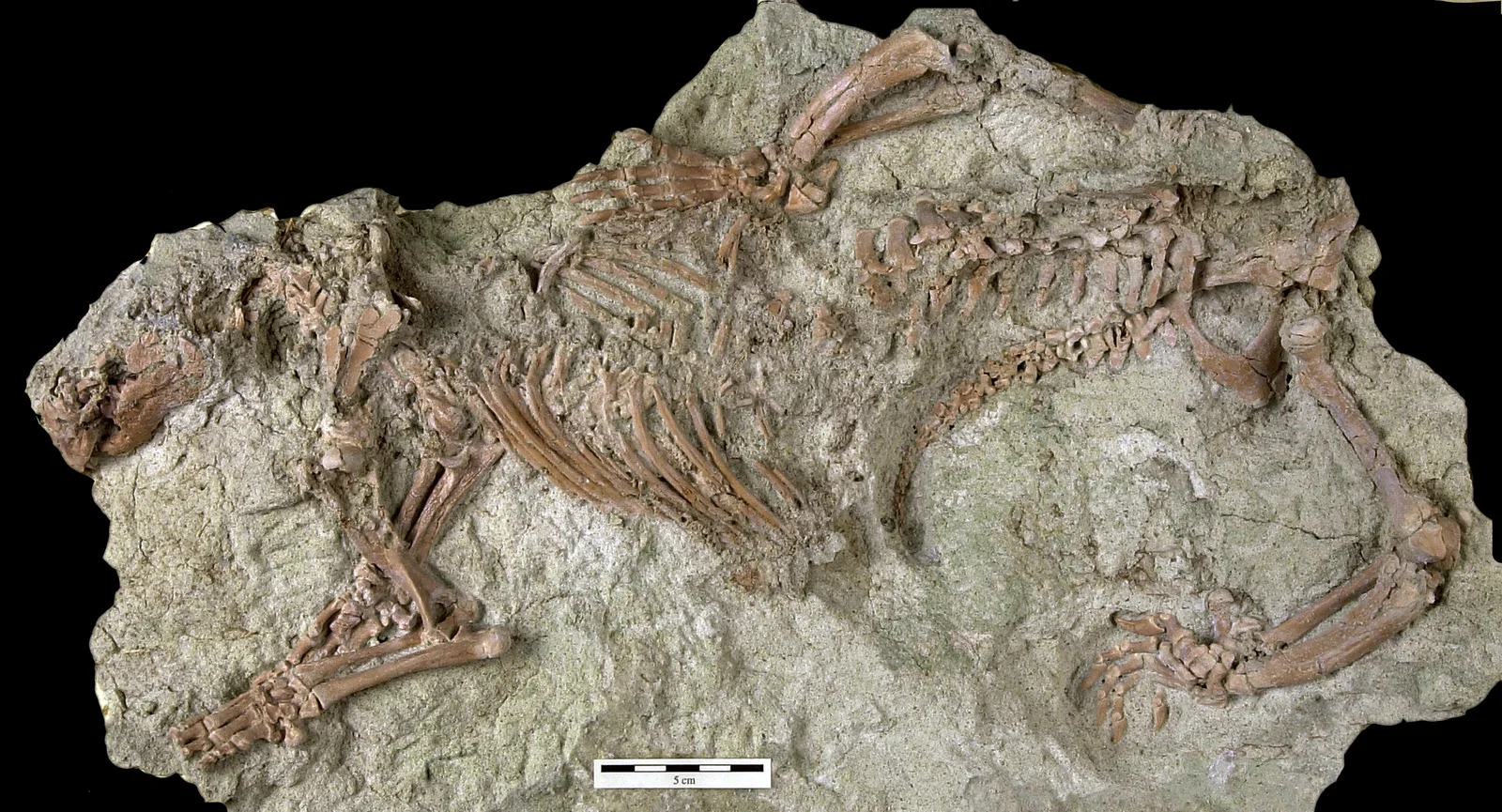
For most of its scientific life, Gondwanatheria was a mammal group assembled at the dentist's office. Isolated teeth and pieces of jaw, scattered across the former southern continents, established that the lineage existed. A single skull from Madagascar added a face. Almost everything behind the head remained blank.[1][2]
Then one sandstone slab supplied a body.
The holotype of Adalatherium hui, catalogued as UA 9030 at the University of Antananarivo, preserves a skull and virtually complete articulated skeleton from the latest Cretaceous of northwestern Madagascar. Hands, feet, ribs, vertebrae and even costal cartilage survived. The specimen did more than add missing bones to a known outline: it revealed that gondwanatherians had evolved a body plan no tooth could have predicted.[1][2]
That surprise is often compressed into the animal's name—adala, Malagasy for “crazy,” joined to the Greek-derived therium, “beast.” The nickname is memorable but scientifically cheap. Nothing about Adalatherium broke evolution's rules. Its anatomy is a coherent result of ancestry, convergence and long isolation. What it breaks is the expectation that an extinct mammal must sort neatly into combinations already familiar from living ones.
The best species profile therefore begins with the strength and the limit of the evidence at the same time. UA 9030 is exceptionally complete, but it is the only known individual of its species. It can establish which bones belonged together. It cannot show how much bodies varied across sex, age, population or time.
One slab changed the scale of the evidence
UA 9030 came from locality MAD99-15 in the Berivotra study area, within the Anembalemba Member of the Maevarano Formation. Those rocks are Maastrichtian in age, within an interval dated broadly to 72.1–66 million years ago. Adalatherium lived on an alluvial floodplain under a strongly seasonal, semiarid climate, close to the end of the Cretaceous.[1][2]
The fossil's route into science was almost an accident. A field team collected the block in 1999 for a reptile exposed on one side; preparation later revealed the mammal underneath. That hidden surface held an animal in extraordinary articulation. Tiny wrist and ankle elements, sesamoid bones embedded around tendons, distal tail vertebrae and mineralized costal cartilages remained associated with the main skeleton.[2][7]
This completeness is evidence about burial as well as anatomy. Sedimentological work interprets the relevant sandstone facies as debris-flow deposits triggered by intense rain. Rapid entombment fits the articulated skeleton, but the slab is not a photograph of ordinary stance or the cause of death. Bones shifted, some regions were damaged after death, and preparation exposed a compressed arrangement. The fossil records a burial event that protected anatomical relationships, not a living animal paused in motion.[2]
Size adds a second correction to the standard Mesozoic-mammal picture. Multiple skeletal proxies produced an average mass estimate of about 3.1 kilograms. That is modest beside a dinosaur and substantial among mammals then known from Gondwana. More strikingly, the individual was not fully mature. Its size makes Adalatherium one of the larger southern Mesozoic mammaliaforms represented by more than teeth and jaws, but a sample of one cannot supply an adult maximum or a species-wide average.[1][2]
The face concentrates nerves—and one unanswered space
The skull looks blunt in the slab, yet its most informative peculiarities are small passages through bone. Adalatherium had five infraorbital foramina and numerous additional openings across the nasal region. Such foramina carried nerves and blood vessels, demonstrating a rich neurovascular supply. Detailed comparison, however, found no evidence that the snout had more specialized touch sensitivity than those of living mammals, and whiskers or other external soft tissues were not preserved.[1][3]
It also retained a large septomaxilla in the front of the snout, a bone absent from therian mammals but present among living monotremes. That does not make Adalatherium an egg-layer or a monotreme relative. It is a retained anatomical feature within a very different lineage, useful precisely because resemblance and relationship are not the same thing.[3]
The most conspicuous cranial oddity is a large internasal vacuity: an opening along the top midline of the snout with no close mammalian equivalent. The surrounding bones prove that the space is real anatomy rather than preparation damage. Its function, however, remains unknown. Calling it a chamber for display, sound, smell or temperature control would convert an opening into an organ without evidence. Here the complete skull sharpens the question but does not answer it.[1][3]
Even the inner ear combines histories. The partially preserved cochlear region carries structures that resemble therian arrangements in some respects while differing in their construction. The authors interpreted part of that resemblance as convergence, not shared possession of a uniquely therian blueprint.[1][3] This is the pattern that repeats through the animal: an old component can persist beside a newly evolved one, and similar mechanical problems can generate similar features in distant mammal branches.
The teeth diagnose the animal without yielding an easy menu
Gondwanatherians were first recognized largely through teeth, but Adalatherium made those teeth stranger by preserving them in a whole skull. Its two upper incisors and single lower incisor were large and open-rooted, with enamel restricted mainly to the lip-facing side. Behind a rudimentary upper canine sat five upper postcanines. The first was small and simple; each of the four farther back carried at least five roots.[1][4]
The crowns refuse familiar shorthand. Each large upper postcanine had four major cusps connected by ridges around a central valley. The lower row contained four postcanines, also organized around four cusps, with the more posterior teeth supported by at least four roots. Their topographic features cannot be matched unambiguously to the standard premolar-and-molar pattern of other mammaliaforms.[4]
That uncertainty mattered enough for the phylogenetic study to test three different ways of coding the lower dental formula. The result is a useful distinction: the teeth are distinctive enough to diagnose Adalatherium, yet so remodeled that deciding which ancestral tooth each one represents becomes a separate evolutionary problem.[4][6]
Popular reconstructions often turn the open-rooted incisors and complex postcanines into a confident herbivore. Plant eating is plausible, but the fossil preserves no stomach contents, chewing sequence or observed food. Crown shape constrains how teeth could contact and process material; it does not name a menu by itself. A responsible reconstruction leaves room between “equipment consistent with plant processing” and a detailed portrait of what the animal ate.[4][7]
One front end and one back end used different postural solutions
Behind the skull, the vertebral column is unusually long through the trunk: at least 16 thoracic and 12 lumbar vertebrae. Long processes project from many of them, marking attachment areas for substantial back musculature. The tail, by contrast, was short, with 24 vertebrae that are mostly wider than they are long.[1][5]
The limbs are more revealing when read as joints rather than silhouettes. A ventrally facing shoulder socket and a well-developed, pulley-shaped joint surface at the distal humerus indicate that the forelimbs worked in a relatively parasagittal posture—held more beneath the body. Features of the femur and hip instead indicate a more sprawling hind-limb posture. The tibia was bowed from front to back and compressed side to side; the ankle included an unusual grooved articulation between the astragalus and navicular.[1][5]
That combination should not be animated as a mammal with a “normal” front half and a reptilian back half. Parasagittal and sprawling describe movement envelopes at joints, not two costumes sewn together. Nor does the burial pose demonstrate gait. The secure claim is anatomical: forequarter and hindquarter transmitted load through different joint geometries, in a combination unknown among living mammals.[5]
Large claws, robust limb elements and strong spinal attachments make digging a reasonable functional hypothesis. They do not tell us whether Adalatherium excavated a permanent burrow, tore into food, scratched shallow shelters or combined several tasks. The skeleton supplies leverage and range; behavior remains an inference that comparisons and future specimens must test.[1][5]
The family address is stable at one scale and mobile at another
The skeleton finally allowed Gondwanatheria to be scored across the body rather than mainly through jaws. In the dedicated analysis, researchers compared 530 morphological characters across 84 cynodont taxa. Every analytical treatment placed Adalatherium within Gondwanatheria, supporting its own family, Adalatheriidae. That is the stable part of the address.[6]
The next lines of the family tree moved. Depending on method and character treatment, Gondwanatheria appeared as the sister group of Multituberculata, nested within it, paired with other allotherians, or caught in an unresolved cluster. The broad result places the group within Allotheria, but the membership and internal branching of Allotheria remain sensitive to analysis.[6]
This is not a failure of a good skeleton to settle the problem. Completeness increases the number of comparisons; it does not guarantee that all comparisons carry a single historical signal. Convergence can make unrelated branches look alike, retained ancestral traits can outlast their expected neighbors, and fossils known only from teeth leave large blocks of missing data. Adalatherium turns a dental riddle into a whole-body dataset, then reveals why a larger dataset can expose conflict rather than erase it.
Madagascar is the setting, not a universal explanation
Madagascar separated from the Indian subcontinent roughly 88 million years ago. By the animal's 72.1–66-million-year age window, roughly 16–22 million years of oceanic isolation had elapsed. Its skeleton indicates a terrestrial animal, not a flier or an aquatic disperser, so the lineage most plausibly occupied Madagascar through much of that interval rather than arriving late across open water.[1]
The timing makes island evolution an attractive explanation for its unusual anatomy. It does not let “island effect” function as a label pasted onto every peculiar bone. Island faunas can shift body size and explore unusual ecological space, but those outcomes depend on resources, competitors, predators and starting ancestry. Without close mainland relatives preserved as whole skeletons, there is no control specimen showing what isolation changed.
The original study was explicit about the strongest tempting claim. Adalatherium and the larger Malagasy gondwanatherian Vintana are unusually big for known Mesozoic mammals from Gondwana, which is consistent with insular gigantism. The southern fossil record is too sparse, however, to establish that their size was caused by the island rule.[1] “Consistent with” is doing essential work: it marks a hypothesis that fits the evidence without pretending the fossil record has run the experiment.
That boundary improves the animal rather than diminishing it. The secure profile is already remarkable. In the latest Cretaceous, a roughly three-kilogram gondwanatherian crossed a seasonal Malagasy floodplain with a snout perforated by abundant neurovascular openings; open-rooted incisors and postcanines unlike those of any other known mammaliaform; a long, muscular trunk; a short tail; and fore- and hind limbs organized around different postural geometries. A rain-driven sediment flow then preserved nearly its entire skeleton.[1][2][3][4][5]
Before UA 9030, Gondwanatheria could be mistaken for a pattern of teeth. After it, the group had a body—but not a generic one waiting behind the jaws. Adalatherium shows why complete fossils are transformative: they do not merely fill white space in a reconstruction. Sometimes they reveal that the white space contained a different set of rules.
Sources
- David W. Krause et al., “Skeleton of a Cretaceous mammal from Madagascar reflects long-term insularity,” Nature 581 (2020)—original description, holotype overview, age, body mass, anatomy and island-evolution hypothesis.
- David W. Krause et al., “Introduction to Adalatherium hui (Gondwanatheria, Mammalia) from the Late Cretaceous of Madagascar,” Journal of Vertebrate Paleontology 40, supplement 1 (2020)—discovery, preparation, geological setting, taphonomy and size context.
- David W. Krause et al., “Craniofacial morphology of Adalatherium hui (Mammalia, Gondwanatheria) from the Late Cretaceous of Madagascar,” Journal of Vertebrate Paleontology 40, supplement 1 (2020)—detailed skull, snout, foramina and cranial comparisons.
- David W. Krause et al., “Dental morphology of Adalatherium hui (Mammalia, Gondwanatheria) from the Late Cretaceous of Madagascar,” Journal of Vertebrate Paleontology 40, supplement 1 (2020)—incisors, postcanine structure, roots, enamel and limits of dental homology.
- Simone Hoffmann, Yaoming Hu and David W. Krause, “Postcranial morphology of Adalatherium hui (Mammalia, Gondwanatheria) from the Late Cretaceous of Madagascar,” Journal of Vertebrate Paleontology 40, supplement 1 (2020)—vertebral column, girdles, limbs, joint orientation and functional boundaries.
- Simone Hoffmann et al., “Phylogenetic placement of Adalatherium hui (Mammalia, Gondwanatheria) from the Late Cretaceous of Madagascar: implications for allotherian relationships,” Journal of Vertebrate Paleontology 40, supplement 1 (2020)—character matrix, alternative analyses and stable versus unresolved placements.
- Ben Guarino, “My, what big teeth and strange bones you have,” The Washington Post (29 April 2020)—field history and source page for Marylou Stewart's photograph of the sandstone-preserved holotype used as the article image.