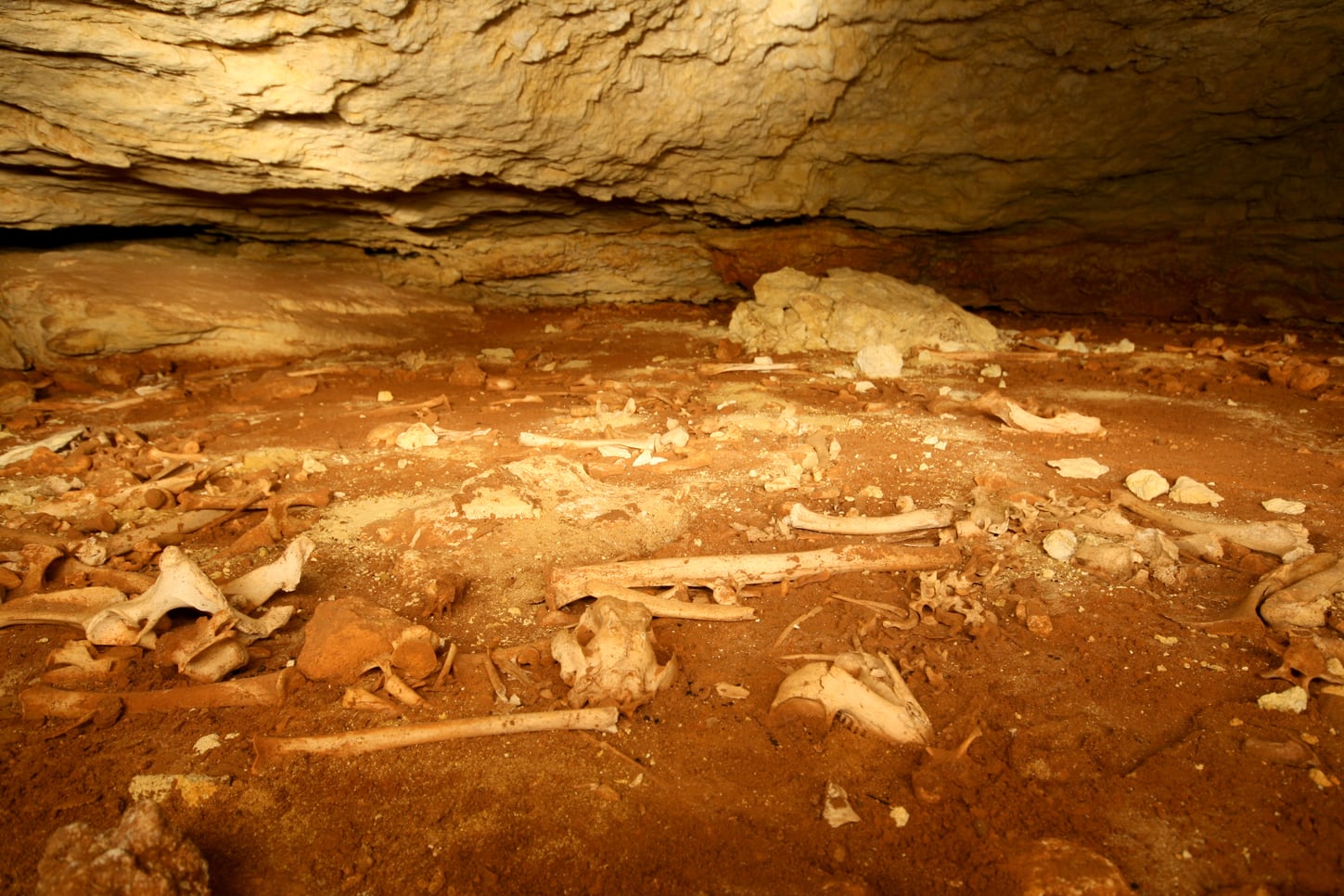
In Victoria Fossil Cave, the bones do not resolve into one catastrophe. They surface from reddish sediment under a low limestone ceiling: jaw fragments, limb bones, vertebrae, pieces separated from the bodies they once supported. Their abundance invites a quick story—a trap opened, animals fell, a vanished Australian community was sealed underground. The cave recorded something richer and less tidy.
Naracoorte is a complex of shallow caves in southeastern South Australia, not a single bone chamber. Its deposits range from the middle Pleistocene toward the present and preserve extinct megafauna beside smaller animals with living relatives.[1] Some remains arrived through narrow vertical shafts. Some entered through broad roof windows. Owls concentrated small bones in pellets. Sediment came in pulses, entrances clogged and reopened, and calcite grew during intervals when loose material was not accumulating.[4][5][6]
That variety is the site’s scientific advantage. It is also its main warning. A cave deposit is never an automatic census of the landscape above it. Before Naracoorte can say which animals lived together, how communities responded to climate, or what disappeared near the time humans reached the continent, each chamber must first be read as a collecting device with its own aperture, agent, and clock.
The World Heritage property links Naracoorte with the much older Riversleigh deposits in Queensland. Riversleigh carries the Australian mammal story through much of the Oligocene and Miocene; Naracoorte takes up a later Pleistocene interval marked by major climatic oscillations and the loss of megafauna.[1] The handoff is grand in scale. Underground at Naracoorte, however, the evidence arrives one entrance at a time.
A cave must open before it can collect a fossil
The distinction between making a cave and opening it to the surface sounds minor until the chronology is examined. Water can dissolve limestone and create a chamber while that chamber remains closed to falling animals, windblown pollen, charcoal, and surface sediment. A hollow underground is not yet a fossil trap.
Rieneke Weij and colleagues tested that boundary by dating Naracoorte speleothems—the flowstones, stalagmites, and related calcite bodies that grow inside caves—and measuring charcoal and pollen sealed within them. Uranium–thorium and uranium–lead dates showed speleothem formation beginning at least 1.34 million years ago. Charcoal and pollen, which require a route from the surface, indicated substantial opening later. The study concluded that initial cave development preceded entrance development by several hundred thousand years.[4]
This changes what an “old cave” means. The date of the limestone void cannot simply be transferred to the bones. Fossils could begin accumulating only after a solution pipe or roof collapse connected the chamber to the living surface. Even then, that connection was not permanent. Entrances blocked and reopened, alternating phases of sediment entry with calcite growth.[4][5]
The same study found increased charcoal and pollen signals after about 600,000 years ago, raising the prospect that undiscovered deposits older than 300,000 years may survive in chambers whose opening history has not yet been sampled.[4] That is a prediction, not a fossil discovery. It directs future searches by identifying when the underground architecture may have begun listening to the world above.
The hole decides which bodies arrive
Naracoorte’s most famous collecting mechanism is the pitfall. A narrow solution pipe can descend vertically from the surface into a chamber, admitting sediment and animals while offering no workable return. At the base, successive falls and sediment pulses can build a cone-shaped deposit. Larger roof windows create wider targets and may remain active differently through climatic cycles.[4][5]
In 1969, cave explorers entered the Main Fossil Chamber of Victoria Fossil Cave and encountered the deposit that established Naracoorte’s international reputation. The official site describes a chamber that had acted as a pitfall for more than 200,000 years and from which tens of thousands of bones have since been recovered.[3] Research has expanded well beyond that chamber: the park’s own account records 23 fossil deposits in 13 of its 28 caves.[2]
Those numbers should not be flattened into one pile. Entrance diameter, drop geometry, visibility, surrounding vegetation, animal size, and the length of time a shaft stayed open all affected what could enter. A large kangaroo and a small lizard did not face the same probability of falling, surviving the fall, being scavenged, or leaving identifiable bone. A trap near a travel route could overrepresent animals that crossed that patch of ground. A closed interval could create a gap even while the outside community persisted.
The cover photograph makes this problem tangible.[7] Bones occupy the sediment so densely that the surface resembles a community laid down at once. Yet proximity in the cave does not by itself prove simultaneity above ground. The assemblage first records the repeated operation of an entrance and a sediment pathway. Ecological reconstruction begins only after that machinery is understood.
Owls sampled the landscape from the other end of the size scale
Not every Naracoorte deposit was built by gravity alone. Wet and Blanche Caves preserve dense concentrations of small vertebrates accumulated largely through owl pellets.[6] Here the collecting device includes a predator. An owl hunted outside, selected prey that it could catch and swallow, returned to a roost, digested soft tissue, and deposited resistant bones in a compact package.
That pathway produces a different census from a pitfall. It can be exceptionally sensitive to small mammals that a broad fossil chamber might undersample. Teeth and jaws from many prey individuals can turn a roost into a record of local habitat and community change. But the abundance is filtered through hunting range, prey preference, body size, digestion, roost use, and the physical survival of each skeletal element.[6]
The bias is therefore useful rather than merely defective. A pitfall may capture medium and large animals moving across the surface; owl pellets repeatedly sample small nocturnal prey. Agreement between those records strengthens an environmental interpretation because the evidence passed through different filters. Disagreement can be equally informative if it reveals a size bias, a habitat boundary, or two deposits that are not actually the same age.
This is why “the Naracoorte fauna” must remain a comparison among deposits. The caves did not passively receive a scaled model of southeastern Australia. Each one edited the landscape differently.
A layer is a duration, not a date label
The second major correction is temporal. Cave sediment can accumulate quickly, pause, erode, or restart. Bones that lie close together may represent repeated events over centuries or millennia. A dated specimen constrains that specimen; it does not automatically timestamp every object in the layer.
Amy Macken, Richard Staff, and Elizabeth Reed addressed this problem in Wet and Blanche Caves by combining radiocarbon measurements with the observed order of sedimentary layers in Bayesian age-depth models. The method did not make sparse dates magically precise. It used stratigraphy to test which age relationships were plausible, estimate the beginning and end of depositional phases, and compare layers between the two caves while retaining uncertainty.[6]
That last step matters because visually different packages can overlap in time, while similar-looking sediments can belong to different episodes. The study found that groups of fine layers in Blanche Cave could be correlated with longer-duration units in Wet Cave. It also emphasized that some phases remained imprecise because only a few radiocarbon determinations were available across deposits spanning tens of thousands of years.[6]
Longer-range luminescence work added another scale. Lee Arnold and colleagues tested 22 sediment samples from six Naracoorte sites with multiple luminescence signals, extending a comparison of infill histories across roughly 550,000 years. Their results showed that solution pipes could reactivate through multiple discontinuous episodes rather than opening once and filling on a simple schedule. The distribution of dated infill also appeared non-uniform, with more solution-pipe development during relatively wet parts of interglacial or interstadial cycles.[5]
If wetter intervals opened or reactivated more traps, the fossil record may contain more evidence from those intervals even without a larger animal population. That is the crucial taphonomic boundary: abundance in the cave can reflect abundance of animals, efficiency of collection, duration of accumulation, or some combination of all three.
The extinction question needs the cave history attached
Naracoorte spans a period in which Australian mammal communities endured repeated climate changes, humans reached the continent, and many large-bodied species vanished.[1] This makes the caves indispensable to extinction research. It does not make every absence an extinction date or every faunal turnover a diagnosis of cause.
Suppose a megafaunal species occurs below a certain level but not above it. The biological interpretation is tempting: the animal disappeared from the region. Before accepting it, researchers must ask whether the upper layers were deposited continuously, whether the entrance still admitted an animal of that size, whether the sampled volume is adequate, and whether dates from sediment and bone agree. A reopened shaft can place long pauses between adjacent layers; a predator deposit can remain excellent for small mammals while saying little about large ones.[4][5][6]
Naracoorte’s power comes from replication. Multiple caves, different accumulation agents, and independent dating methods allow one record to expose another’s blind spot. The World Heritage listing also protects the unexcavated future of that comparison: UNESCO reports that less than one percent of the fossil resource has been affected by excavation and that many deposits remain undisturbed.[1]
Leaving most of the archive in place is not scientific hesitation. It preserves context for questions and techniques that do not yet exist. The 1969 breakthrough came from entering one chamber.[2][3] More recent work learned to date the cave’s opening from pollen and charcoal inside calcite, and to model intermittent sediment infill with several luminescence signals.[4][5] The next advance may depend on an untouched layer whose value is currently invisible.
The clearest field reading of Naracoorte therefore starts with the holes. A chamber collected only after the surface reached it. A pitfall, an owl roost, and a roof window sampled different bodies. Sediment turned repeated events into layers, and dating turned those layers into durations with uncertainty rather than neat labels. The caves preserve a lost world precisely because they preserve several incomplete versions of it. Their agreement is evidence; their differences are evidence too.
Sources
- IUCN World Heritage Outlook, “Australian Fossil Mammal Sites (Riversleigh / Naracoorte)”—World Heritage significance, Pleistocene scope, integrity, excavation limits, and the relationship between the two fossil regions.
- Naracoorte Caves, “Palaeontology”—official research history, the 1969 Main Fossil Chamber discovery, and the distribution of known deposits across the park’s caves.
- Naracoorte Caves, “Victoria Fossil Cave”—official account of the Main Fossil Chamber, its long pitfall history, continuing excavation, and recovered bone assemblage.
- Rieneke Weij et al., “Cave opening and fossil accumulation in Naracoorte, Australia, through charcoal and pollen in dated speleothems,” Communications Earth & Environment 3 (2022)—U–Th–Pb chronology, entrance proxies, cave-opening history, and the search boundary for older deposits.
- Lee J. Arnold et al., “Examining sediment infill dynamics at Naracoorte cave megafauna sites using multiple luminescence dating signals,” Quaternary Geochronology 70 (2022)—multi-site dating, repeated solution-pipe activation, and climate-linked infill bias.
- Amy C. Macken, Richard A. Staff, and Elizabeth H. Reed, “Bayesian age-depth modelling of Late Quaternary deposits from Wet and Blanche Caves, Naracoorte, South Australia,” Quaternary Geochronology 17 (2013)—owl-derived assemblages, radiocarbon-plus-stratigraphy models, inter-cave correlation, and chronological uncertainty.
- Steven Bourne, “Pitfall megafauna fossil assemblage in the Upper Ossuary, Victoria Fossil Cave, Naracoorte”—author-provided documentary photograph hosted by Phys.org and used as the cover image.