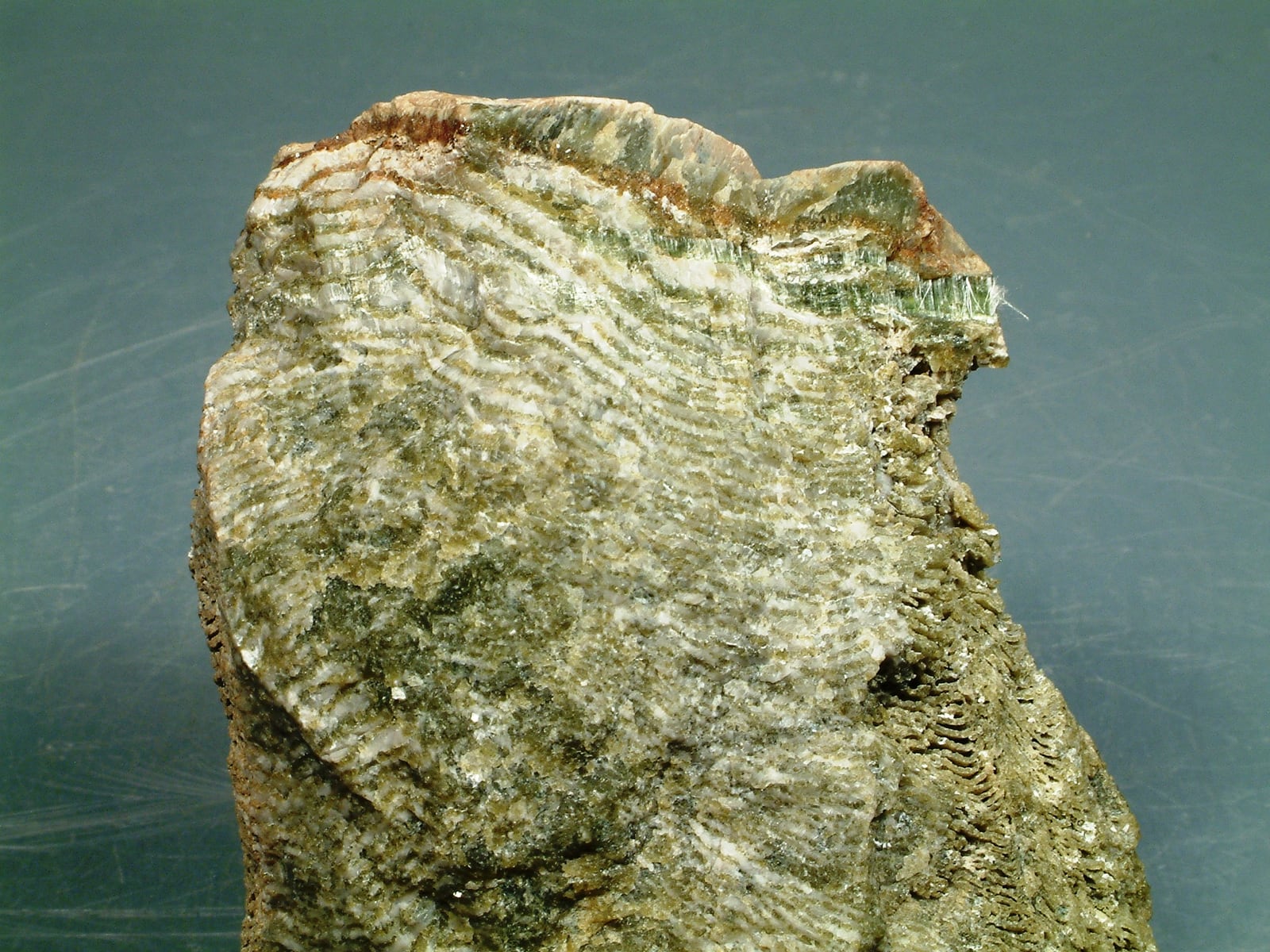
The rock seems to have organized itself around a body. Pale bands fold through green mineral fabric, divide, reunite and thicken into stacked lobes. Across the exposed face, the alternation looks less like random veining than like a chambered thing caught in cross-section. In the 1860s, that resemblance was given a name: Eozoon canadense, the “Canadian dawn animal.”
The cover specimen is not an artist’s reconstruction of that claim. It is the object that survived it: Geological Survey of Canada national type collection specimen 24368 from Côte St. Pierre, Quebec, now cataloged as layers of calcite and serpentine in Grenville-age metamorphic rock.[6] Nothing had to be painted onto the slab to make it persuasive. The pattern was already there.
That is why Eozoon deserves more than a place in a cabinet of scientific blunders. Its nineteenth-century interpreters were wrong about the organism, but they were responding to real structure at several scales. The fossil reading failed only when the apparent anatomy was forced to compete with a geological process capable of making the same forms. Read closely today, Eozoon is a lesson in what a fossil claim must do: not merely resemble life, but outlast the strongest nonliving explanation for its shape.
The first specimen arrived before the animal
Earlier banded specimens from Burgess, Ontario, had reached Geological Survey of Canada director William Logan as mineral curiosities. In 1858, Survey explorer J. McMullen collected differently mineralized material from crystalline limestone at Grand Calumet on the Ottawa River. Logan exhibited it as a possible Laurentian fossil in 1859, and Geology of Canada illustrated it in 1863; John William Dawson named Eozoon canadense in 1864 and promoted it as a giant fossil foraminifer.[1][3] The sequence matters. A banded rock came first; organism, anatomy and name were interpretations added afterward.
Foraminifera offered a plausible comparison. Living members are single-celled organisms that build chambered tests, often from calcium carbonate. Dawson and the microscopist William Benjamin Carpenter treated the pale carbonate layers as a calcareous skeleton and the green silicate as material that had entered spaces once occupied by soft living matter. Fine branching features seemed to supply still more anatomy: tubules in a wall, canals through an intermediate skeleton, and successive chambers produced as the organism grew.[3]
This reading also solved a much larger problem. The host rocks belonged to the Precambrian, then widely treated as effectively “Azoic”—without known life. If the Canadian structure really was a foraminifer, what Victorian zoologists regarded as animal life would extend beneath the Cambrian fossil record in one dramatic step. Dawson did not imagine a microscopic curiosity. He imagined masses of Eozoon building something like a reef in an ancient Laurentian sea.[3][4]
The claim therefore joined three different observations: a layered hand specimen, details visible in thin section and a geological setting old enough to transform the history of life. Each was real. The mistake was treating their fit with one biological story as proof that no mineral story could fit better.
Acid made the supposed body more convincing
Dawson’s case was not based on silhouette alone. When acid dissolved the carbonate, a coherent serpentine form could remain. To an Eozoon advocate, this looked like a cast of chambers, passages and soft-body spaces: remove the mineralized skeleton and the infill preserves the architecture around it.[3] The procedure appeared to reveal hidden anatomy by subtraction.
Yet the experiment did not establish how that architecture originated. Acid separated minerals with different chemistry. If calcite and serpentine had intergrown during metamorphism, dissolving one would also leave a detailed cast of their boundary. The residue could faithfully preserve a pattern without preserving a body.
This distinction is the center of the specimen. A cast records the shape of an interface; it does not, by itself, identify what made the interface. Fossil preparation often depends on differences between bone, shell, matrix and replacement mineral. But a clean separation is evidence of composition before it is evidence of biology. Eozoon looked stronger after etching because the treatment amplified its internal complexity. It also made the alternative explanation testable: could metamorphic minerals generate the same complexity without an organism?
Connemara marble supplied the rival specimen
William King and Thomas Rowney answered from Galway in 1866. They compared the Canadian material with similarly intricate structures in the metamorphic rocks of Connemara and argued that mineral processes, not a foraminiferal test, produced the resemblance. Their point was not that Eozoon lacked pattern. It was that pattern could no longer be assigned exclusively to life.[2][4]
The controversy became unusually durable because both camps could point to legitimate expertise. Dawson and Carpenter read repeated layers, supposed walls and canal-like details through zoology and microscopy. King and Rowney read mineral intergrowths, alteration and crystalline rock through petrography. Adelman’s historical account shows that the dispute was also a contest over credibility: institutional position, access to specimens and the authority to decide who counted as a competent observer shaped how evidence circulated.[4]
That social history should not be simplified into “Victorians saw what they wanted to see.” The harder problem is that a genuine natural form supported two causal readings. More samples gradually changed the balance. Comparable structures appeared in rocks of different ages and localities. Logan began to doubt the organic interpretation, while Dawson continued to defend it.[1] Replication, which initially seemed to multiply fossils, was beginning to multiply examples of a mineral fabric instead.
The famous 1894 comparison sharpened that reversal. Similar “eozoonal” structures were identified in metamorphosed limestone blocks ejected from the Monte Somma–Vesuvius volcanic complex. Such material provided a setting in which heat and mineral reaction could make the pattern without requiring a Precambrian organism.[1] It did not cause every participant to surrender at once, but it gave the inorganic model something the fossil model could not absorb comfortably: an independent route to the same apparent anatomy.
The photograph preserves persuasion, not anatomy
Return to the cover specimen and resist both easy reactions. It is not a giant protozoan. It is also not visual nonsense. The light and green-gray bands are sufficiently coherent to invite segmentation; their curves make a static rock look as if it grew outward in episodes. The photograph preserves the irregular edges and crystalline texture around that pattern, keeping the seductive “anatomy” visibly attached to a rock rather than isolating it as a diagram.[6]
What the hand specimen cannot show is just as important. It has no demonstrated outer boundary belonging to one organism, no repeated developmental sequence that distinguishes chambers from mineral bands, and no independent organic or ecological context that requires a living maker. Its most persuasive traits—layering, branching and infill—are also traits that mineral replacement and metamorphic intergrowth can produce.[5][6]
The modern collection label therefore changes the object without changing the rock. The same bands once divided skeleton from soft-part infill; now they identify calcite beside serpentine-rich material. The evidence did not vanish. Its causal ownership moved from zoology to metamorphic petrology.
John R. Dolan’s recent review adds a useful caution to the usual victory story. Eozoon was announced in 1864, generated hundreds of publications and was challenged repeatedly, yet no single nineteenth-century demonstration ended the argument beyond dispute. The fossil interpretation faded as its strongest defenders disappeared, even lingering in a biology textbook as late as 1947.[5] Scientific consensus changed for good evidential reasons, but not through one cinematic reveal.
A false fossil can improve the search for real life
Modern work on very early life makes the methodological boundary explicit. A candidate should be judged through converging lines of evidence: composition consistent with preserved or replaced biology, cellular complexity that plausible nonbiological processes cannot reproduce, multiple specimens, an ecologically credible assemblage and variation consistent with decay and preservation.[7] No item is magic. Together they make resemblance carry a causal burden.
Eozoon failed that convergence. Its abundance did not isolate a biological process; mineral growth could imitate its supposed canals and walls; and its great age raised the importance of the claim without improving the evidence. Most decisively, geological models explained why comparable organization appeared where a biological origin was unnecessary.[1][5][7]
That failure gives the slab a second scientific life. It shows that experimental preparation can clarify structure while leaving cause unresolved, and that additional specimens may reproduce the alternative hypothesis rather than the favored one. The “dawn animal” was never alive, but the pattern that sustained it was real. A candidate fossil may begin with resemblance; it earns the name only when anatomy, chemistry, geological context and comparison point toward life more strongly than stone can point back.
Sources
- Geological Survey of Canada, “Eozoon canadense (1864)”—official history of the 1858 find, Dawson’s naming, the competing mineral interpretation and the 1894 volcanic comparison.
- National Museum of Ireland, Alan O’Connor, “Canadian Pseudo-fossil”—collection history for Dawson’s polished specimen and King and Rowney’s comparison with Connemara metamorphic rock.
- John William Dawson, Life’s Dawn on Earth (1875), Project Gutenberg—Dawson’s primary-source account of the proposed chambers, canals, mineral infill and Laurentian reef.
- Juliana Adelman, “Eozoön: debunking the dawn animal,” Endeavour 31 (2007)—historical analysis of the Galway challenge, Victorian scientific credibility and the controversy’s public life.
- John R. Dolan, “The saga of the false fossil foram Eozoon,” European Journal of Protistology 87 (2023), PubMed record—modern review of the evidence, personalities and unusually long decline of the fossil interpretation.
- Natural Resources Canada, “Eozoon canadense Dawson”—Geological Survey of Canada image and catalog record for national type collection specimen 24368, used as the cover photograph.
- J. William Schopf, “Fossils and Pseudofossils: Lessons from the Hunt for Early Life on Earth,” in a National Research Council workshop volume (1999), NCBI Bookshelf—criteria for testing ancient biosignatures against nonbiological alternatives.