The standard public version of mammal history has a clean dramatic hinge: dinosaurs dominate, an asteroid strikes, and mammals finally inherit the world. Multituberculates make that story less tidy and more interesting. They were not waiting in the dark for a vacancy sign. This extinct mammal group built a long-running ecological career beside dinosaurs, through the Cretaceous-Paleogene extinction, and deep into the Cenozoic, largely by turning teeth into a flexible feeding system.[2][3]
Their name starts with the mouth. Multituberculates are the "many tubercle" mammals, marked by back teeth covered in rows of bumps and ridges rather than the simpler slicing or piercing surfaces that fit a narrow carnivorous diet.[1][2] That sounds technical until the animal is put back into a landscape. A bumpy molar is not an ornament. It is a food-processing machine. It can crush seeds, shred plant material, grind softer vegetation, and handle mixed meals in a world where small mammals did not all live as generic insect hunters.
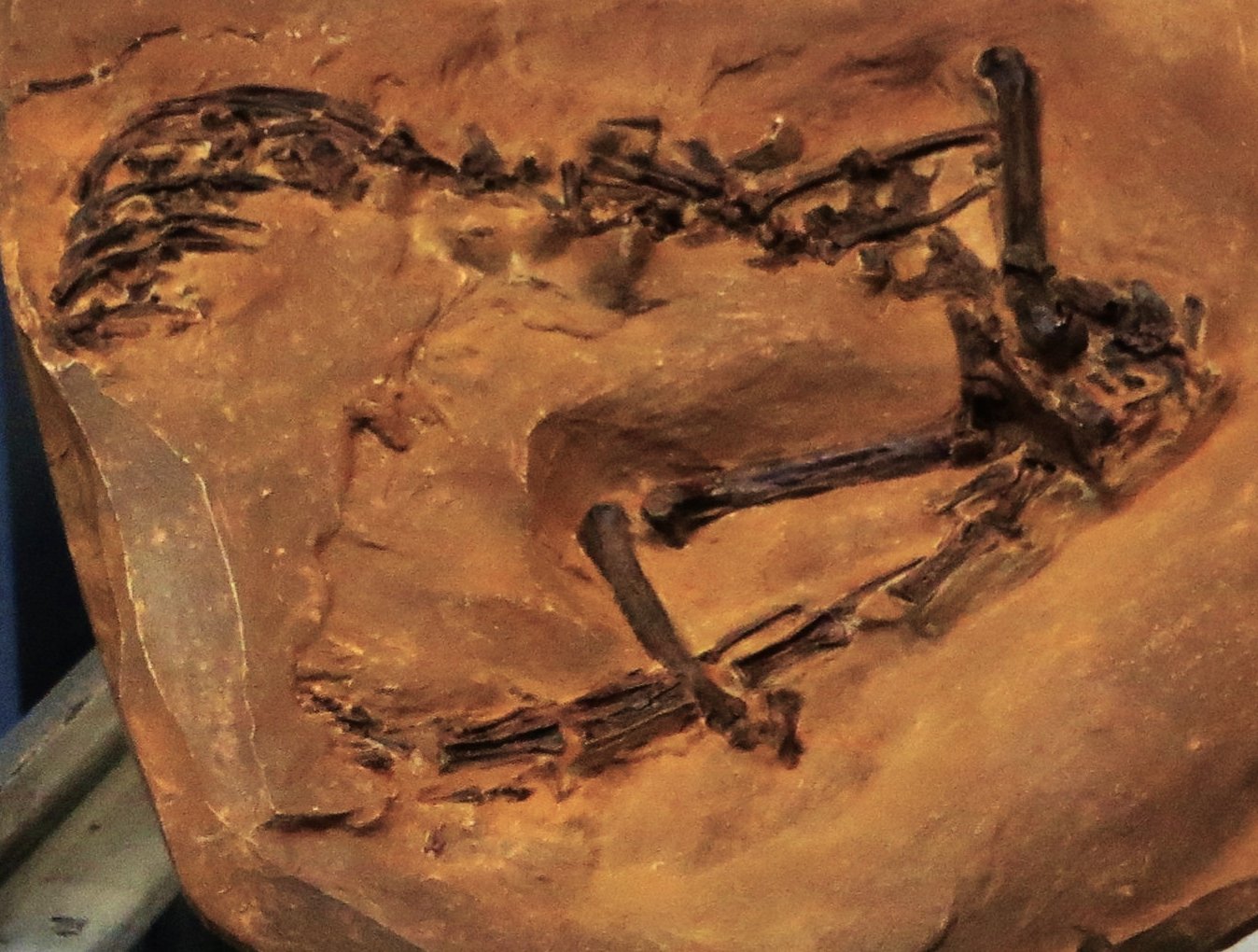
That is why the cover image matters. The photograph shows Ptilodus kummae, a Paleocene multituberculate displayed as a fossil body rather than as an abstract tooth row.[5] The skull and jaws still draw the eye, but the limbs, spine, and long tail keep the animal out of caricature. Multituberculates were rodent-like in some habits and proportions, yet they were not rodents and not a preview sketch of one modern group. They were their own long experiment in small-mammal success.
The Tooth Was A Calendar
Teeth are unusually good timekeepers in paleontology because they survive where fragile bodies vanish. For multituberculates, they also record ecological change. Gregory Wilson and colleagues tested dental complexity across 41 multituberculate species and argued that the group began an adaptive radiation at least 20 million years before the non-avian dinosaurs disappeared, then continued across the extinction boundary rather than starting from scratch afterward.[2]
That finding changes the plot. Mammal diversification was not only a post-impact release from dinosaur pressure. In this case, the evidence points to a Mesozoic expansion already underway. The study connected rising dental complexity, increasing body-size disparity, and a shift toward greater herbivory with the spread of angiosperms, the flowering plants that were becoming more ecologically important late in the age of dinosaurs.[2]
The most useful part of that argument is its restraint. It does not say every mammal was already free from dinosaur-shaped limits. It says one major mammal group found a route through those limits. The route ran through molar surface, cusp count, blade-like premolars, jaw action, and the ability to turn plant resources into mammalian body plans before the famous extinction made larger openings elsewhere.
Rugosodon Keeps The Body In The Story
If teeth explain the signal, Rugosodon eurasiaticus gives it a body. The University of Chicago account of the 160-million-year-old fossil describes it as the earliest known complete skeleton of a multituberculate, from Jurassic deposits in Liaoning, China.[3] Its importance is not just age. It shows a small animal with flexible ankles, agile ground movement, and ridged teeth suited to an omnivorous diet that could include leaves, seeds, ferns, gymnosperms, worms, and insects.[3]
That combination is the hinge. Later multituberculates became famous for plant-processing specializations, but Rugosodon suggests that the starting package was not a narrow herbivore dropped into the Jurassic fully formed. It was a small, mobile mammal with teeth that could handle a mixed menu. The plant-rich future of the group seems to have grown from versatility, not from instant specialization.[3]
The ankle evidence matters because a successful feeding system still needs a body that can reach the food. University of Chicago's report notes that the flexible ankle bones help explain later multituberculate locomotor variety, including forms associated with climbing, digging, and ground movement.[3] In other words, the tooth story is not only dental. It is dental plus movement plus habitat access. A molar can process a seed only if the animal can find the seed, reach it, avoid predators, and keep repeating the behavior across generations.
Surviving The Asteroid Was Not The Same As Beginning
The Cretaceous-Paleogene boundary remains a real catastrophe. The point is not to downplay it. The point is to stop treating it as the only moment mammals became interesting. Wilson and colleagues argued that multituberculate dental complexity and body-size disparity were already rising before the boundary and that the resources used by some multituberculates appear to have persisted through the extinction pulse.[2]
That is a sharper claim than "mammals survived." Survival alone can be passive. A lineage can survive by being lucky, small, hidden, or geographically buffered. Multituberculates look more active than that. They carried a working ecological toolkit through the disaster: plant-processing teeth, small flexible bodies, and niches linked to food sources that were not erased in the same way as many large-bodied dinosaur systems.[2][3]
This also changes how the "age of mammals" should sound. The phrase is useful if it names a Cenozoic expansion in size, diversity, and ecological reach. It becomes misleading if it implies that mammal innovation waited until the crater. Multituberculates were already showing that small mammals could be ecologically precise while tyrannosaurs, hadrosaurs, ceratopsians, and other dinosaurs still occupied the large-animal theater.
Why "Rodent-Like" Can Mislead
Calling multituberculates rodent-like is almost unavoidable, and it can be helpful at first glance. The phrase points to small bodies, gnawing-style front teeth in many forms, and ecological roles that later rodents would partly occupy. But the resemblance can also flatten the group. It makes multituberculates sound like temporary stand-ins, as though their main historical job was to hold a place until rodents arrived.
The fossil record argues against that condescension. University of Chicago's overview places their continuous record from roughly 170 million years ago to about 35 million years ago, meaning they lived with dinosaurs for more than 100 million years and then outlasted them by tens of millions more.[3] A lineage with that duration deserves to be read as a successful experiment, not as a failed rehearsal.
The UCMP's collection note is a good reminder of how that success is studied in practice. It frames multituberculates as small Cretaceous mammals with especially bumpy teeth and points to collection work as the route into their biology.[1] The glamour is low. The leverage is high. Rows of isolated teeth, jaw fragments, and small skeletons can map diet, body size, local abundance, and ecological change with a precision that a single spectacular skeleton cannot supply by itself.
The Ending Was Not A Single Knockout
Multituberculates eventually disappeared, and the old explanation has often leaned on rodents: similar niches, later arrivals, competitive exclusion. That idea is plausible enough to keep in the conversation, but the clean replacement story is no longer the only defensible one. A 2025 Paleobiology study comparing Eocene North American multituberculates, rodents, and fossil plant distributions frames the problem as spatial paleoecology rather than as a simple head-to-head contest.[4]
The study reviews the rodent-competition hypothesis, then tests mammal-plant associations across Eocene forest communities. Its results linked multituberculates most closely with plant groups such as swamp cypress, dawn redwood, and alder, while rodent groups showed different patterns; the paper argues that the decline of rodent families and the extinction of multituberculates coincide with major shifts in forest communities rather than demonstrating direct competition as the whole cause.[4]
That does not absolve rodents from all ecological pressure. It does something better: it makes the extinction problem historical. Food plants moved. Forest structure changed. Mammal groups overlapped unevenly. Sampling and geography had to be tested. A lineage that had succeeded through teeth and habitat access may have become vulnerable when the habitats underwriting that success changed faster than its old toolkit could track.[4]
The Mammal Story Gets Better When It Gets Smaller
Multituberculates are easy to overlook because they rarely supply the huge skeletons that dominate public paleontology. Their drama sits in rows of teeth, small jaws, ankle bones, museum drawers, and modest fossil mounts. But that scale is exactly why they matter. They show that mammalian history was not only made by the first whale, the first horse, the first big predator, or the first primate. It was also made by small bodies repeatedly solving food.
The teeth carry the thesis because teeth are where ecology becomes wear, relief, and shape. The ridged molars do not merely identify a group. They record a way of meeting the world: crushing, slicing, grinding, mixing plant and animal foods, and tracking the rise and rearrangement of vegetation across deep time.[2][3][4]
So the old hinge can stay, but it has to bend. The asteroid did not create mammalian possibility from nothing. It changed the size of the stage. Multituberculates remind us that some mammals had already learned their lines, and many of those lines were written in enamel.
Sources
- University of California Museum of Paleontology, "Fossil Feature: Multituberculates" (2019) - collection context and bumpy-tooth framing.
- Gregory P. Wilson et al., "Adaptive radiation of multituberculate mammals before the extinction of dinosaurs," Nature 483 (2012), PubMed abstract.
- University of Chicago News, "Earliest complete fossil from rodent-like ancient mammal discovered" (2013) - Rugosodon fossil, age, ankle, diet, and longevity context.
- Benjamin John Burger, "Comparative spatial paleoecology: assessing niche competition between Eocene North American multituberculates and rodents regarding forest resources to elucidate the cause of multituberculate extinction," Paleobiology (2025), Cambridge Core.
- Wikimedia Commons, "File:Ptilodus kummae cropped.jpg" - source page for the real fossil photograph used as the article image.