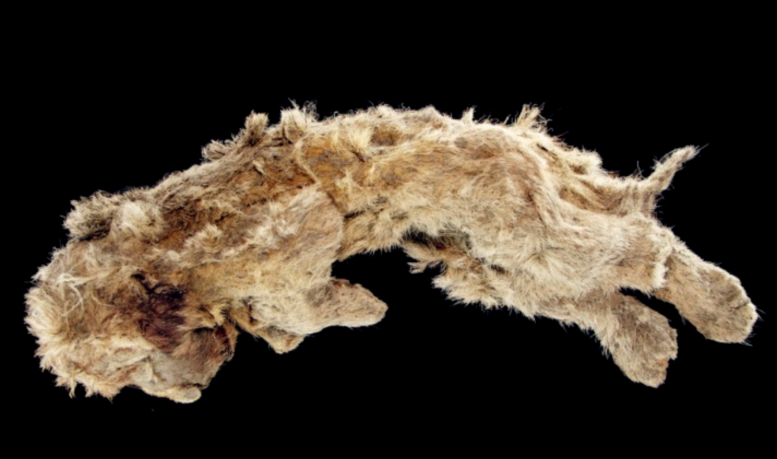
The quickest way to mishandle Sparta is to call her a perfect Ice Age snapshot. The mummified cave lion cub looks startlingly present: a small body, fur still visible, paws folded, the outline of a young predator held in permafrost rather than compressed into stone. But the science is stronger when the wonder is slowed down. Sparta is not time travel. She is a fossil-find problem in soft tissue, radiocarbon, tooth development, CT anatomy, and permafrost taphonomy.
The paired discovery makes that discipline unavoidable. The two cubs, Sparta and Boris, were found near the Semyuelyakh River in Yakutia in 2017 and 2018, close enough in place to invite a sibling story. The dates break that story apart. The primary paper reports Sparta at 27,962 +/- 109 uncalibrated years before present, while Boris dates to 43,448 +/- 389 uncalibrated years before present. They were found near one another, but they are separated by roughly fifteen thousand years of Ice Age time.[1]
That gap is the first lesson. Permafrost can make proximity look like intimacy. A riverbank can release two bodies from nearly the same place even though the animals belonged to different episodes, different winters, and different den histories. The fossil has to be read as geology and chronology before it can become biography.
Read The Fur Before The Fantasy
The most visible evidence is the coat, and it is tempting to turn that immediately into color restoration. The paper is more cautious. It describes Sparta's general fur tone as greyish to light brown and Boris as lighter, greyish yellowish, then raises the possibility that a light coat may have been adaptive in northern snow-covered landscapes.[1] That is a useful inference, but it is not a license to paint a whole species from two cubs.
Several filters sit between preserved hair and living appearance. These are very young animals, probably one to two months old based on development. They are natural mummies, not living skins. Freezing, drying, burial chemistry, microbial alteration, and exposure after discovery can all change texture and color. The better claim is narrower: the cubs preserve enough fur to make coat evidence part of cave lion biology, while still requiring caution about age, preservation, and sample size.[1]
That narrower claim is more interesting than a poster-ready restoration. A skeleton can tell us a great deal about size, skull shape, and limb proportions. A mummy can add surface: coat density, whisker pads, tail brush, paws, ears, skin damage, and the physical relationship between soft tissue and bone. Sparta matters because she lets paleontology handle the part of a predator that usually disappears first.
Teeth Make The Cubs Young
The cubs are not just small cave lions. Their age matters because it controls almost every biological interpretation. The primary analysis places both at roughly one to two months old.[1] That keeps the article from treating them as miniatures of adult behavior. They were den-age animals, still in the vulnerable stage before independent hunting and before adult proportions could settle.
That point changes the likely death story. If these were very young cubs in or near a den, then a sudden burial event becomes more plausible than an open-landscape predator encounter. The paper discusses possible causes of death in that frame, including den collapse or rapid burial, and the preserved condition is consistent with a scenario in which bodies were covered quickly and frozen before ordinary decay, scavenging, and weathering could dismantle them.[1]
The important boundary is that "possible" does real work. The bodies do not preserve a narrated accident. They preserve injuries, positions, soft tissue, and context from which a death scenario can be inferred. A den collapse is not a cinematic certainty; it is a taphonomic explanation that fits the age, preservation, and absence of a clean predation story better than many alternatives.
CT Turns The Mummy Into Anatomy
A mummified cub also has a hidden interior. The 2021 paper explicitly treats computed tomography as part of the evidence, not as an accessory image.[1] That matters because permafrost preservation can be visually persuasive on the surface while still leaving internal questions unresolved. CT lets researchers ask whether bones, skull shape, teeth, soft tissues, and damage patterns align with the external impression.
This is where Sparta and Boris belong beside newer permafrost-felid work without being confused with it. The 2024 Scientific Reports study of a mummified juvenile Homotherium latidens from Yakutia used external appearance and CT analysis to identify a saber-toothed cat cub, noting features such as a massive neck region, elongated forelimbs, small ears, dark coat color, and skull traits diagnostic of Machairodontinae.[4] That comparison is useful because it shows what permafrost can add: not only skin, but a three-dimensional bridge between surface anatomy and skeletal identity.
The cave lion cubs are a different animal and a different evidence problem. They do not need to prove that permafrost can preserve an extinct cat; they show how preservation can sharpen a known Pleistocene predator at an unusually young life stage. The soft tissues do not replace bones, dates, or genetics. They force those evidence types to speak to one another.
A Cub Is Not The Whole Species
The broader cave lion frame keeps the discovery from shrinking into two named mummies. Cave lions were widespread across the Holarctic during the Pleistocene. A 2020 mitogenome study analyzed 31 cave lion mitochondrial genomes and found deep internal structure, including a Beringian clade and a western Eurasian clade, supporting the view that cave lions and modern lions were distinct species and that cave lion diversity was not geographically flat.[2]
That is crucial for reading Sparta and Boris. Their bodies come from Yakutia, and their preservation is extraordinary, but they are not a complete proxy for every cave lion across Eurasia and Beringia. A 2024 distribution-history synthesis makes the same scale visible from the fossil-record side, treating the cave lion as a top predator of the mammoth-steppe fauna and reviewing its spread across Eurasia and North America from early occurrences to late-Pleistocene extinction.[3] The cubs are therefore local, late-Pleistocene, northern soft-tissue data points inside a much larger range history.
This scale shift protects the article from two opposite errors. One error is to treat the cubs as curiosities, valuable mainly because they are cute and intact. The other is to treat them as the key to the whole species. They are neither. They are rare evidence for early life, coat, den vulnerability, and permafrost preservation within a predator lineage whose range, genetic structure, and extinction history require many other fossils and genomes.[2][3]
What Permafrost Really Preserved
The strongest reading of Sparta and Boris is not that permafrost stopped time. It edited the fossil record differently from stone. It kept fragile evidence that usually disappears: hair, skin surface, body outline, and some internal soft-tissue relationships. It also created its own traps. A beautiful mummy can make a death look immediate, a color look original, a local body look representative, and two nearby finds look related.
That is why the cave lion cubs are most useful as a close-reading exercise. Start with the real body in the photograph.[5] Move to the dates, which separate two nearby finds by millennia.[1] Use teeth and CT to keep age and anatomy grounded.[1] Then widen to genetics and distribution so the cubs stay connected to the Holarctic cave lion rather than becoming isolated Ice Age mascots.[2][3]
Sparta's preservation is spectacular, but the spectacle is not the point. The point is that paleontology sometimes gets to work with surfaces as well as bones. In this case, fur and skin do not make the science softer. They make it stricter, because every vivid detail has to pass through chronology, anatomy, preservation, and comparison before it can become a claim about a living animal.
Sources
- Crossref DOI metadata record for Gennady G. Boeskorov et al., "The Preliminary Analysis of Cave Lion Cubs Panthera spelaea (Goldfuss, 1810) from the Permafrost of Siberia," Quaternary 4(3), article 24 (2021) - abstract with dates, age estimate, fur-color notes, CT scope, and DOI metadata.
- David W. G. Stanton et al., "Early Pleistocene origin and extensive intra-species diversity of the extinct cave lion," Scientific Reports 10, article 12621 (2020) - mitochondrial-genome evidence for cave lion diversity and distinct species framing.
- Andrey Yu. Puzachenko et al., "Distribution history of the cave lion (Panthera spelaea (Goldfuss, 1810))," Earth History and Biodiversity 1, article 100006 (2024) - range-history synthesis and mammoth-steppe predator context.
- A. V. Lopatin et al., "Mummy of a juvenile sabre-toothed cat Homotherium latidens from the Upper Pleistocene of Siberia," Scientific Reports 14, article 28016 (2024) - comparative permafrost-felid mummy and CT/anatomy boundary.
- Wikimedia Commons, "File:Sparta body lateral view.png" - source page for the real photographic image of the mummified cave lion cub used as the article image.