
A steppe bison can look like a familiar animal with the proportions turned up: bigger horn cores, a colder setting, and a museum label that pushes it safely into "Ice Age fauna." The useful move in Yukon Beringia Interpretive Centre's video is that it refuses to leave the animal as background scenery. A bison in a basement is funny as an opening image, but it also gets at the real paleontological point: these animals survive for us as things people trip over, thaw out, excavate, stabilize, compare, and argue from.[1]
The steppe bison was not a marginal supporting player in Beringia. Yukon Beringia's own exhibit page describes it as the large herbivore that crossed Beringia into North America around 160,000 years ago and then spread far beyond the north, as far south as Mexico.[2] That matters because Beringia is too easy to flatten into a land-bridge diagram. In bison evidence, it becomes a lived corridor: grasslands, cold-adapted herds, population splits, predator pressure, and later permafrost deposits packed with bones.
The video should be watched with that materiality in mind. Its provenance is straightforward: the YouTube upload comes from the Yukon Beringia Interpretive Centre, whose public interpretation work centers on the Ice Age animals and environments of the Yukon and the broader Beringian world.[1][2] This is not a generic extinct-animal montage. It is a museum-side explainer, and the most valuable parts are the moments when the presenter makes ancient bison feel like specimens with collection histories rather than illustrations of an vanished ecosystem.
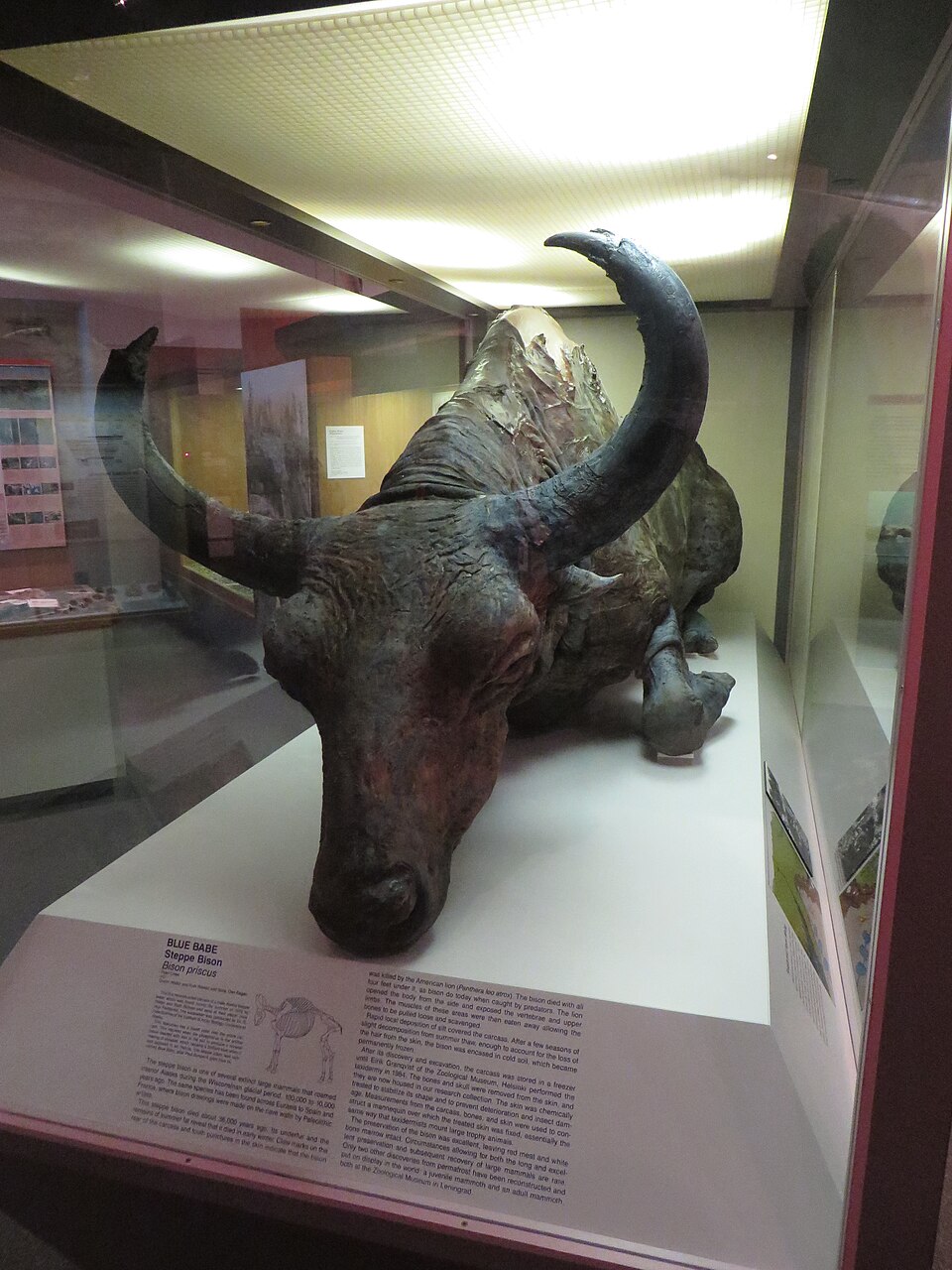
Image context: the cover photograph shows Blue Babe, not the basement specimen featured in the video. That distinction is useful. Blue Babe is a comparable Alaskan steppe-bison mummy: discovered near Fairbanks in 1979, preserved in permafrost, and displayed at the University of Alaska Museum of the North.[3][5] The photograph gives the article a real specimen anchor while the video supplies the broader Yukon Beringia frame.
The Viewing
The first thing to notice is the video's scale shift. It starts from the oddness of a bison specimen in a domestic-feeling space, then pulls outward to a continental story. That move is good paleontology. A single fossil is never only a single fossil. It has an anatomical identity, a place of discovery, a date range, a preservation history, and a comparative value. When Yukon Beringia says steppe bison became the most abundant large herbivore in North America after crossing Beringia, the claim is not decorative background. It explains why one specimen can open a whole archive of movement and ecological change.[2]
The second detail to watch for is how horns do interpretive work. Living plains bison and wood bison make the extinct animal feel close enough to recognize, but the steppe bison's large horns keep it from collapsing into the present. Yukon Beringia notes that steppe bison were similar in body size to living relatives but had much larger horns, and that today's Yukon bison are reintroduced animals rather than direct local descendants of the Ice Age population.[2] That distinction keeps continuity and rupture together. The genus survives, but the Pleistocene population history is not a simple handoff.
Permafrost is the video's silent engine. The Yukon page calls parts of the Klondike permafrost nearly a graveyard of ancient steppe-bison bones, with more than 80 percent of fossil mammal bones from the Klondike gold mines coming from steppe bison.[2] That is the difference between a spectacular specimen and a statistical landscape. A mummy draws the eye, but abundance lets paleontologists ask harder questions about population size, migration, age structure, climate stress, and how often animals were dying or being buried in places where preservation could begin.
Blue Babe shows why the preservation story is never only about cold. The University of Alaska Museum of the North identifies Blue Babe as a 36,000-year-old mummified Alaska steppe bison found by gold miners in 1979 and preserved in Interior Alaska permafrost.[3] The blue color came from vivianite, a mineral that formed on the skin when tissue chemistry met iron in the soil.[3][5] In other words, the famous color is not a museum flourish. It is chemistry produced after death, then intensified when excavation exposed the coating to air.[5]
The predator evidence is just as important as the color. UAF's museum account and the University of Alaska's longer history both describe claw marks and tooth punctures that led researchers to interpret Blue Babe as having been killed by an Ice Age American lion.[3][4] The University of Chicago Press description of R. Dale Guthrie's Frozen Fauna of the Mammoth Steppe frames that work as detective analysis of the carcass, its surroundings, death circumstances, appearance in life, and freezing processes.[6] That is the mode the video encourages: not "look at a cool animal," but "learn how a body becomes evidence."
The season of death deepens the lesson. The Alaska article reports that underfur and a layer of fat suggested a fall or winter death, after which cold conditions helped the carcass cool rapidly before burial and long permafrost preservation.[4] That timing matters because preservation is a sequence, not a miracle. The animal had to die in a particular environment, cool before decay erased key tissues, avoid complete destruction by scavengers, become buried, and then remain insulated inside frozen ground. Paleontology here is part anatomy, part geology, part taphonomy, and part accident.
This is why a basement-bison video is worth annotating. It restores the ordinary handling side of paleontology. Fossils are not born as museum statements. They pass through miners, homeowners, preparators, curators, radiocarbon labs, comparative collections, and public explainers. The most famous examples can become mascots, but their scientific value comes from what they still allow researchers to test: migration routes, predator communities, cold-steppe ecology, DNA histories, and the relationship between northern and southern bison populations after glacial barriers reshaped the continent.[2]
The final thing to watch is the tension between closeness and distance. A steppe bison is close because bison still exist, and because the video can stand near a specimen and let the viewer understand its body as a body. It is distant because the animal belonged to a mammoth-steppe world that was cold, dry, grassy, and ecologically unlike the simplified Ice Age backdrop in popular imagination.[6] The video works because it keeps both truths active. Beringia becomes neither a map label nor a frozen fantasy scene. It becomes a record of animals whose remains are still being pulled out of ground, basements, and museum storage into new questions.
Sources
- Yukon Beringia Interpretive Centre, "Steppe Bison in a Yukon Basement? A Brief History of Ancient Bison - #BCST," YouTube video.
- Yukon Beringia Interpretive Centre, "Steppe Bison," official exhibit page.
- University of Alaska Museum of the North, "Blue Babe," museum spotlight page.
- University of Alaska, "Blue Babe, A Messenger from the Ice Age," UA Journey republication of Gary Selinger's June 1986 UA Magazine article.
- Wikimedia Commons, "File:Blue Babe @ Museum of the North.jpg," source page for Bernt Rostad's 2014 photograph.
- University of Chicago Press, Frozen Fauna of the Mammoth Steppe: The Story of Blue Babe by R. Dale Guthrie, official book page.