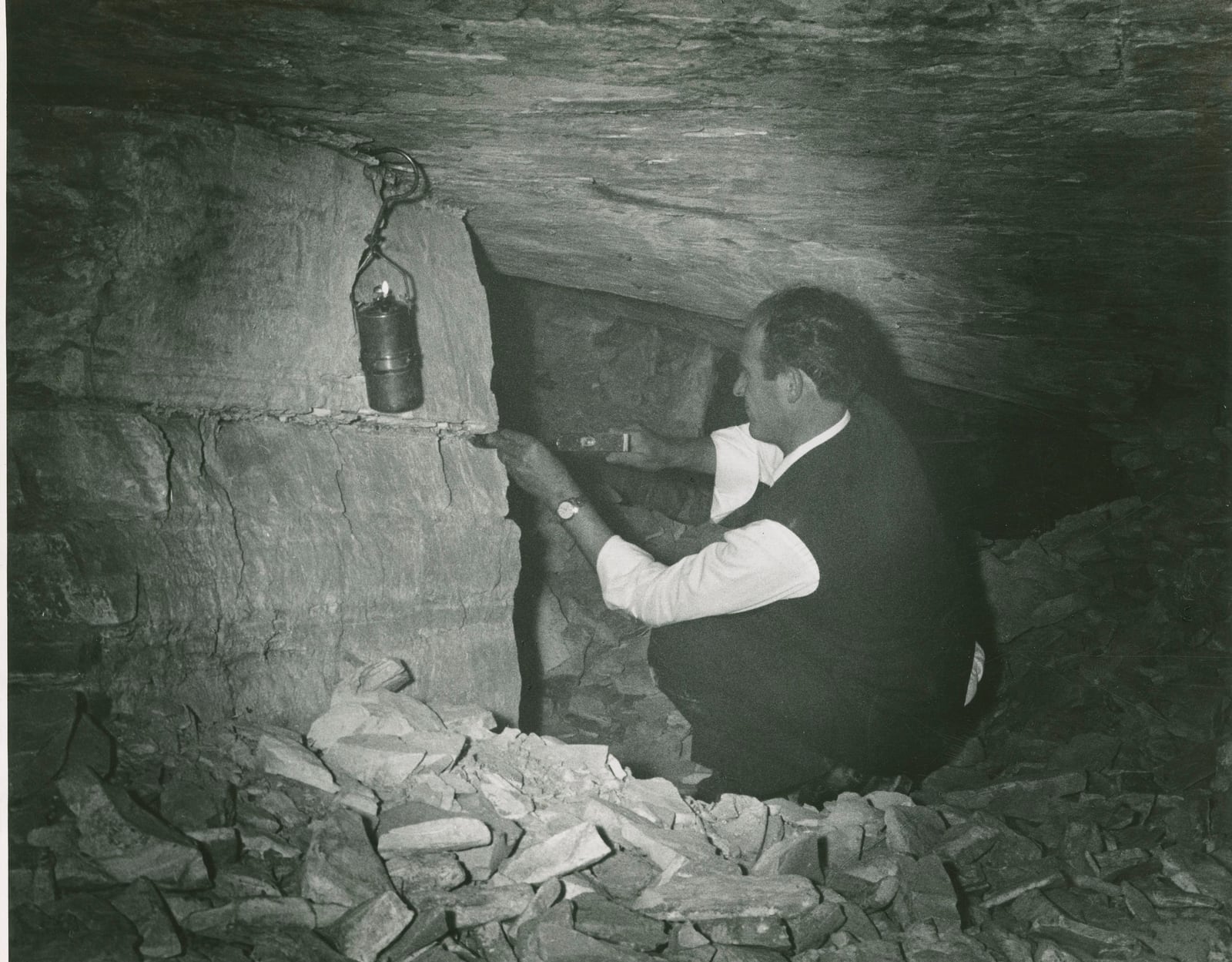
In the 1964 cover photograph, Massimiliano Cerato works low to the floor of the Pesciara quarry. Thin limestone slabs lean in stacks around him. Each split is a wager: blank stone, a fragment, or a fish with scales, fins, and body outline still legible after roughly 50 million years.[1][6]
The usual Monte Bolca story begins with that spectacular completeness and expands outward into an Eocene coral-reef aquarium. The rocks demand a more interesting story. “Monte Bolca” gathers several fossil localities under one famous name, and its two principal fish deposits do not preserve the same environment in the same way. Pesciara supplies most of the exquisitely articulated fishes. Monte Postale contains stronger direct signs of a coral-fringed coast, but its fishes are generally more disturbed and harder to identify.[1][3]
That inversion is the field report's central fact: the cleanest fossil does not necessarily come from the habitat that best matches the animal's ecological reputation. At Bolca, anatomical clarity and environmental completeness pull in different directions.
Put the fish back on the Lessini shelf
Pesciara and Monte Postale lie in the eastern Lessini Mountains of northeastern Italy, about two kilometres northeast of the village of Bolca. In the late Ypresian age of the early Eocene, the region formed part of a warm, shallow carbonate shelf along the northern margin of the western Tethys. Larger foraminifera and calcareous nannofossils place the productive beds near 50 million years ago, while the rock records a coastal mosaic of restricted basins, shallow bottoms, emerged land, and connections to open water.[1][2]
The shared age and geography make it tempting to merge the sites into one scene. Controlled excavations show why that fails. Between 1999 and 2011, researchers collected fossils systematically at both localities, recording abundance and preservation rather than selecting only display-quality specimens. Their comparison recovered two distinct fish assemblages and two depositional settings.[3]
The distinction is not a claim that two sealed aquariums sat side by side. Fish could move through a connected coastal seascape, and some taxa occur at both sites. The distinction is sedimentary: the carcasses entered different bottom conditions, experienced different decay and disturbance, and therefore passed through different filters before becoming data.
Pesciara made the sharper body
Pesciara's productive rock is finely laminated micritic limestone. Much of the carbonate mud settled in a basin with restricted circulation and very low energy. Coarser, foraminifera-rich layers arrived episodically from nearby shallow areas, probably during storms or sea-level changes. The basin was close enough to land to receive plants and terrestrial animals, but its bottom remained poorly oxygenated—at times anoxic—and may have supported microbial mats or biofilms.[2][3]
Those are excellent conditions for preserving a fish and inhospitable conditions for many organisms that would dismantle one. Low bottom-water oxygen limits scavengers and burrowers. A biofilm can stabilize a carcass and delay decomposition. Fine mud settles around delicate structures without the abrasive movement that scatters bones. Repeated burial in laminated sediment can keep scales aligned and fins readable rather than reducing an animal to a patch of disarticulated elements.[1][3]
Pesciara's ecological signal is nevertheless narrower than its visual abundance suggests. The controlled sample has what researchers call an oligarchic structure: a few forms dominate, especially plankton-feeding fishes. The small clupeomorph Bolcaichthys catopygopterus accounts for about half of the fishes in recent controlled collections. A cabinet full of beautiful species can therefore coexist with a burial census numerically dominated by shoaling plankton feeders.[1][3]
Exceptional preservation is not the same as an even sample. Pesciara tells us a great deal about the anatomy of animals admitted to its quiet bottom. It does not automatically tell us the relative abundance of every fish living across the wider coast.
Monte Postale kept more of the shoreline—and roughened the fish
Monte Postale reverses the emphasis. Its deposits include abundant marine and terrestrial plants, invertebrates, and corals. Sedimentological work reconstructs a shallow lagoon near emerged land, bordered by small coral-and-algal buildups, seagrass patches, and carbonate sands. Channels through an incomplete rim connected the lagoon with the open sea.[1][3]
That habitat left a more explicit environmental company around the fish. It also produced a harsher taphonomic record. Skeletons at Monte Postale are commonly less complete and more disarticulated. Scattered elements and bioturbation show that the bottom was disturbed; periodic oxygenation allowed benthic animals to return and work the sediment. Water movement, decay, scavenging, and burial all had more opportunity to pull a carcass apart.[1][3]
Moderate preservation has a scientific cost. Many Monte Postale fishes cannot be identified confidently to genus or species, so its food-web structure is harder to resolve at the same taxonomic level as Pesciara's. The site can preserve a convincing coral-and-coast context while blurring the identities of some animals inside it.
The contrast is almost perversely tidy. Pesciara keeps the body and weakens the direct reef signal. Monte Postale strengthens the coastal reef signal and weakens the body.
The “first reef-fish assemblage” survives—with boundaries
In 1996, David Bellwood compared Bolca's fishes with modern coral-reef communities at the family level and described them as the earliest clearly recognizable coral-reef fish assemblage. The claim captured something real. Bolca contains early members of numerous lineages now familiar in tropical shallow seas, including surgeonfishes, rabbitfishes, squirrelfishes, anglerfishes, flatfishes, and pufferfish relatives. It records a strikingly modern spread of feeding roles and body plans relatively soon after the end-Cretaceous extinction.[1][4]
But “reef fish” describes an ecological association, not proof that every carcass died above coral. Bellwood also found abundance patterns unlike those of living reefs. Later facies work found no coral bioherm at Pesciara and left open whether a true coral reef stood immediately beside its basin.[2][4] The direct coral case is stronger at Monte Postale.
A 2016 body-shape analysis pushed the caution further. The researchers found that Bolca's fishes occupied a breadth of morphospace comparable to modern tropical shallow-water assemblages, with unusually high morphological disparity and many deep-bodied forms. Because early Eocene coral communities had limited reef-building capacity and coral evidence at Bolca was uneven, they argued that coral reefs may have played a secondary rather than exclusive role in generating this richness.[5]
That does not remove reefs from the landscape. It removes the shortcut in which diverse, deep-bodied tropical fishes automatically prove a modern-style reef beneath them. Bolca documents the early assembly of a tropical marine fish fauna across a coastal system. Coral was part of that system, clearest at Monte Postale, but not a sufficient explanation for every shape in the limestone.
Four centuries of beautiful selection
Bolca's sampling filter did not end with burial. Fossil fishes from the area have attracted collectors since at least 1550. Across more than four centuries, roughly 100,000 specimens were extracted, and complete, visually arresting fishes naturally travelled into collections around the world.[1]
The current numbers reveal both richness and uncertainty. A 2026 synthesis lists 260 species-level fish taxa: 240 recorded at Pesciara, 49 at Monte Postale, and 29 shared. The authors explicitly warn that these totals will change as new material is described and old names are revised.[1] They also reflect unequal preservation and collecting histories. Pesciara's apparent taxonomic advantage is biological information braided together with easier identification and a much larger harvest of readable specimens.
This is why controlled excavation matters even at a site worked for centuries. A spectacular slab can establish anatomy. A systematic sample can establish which forms are common, which are rare, how completeness varies by layer, and what was ignored when beauty governed recovery. The two kinds of evidence answer different questions.
The archival photograph makes that distinction tangible. It shows neither a reconstructed reef nor an isolated museum object. It shows a person inside a quarried deposit, selecting and splitting actual layers. Every fish reaches the page through that physical encounter as well as through Eocene chemistry.[6]
The sharpest window is still a window
A Bolca fish should therefore be read with two labels in mind. The taxonomic label names the animal. The locality label names the preservation system. “Monte Bolca” alone is often too broad: Pesciara or Monte Postale changes what completeness, abundance, and associated organisms can mean.
Pesciara's articulated fishes are not false pictures of the Eocene. They are exceptionally precise pictures made by a selective, oxygen-poor basin. Monte Postale's rougher skeletons are not inferior evidence. Their disturbance, corals, plants, and burrows preserve environmental processes that a flawless body can hide.
The field lesson travels beyond Italy. Fossil deposits do not merely show ancient ecosystems; they edit them. At Monte Bolca, the most photogenic edit came from the less reef-like bottom. The reef story becomes stronger, not weaker, once the beautiful fish is separated from the sedimentary machine that kept it whole.
Sources
- Giorgio Carnevale and colleagues, “The Bolca Lagerstätten: a one-day palaeontological field trip into the Eocene tropical marine life of the western Tethys,” Geological Field Trips and Maps 18.1.6 (2026) — current synthesis of stratigraphy, excavation history, taxonomic counts, taphonomy, and palaeoenvironment at Pesciara and Monte Postale.
- Cesare Andrea Papazzoni and Enrico Trevisani, “Facies analysis, palaeoenvironmental reconstruction, and biostratigraphy of the ‘Pesciara di Bolca’,” Palaeogeography, Palaeoclimatology, Palaeoecology 242 (2006) — primary facies, age, restricted-basin, storm-bed, oxygen, and microbial-mat evidence.
- Giuseppe Marramà and colleagues, “Controlled excavations in the Pesciara and Monte Postale sites provide new insights about the palaeoecology and taphonomy of the fish assemblages of the Eocene Bolca Konservat-Lagerstätte,” Palaeogeography, Palaeoclimatology, Palaeoecology 454 (2016) — systematic comparison of the two assemblages, preservation regimes, and depositional settings.
- David R. Bellwood, “The Eocene fishes of Monte Bolca: the earliest coral reef fish assemblage,” Coral Reefs 15 (1996) — original family-level comparison with living reef-fish assemblages and its abundance caveats.
- Giuseppe Marramà, Claudio Garbelli, and Giorgio Carnevale, “A morphospace for the Eocene fish assemblage of Bolca, Italy,” Bollettino della Società Paleontologica Italiana 55 (2016) — body-shape comparison and the argument that high tropical fish disparity did not require a fully modern coral-reef setting.
- Archivio Storico del Touring Club Italiano, “Massimiliano Cerato during fossil extraction operations at the Cave della Pesciara,” 1964 — source and provenance for the archival cover photograph.