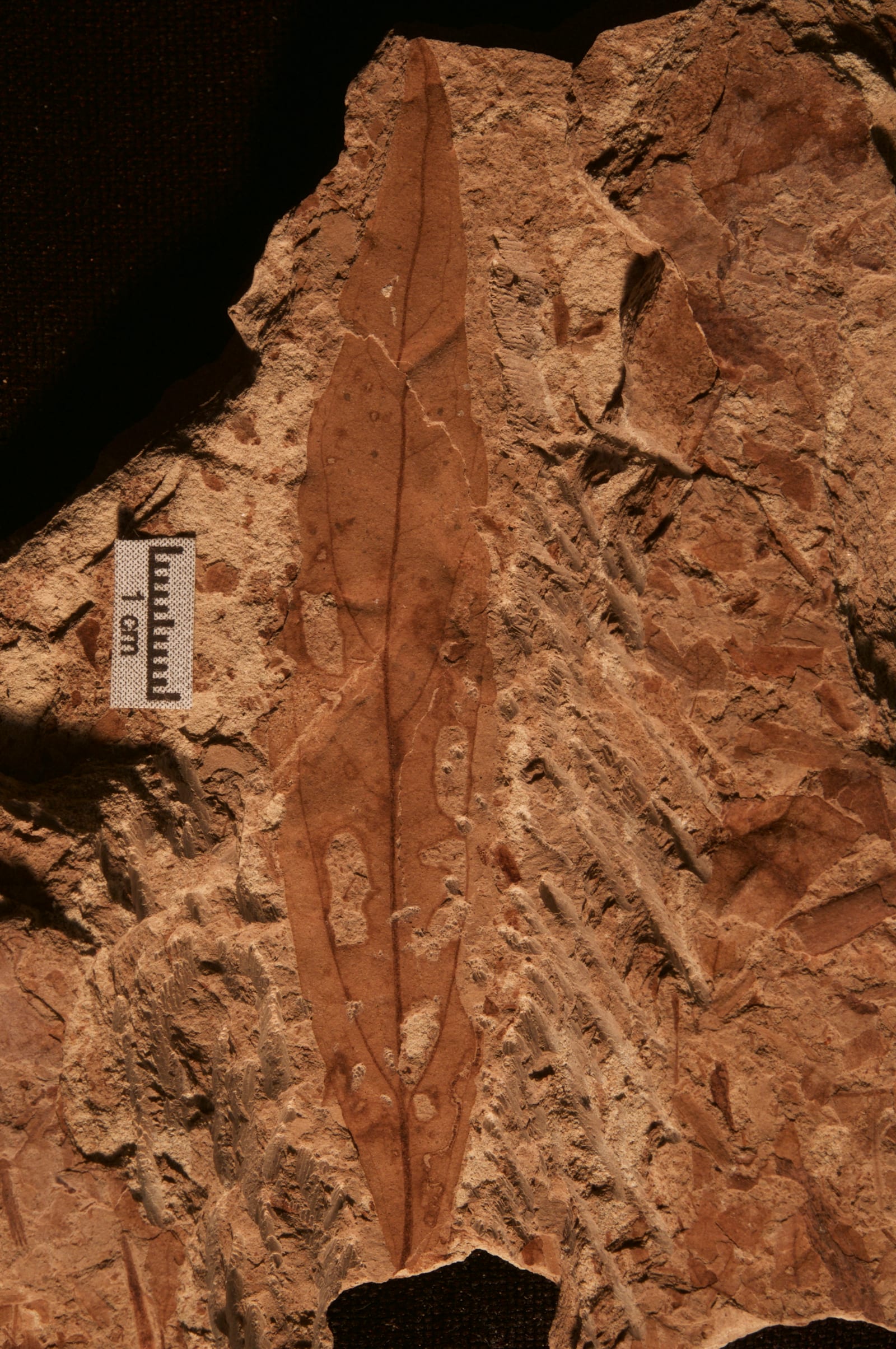
The most revealing mark in the cover photograph is easy to miss. Several leaves lie flattened into the rock; some carry obvious holes. At lower right, however, a pale route wanders through a smaller leaf. It is a leaf mine, the remains of a tunnel made by an insect larva feeding between the leaf's outer layers about 67–66 million years ago.[7][10]
The larva itself is gone. No wings, legs, mouthparts, or body outline identify it. Yet the fossil is not merely evidence that an insect once existed nearby. Its path can preserve where feeding began, how the animal grew, what tissue it avoided, where it left waste, and sometimes how it departed. The leaf is both the larva's food and the page on which part of its life was written.
That makes a fossil mine unusually intimate—and unusually easy to overread. A mine can be direct evidence of behavior before it is secure evidence of an insect family. One mine can record a life; many mines, sampled carefully, can reveal a relationship between plant and herbivore. Only an assemblage measured across beds can begin to support claims about extinction, recovery, or climate. The same trace becomes a different kind of evidence as the scale of the question changes.
A tunnel that widens with its maker
A convincing leaf mine is more than a squiggle. It occupies the leaf tissue rather than sitting on its surface, usually begins at an oviposition point, and commonly broadens as the larva eats and grows. Dark pellets or a continuous line of frass—the miner's waste—may run through the tunnel. Veins can deflect the route. A chamber, slit, or breach near the end may mark pupation or exit.[1][3][6]
The oldest unequivocal example now known makes that miniature biography remarkably clear. In 2025, Michael Laaß and colleagues re-examined Asteronomus maeandriformis on seed-fern leaves from Crock in central Germany. The material comes from the early Permian, about 298 million years ago. The mines begin near structures interpreted as eggs or oviposition scars, travel within the leaf, widen progressively, contain frass, and end at exits. More than 80 percent of the abundant Autunia conferta foliage at the locality was affected.[1]
Those features turn static rock into a sequence. A small beginning precedes a large ending. Food consumption increases with body size. Waste follows the animal through its shelter. The route is not a preserved body, but it is a record made by a body changing over time.
Late Triassic mines from a fern in Japan tell a similar story with different details. Three roughly 220-million-year-old mines on Cladophlebis leaves contain winding frass trails that expand along with the tunnels. Their makers crossed secondary veins but generally did not cross the stronger midrib, and one broadened terminus may be a pupal chamber. Chemical mapping found phosphorus-rich material consistent with coprolites inside the mine.[3] Growth, feeding, defecation, movement, and perhaps metamorphosis are compressed onto one leaf surface.
The plant also answered back. Living tissue can form reaction rims around damage, evidence that the injury occurred while the leaf was alive rather than as a tear after burial.[1] The fossil therefore contains an interaction, not just an action: an insect ate; a plant responded.
“Oldest” depends on what counts
The early Permian discovery shifted the accepted history of leaf mining by more than 40 million years. Before 2025, convincing examples were generally placed in the Triassic; the Japanese mines described below were among the oldest well-documented cases. Yet an older Carboniferous trace had already complicated that timeline. A roughly 312-million-year-old mark on Macroneuropteris from Massachusetts was interpreted in 2023 as endophytic feeding—feeding within plant tissue—but not as a fully developed leaf mine. It lacks the complete package of features used to recognize the modern habit.[2][3]
This is not semantic fussiness. It is how a trace-fossil record acquires a reliable beginning. If every internal blemish counts, the behavior may seem ancient but the category becomes loose. If the standard requires a route, evidence of growth, waste, tissue response, and a plausible beginning or end, fewer fossils qualify but each carries more information.
So “the oldest leaf mine” is a statement about both time and definition. The Carboniferous trace may preserve an evolutionary precursor. The Permian mines meet a stronger behavioral test. The Triassic fern mines remain important records of a later miner on a different host, even though they have lost the superlative.[1][2][3] A new fossil did not make the older studies useless; it changed the map onto which they fit.
A habit can be clearer than an identity
Leaf mining evolved independently in multiple insect lineages. Living miners include larvae of moths, flies, beetles, and sawflies. Their mines vary within groups, while unrelated miners can produce similar forms.[1][3] That convergence creates the central asymmetry of the evidence: a fossil can show with high confidence that an insect mined a leaf while leaving the insect's exact lineage unresolved.
Researchers narrow the possibilities by reading combinations rather than outlines alone. They examine where the egg was placed, whether the mine crosses veins, how its width changes, whether it occupies the upper or lower leaf tissue, how frass is arranged, what happens at the margin, and which plant hosted it.[3][6] Age matters too: a resemblance to a living mine cannot identify a lineage that had not yet evolved.
Some combinations can be diagnostic. Isaac Winkler and colleagues argued that certain Paleogene mines preserve a distinctive agromyzid-fly pattern: intermittent, fluidized frass deposited alternately along the mine margins. One fossil also preserves small feeding punctures like those made by adult female flies near egg-laying sites.[4] The claim rests on several behaviors occurring together, not on a generic winding line.
Even then, identity has limits. The fossil is usually named as a trace made by an organism, not as the body fossil of that organism. Ancient host associations can also differ from modern ones: the plant genera hosting the fossil agromyzid mines studied by Winkler and colleagues are not mined by agromyzids today.[4] The past does not have to preserve the ecological pairings familiar to a field guide.
The host leaf is half the fossil
A mine is one of the rare traces that arrives with its food attached. Leaf shape and venation can sometimes identify the host plant; the mine records how the insect used it. Together they preserve a trophic link—plant to herbivore—even when the consumer has no body fossil.
But a damage type is not automatically an insect species. Similar marks may be made by more than one taxon, and the same insect lineage can alter its mine as it grows or moves among hosts. Preservation hides delicate features, collecting favors conspicuous leaves, and rare interactions are easily missed. A leaf assemblage with no observed mine may represent a true biological absence, a host that was uncommon, a small sample, or damage too faint to survive.[5]
This is why paleobotanists census leaves rather than assembling only a cabinet of spectacular examples. They record the number of specimens, host taxa, damage categories, feeding frequencies, and sampling coverage. They compare like-sized samples or use methods that account for unequal coverage.[5][9] Repetition changes the question. One mine says, “a larva fed here.” Many similar mines on the same host suggest a recurring association. Comparable samples across layers can show whether an interaction persisted, disappeared, or was replaced.
The host is not background scenery in that analysis. If a plant vanishes, its specialist miner may vanish with it. If the plant survives but its characteristic mines do not, the plant lineage and the ecological relationship have told different extinction stories.
Extinction can spare the leaf and erase the relationship
The end-Cretaceous extinction makes that distinction visible. At Mexican Hat in Montana, researchers compared 1,073 early Paleocene leaves with more than 18,000 Cretaceous and Paleocene leaves from the wider region. They found nine leaf-mine damage types at Mexican Hat, six unique to that flora, and no convincing evidence that the region's Cretaceous mining associations continued across the boundary. Familiar-looking vegetation did not imply continuity among its specialized herbivores.[6]
Patagonia supplies a revealing contrast. A study of 3,646 fossil leaves from the latest Cretaceous and three slices of the early Paleocene found diverse, novel mines at all of the post-extinction sites. Specialized plant–insect associations appear to have recovered more rapidly there than in western North America.[7] The difference is regional, not a contradiction to be averaged away. Extinction recovery did not proceed at one universal speed.
The leaf mine is powerful here because specialization leaves a spatially precise trace. A hole records consumption. A mine often records a larva living inside a particular host for a substantial part of its development. The disappearance of that recurring design can therefore mark the loss of an ecological relationship even when leaves and insect body fossils offer separate, incomplete histories.
Still, novelty of mine form does not prove the sudden origin of a new insect family. It shows that the sampled interaction pattern is new. The distinction preserves what the fossils genuinely demonstrate.
Climate appears in the census, not the single path
Mined leaves can also help test how herbivory changed during rapid warming. In a study spanning the Paleocene–Eocene Thermal Maximum in Wyoming, Ellen Currano and colleagues scored 5,062 fossil leaves and recognized 50 damage types. Damage frequency and diversity, including the diversity of mines, peaked in the warm interval.[8]
That result does not turn one fossil mine into a thermometer. Temperature, atmospheric carbon dioxide, plant composition, leaf nutrients, seasonality, insect metabolism, and sampling can all affect the preserved pattern. The signal emerges from standardized comparisons among floras, not from the drama of an individual specimen.[5][8]
The hierarchy matters. At the smallest scale, a widening path is evidence of larval growth. Repeated paths on one host can support a host association. A sampled food web can reveal specialization. A sequence of sampled food webs can test ecological change through extinction or warming. Each step adds explanatory reach, but also adds assumptions that must be measured.
Read the absence at the right scale
The vanished insect is what first makes a leaf mine poignant. The path feels like a substitute for a body: motion without an animal, appetite without a mouth. Scientifically, however, the absence is not a defect to be filled with the most vivid possible story. It defines the inference.
The mine directly preserves an insect feeding within living tissue. Its widening can record growth; frass can record passage; reaction tissue can record the host's response. A bundle of features may narrow the maker to a lineage, but convergent behavior keeps some identities provisional. Repeated mines can reconstruct relationships, but incomplete sampling keeps apparent absences conditional.[1][4][5]
That disciplined uncertainty does not make the trace thin. It makes it unusually rich. A body fossil usually preserves what an organism was. A leaf mine can preserve something the organism did, in order, to another living thing. The larva vanished, but for part of its larval life it turned a leaf into food, shelter, refuse trail, and map. Deep time kept the map.
Sources
- Michael Laaß and colleagues, “Host-specific leaf-mining behaviour of holometabolous insect larvae in the early Permian,” Scientific Reports 15 (2025) — open study of Asteronomus mines, oviposition structures, growth, frass, exits, reaction tissue, and host frequency.
- Richard M. Knecht and colleagues, “Endophytic ancestors of modern leaf miners may have evolved in the Late Carboniferous,” New Phytologist 240 (2023) — record and abstract for the 312-million-year-old internal-feeding trace interpreted as a precursor rather than an unequivocal mine.
- Yume Imada and colleagues, “Oldest leaf mine trace fossil from East Asia provides insight into ancient nutritional flow in a plant–herbivore interaction,” Scientific Reports 12 (2022) — open study of Late Triassic fern mines, frass, vein crossing, and possible pupation.
- Isaac S. Winkler and colleagues, “Distinguishing Agromyzidae (Diptera) leaf mines in the fossil record: new taxa from the Paleogene of North America and Germany and their evolutionary implications,” Journal of Paleontology 84 (2010) — journal record for diagnostic frass, feeding punctures, and changing host associations.
- Sandra R. Schachat and colleagues, “Linking host plants to damage types in the fossil record of insect herbivory,” Paleobiology 49 (2023) — analysis of sample coverage, host specificity, and the limits of equating damage types with insect taxa.
- Michael P. Donovan and colleagues, “Novel insect leaf-mining after the end-Cretaceous extinction and the demise of Cretaceous leaf miners, Great Plains, USA,” PLOS ONE 9 (2014) — open study of mine identification and Paleocene turnover at Mexican Hat.
- Michael P. Donovan and colleagues, “Rapid recovery of Patagonian plant–insect associations after the end-Cretaceous extinction,” Nature Ecology & Evolution 1 (2017) — fossil-leaf census showing a regionally distinct recovery of specialized herbivory.
- Ellen D. Currano and colleagues, “Sharply increased insect herbivory during the Paleocene–Eocene Thermal Maximum,” Proceedings of the National Academy of Sciences 105 (2008) — open assemblage study of 5,062 leaves and 50 damage types across a rapid warming event.
- Conrad C. Labandeira and colleagues, Guide to Insect (and Other) Damage Types on Compressed Plant Fossils (version 3.0, Smithsonian Institution, 2007) — institutional record for the damage-type framework used to classify fossil plant–insect associations.
- Penn State, “Patagonian fossil leaves reveal rapid recovery from dinosaur extinction event” — provenance and caption for the real 67–66-million-year-old Lefipán Formation fossil-leaf photograph used as the article image.