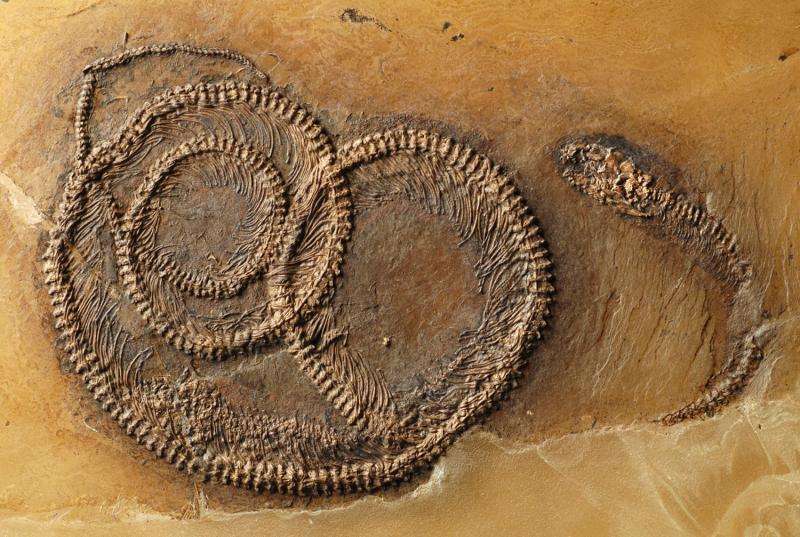
The snake forms a loose knot of vertebrae and ribs. Inside lies a lizard; inside the lizard, fragments of an insect. Senckenberg specimen SMF ME 11332 preserves two meals, one carried into the next.[1]
The snake was about 103 centimetres long, a young animal of a species that could exceed two metres. Its prey had been swallowed headfirst. By the time the snake died, it had become the outermost container in a small chain of consumption. That chain survives in the roughly 48-million-year-old lake deposits of Germany's Middle Messel Formation.[2][4]
That lake occupied a volcanic crater surrounded by warm forest. A major review published in 2024 describes a paratropical setting near the end of the Early Eocene Climate Optimum, while cautioning against routinely calling it a tropical rainforest. Messel's unusual richness comes partly from preserving organisms together that fossil deposits often separate: plants, insects, vertebrates and much smaller life.[3] This particular fossil gives those neighbours a sequence of actions.
Read through the ribs
The crucial detail is the overlap: snake ribs cross the lizard's skeleton, establishing that it lay inside. The insect occupies the lizard's abdomen. Krister Smith and Agustín Scanferla's 2016 paper identifies that innermost animal only as an insect. Its cuticle retains structural colour, but too little anatomy survives for greater precision.[1]
A fossil association needs this sort of physical argument. Three creatures on one surface could have arrived separately. Here, the nesting supplies a direction: the lizard consumed the insect before the snake consumed the lizard. The position of a body does work that a list of species cannot.
Preparation changed the view. The fossil was transferred from oil shale onto epoxy resin and exposed from the opposite side. The insect, documented on the original surface, became difficult to see.[1] Its excavation record preserves a view the finished object cannot supply.
The lizard brought its own history
The prey belongs to Geiseltaliellus maarius, a relative of living basilisks and casquehead lizards. Long hindlimbs, pointed claws and an exceptionally long tail help explain its reconstruction as a climber. The Messel site's account describes a tail that could reach three times the combined length of head and trunk. It also presents the animal as capable of moving effectively on the ground.[5]
That last detail keeps the scene open. A climbing animal can descend to feed, cross a gap or move between trees. Finding it in another animal's stomach identifies an encounter; it does not locate the branch, bank or patch of leaf litter where the encounter happened.
The site's synthesis describes adult Geiseltaliellus as eating both insects and plant material.[5] Against that broader diet, the insect inside this individual becomes especially useful. It gives one feeding event a physical address. It cannot tell us the proportion of insects in the lizard's usual diet, whether that proportion changed with the season, or how often plant food supplemented it. Those questions require a series of meals, or other independent evidence.
Move the imagined hunt closer to the ground
Readers following older labels will meet the snake as Palaeopython fischeri. In 2020, Scanferla and Smith assigned it to the new genus Eoconstrictor, resolving its affinities with the lineage of Neotropical boas. The change came from comparative anatomy and phylogenetic analysis; the nested meal remained the same specimen.[4]
Their study also tested habitat preferences using body and tail proportions in living snakes. Eoconstrictor fitted a generalist interpretation best, with substantial time on the ground more likely than a strictly arboreal life. This was an anatomical comparison, not a preserved movement trace.[4]
Put that result beside the lizard's climbing equipment and a useful asymmetry appears. A predator need not share every habitat preference of its prey. The fossil allows us to imagine a meeting between animals using the forest differently, without turning the swallowed lizard into proof that the snake hunted high in the canopy.
A short interval inside a long one
The prey's preservation suggests a brief interval between feeding and the snake's death. The Messel site's account gives an estimate of one to two days, based on how little digestion had damaged the lizard.[2] That estimate makes the event feel almost reachable. It remains an inference from digestion, rather than a timestamp measured from the rock.
The subsequent journey to preservation had its own complications. In a 2012 study of other Geiseltaliellus fossils, Smith and Michael Wuttke found that most examined carcasses apparently sank quickly after entering the lake, while one had floated. They also discussed how decay gases, water pressure and the formation of fatty, waxlike adipocere could affect whether bodies stayed together.[6]
Those observations matter because an intact skeleton can tempt us to erase everything between death and burial. The lizard inside this snake followed a different route into the lake from a free carcass. Its enclosing predator was part of that route. Reconstructing the meal and explaining the preservation are connected tasks, each needing its own evidence.
The specimen's lasting appeal is its change of scale. An Eocene forest becomes a single snake; the snake becomes the space around a lizard; the lizard becomes the resting place of an insect's cuticle. Each inward step brings the story closer to an individual action. At the centre is a meal whose consumer became somebody else's food.
Sources
- Krister T. Smith and Agustín Scanferla, “Fossil snake preserving three trophic levels and evidence for an ontogenetic dietary shift,” Palaeobiodiversity and Palaeoenvironments 96 (2016), pp. 589–599—specimen, preparation, nested remains and fossil photograph.
- Welterbe Grube Messel, “Eoconstrictor fischeri,” specimen and species fact sheet—body size, swallowed prey and the proposed interval before death. German-language PDF.
- Krister T. Smith and colleagues, “The biodiversity of the Eocene Messel Pit,” Palaeobiodiversity and Palaeoenvironments 104 (2024), pp. 859–940—geological setting, forest environment and the range of preserved organisms.
- Agustín Scanferla and Krister T. Smith, “Exquisitely Preserved Fossil Snakes of Messel,” Diversity 12 (2020), article 100—taxonomic revision and comparative habitat analysis, especially sections 3.1 and 3.5. Publisher PDF.
- Welterbe Grube Messel, “Geiseltaliellus maarius”—anatomy, living relatives, climbing adaptations and mixed diet. German-language species account.
- Krister T. Smith and Michael Wuttke, “From tree to shining sea,” Palaeobiodiversity and Palaeoenvironments 92 (2012), pp. 45–65—study of decay and preservation in Messel's Geiseltaliellus fossils.