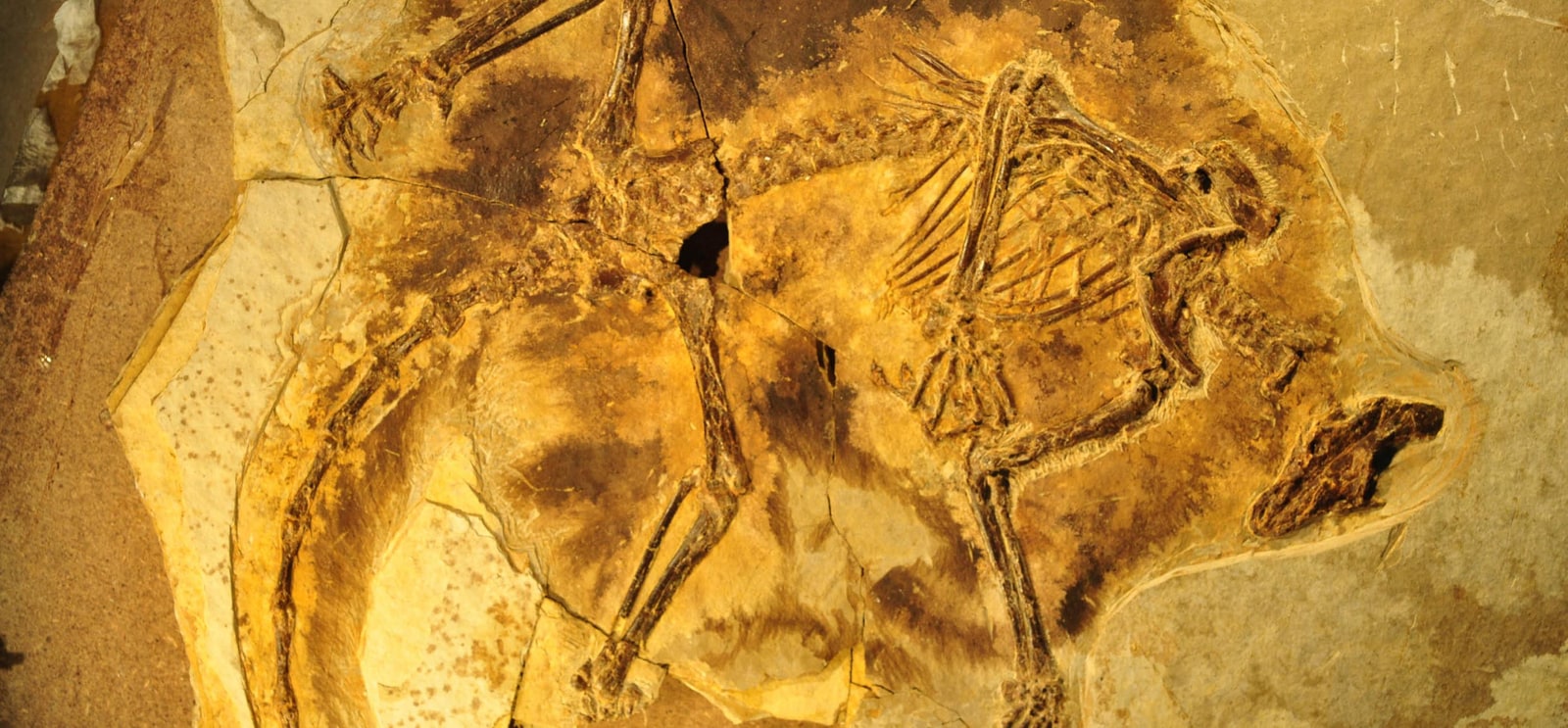
A small skeleton lies spread across a slab, its limbs reaching into a darker fringe. In Maiopatagium furculiferum, traces of fur and skin preserve the surface that supported a Jurassic glider.[1]
The specimen belongs to a world roughly 160 million years old. It came from the Tiaojishan Formation in northeastern China, where discoveries have revealed mammals and their close relatives experimenting with life above the ground. Maiopatagium was a haramiyidan, a member of an extinct branch of the broader mammalian family. Its resemblance to a flying squirrel offers a useful starting comparison, provided we keep the two animals on their separate evolutionary branches.[2]
Reading the space beside the skeleton
Qing-Jin Meng and colleagues described the fossil in 2017. The main slab preserves almost the entire skeleton; broken, thin counter-layers retain corresponding traces of its covering. Under ultraviolet illumination, the researchers could distinguish preserved fur and membranes from the surrounding rock. They interpreted a membrane running from wrist to ankle, another in front of the forelimb, and an incompletely preserved rear membrane.[1]
This is why the space between the limbs deserves attention. A skeleton alone makes us estimate how far a living surface extended. Here, tissue traces help constrain the outline itself. The outline still needs anatomical interpretation: a stain does not arrive with a label explaining its function. But its position beside the articulated bones lets researchers ask a more specific question than whether the animal merely looked capable of climbing.
Long limbs, elongated digits and preserved membranes together supported the interpretation of a tree-dwelling glider.[2] The force of the case comes from their agreement. Each feature contributes something different: a surface, supports for that surface, and a body suited to using branches. The fossil preserves the equipment for an inferred behavior; it does not preserve a journey through the air.
A shoulder with an unfamiliar arrangement
The shoulder supplied a surprise. The clavicles and interclavicle formed a rigid, wishbone-like structure. The researchers located the mobility needed for gliding at other shoulder joints, unlike the pivotal clavicle–sternum arrangement of living marsupial and placental gliders.[1]
A superficial likeness can therefore hide a different mechanical arrangement. Giving an extinct animal the silhouette of a flying squirrel may help us imagine its movement, but the analogy becomes more informative when we look for the places where it breaks down. Which connections were rigid? Where could the arm move? Those questions turn a familiar outline into an anatomical investigation.
A broader study by David Grossnickle and colleagues, published in 2020, tested comparisons among living gliders and included fossil forms. Living glider groups generally had longer, more slender limbs than other tree-dwelling mammals, yet their skeletons retained substantial differences. The authors described this as incomplete convergence: repeated movement toward similar functional solutions without arrival at a single shared body shape.[3]
That result gives Maiopatagium room to be distinctive. Differences from living gliders need not automatically defeat a gliding interpretation. They must be assessed alongside the preserved membranes and the rest of the skeleton. Conversely, elongated limbs alone cannot specify the complete flight apparatus. The comparison works best as a way to test particular features, with attention to body size and membrane attachment.[3]
Bringing the animal back into the trees
Reconstructing a living Maiopatagium requires another step. The University of Chicago’s account of the illustration process describes how CT scans informed three-dimensional skeletal models, which then supported artwork and animation. Illustrator April Neander also used comparisons with living animals to fill gaps, including the appearance of the external ears.[4]
The resulting creature can seem wonderfully immediate. That immediacy combines preserved structures with choices about missing anatomy and posture. A reader can enjoy the reconstruction while asking which parts were measured, which were inferred, and which were selected to make the animal visible as a living whole. The photograph offers a useful place to return: the extended bones remain crisp in places, while the surrounding tissue is less tidy than an illustrated wing.
The forest itself also resists a simple modern replacement. The researchers placed these animals among Jurassic vegetation dominated by ferns and gymnosperms, including conifers and cycads, before flowering plants became dominant. They inferred plant feeding in an ecosystem with a different menu from many living gliders’ habitats.[2]
A leap between those trees is something we reconstruct. The membrane left beside the bones is something we can examine. Maiopatagium brings the two unusually close together, allowing an aerial life to be argued from a surface that survived in stone.
Sources
- Meng, Grossnickle, Liu, Zhang, Neander, Ji and Luo, “New gliding mammaliaforms from the Jurassic.” Nature 548 (2017), 291–296 — original description, preserved membranes and shoulder anatomy.
- Matt Wood, “First winged mammals from the Jurassic period discovered.” University of Chicago News, August 9, 2017 — age, geological setting, relationships and ecological interpretation.
- David Grossnickle, “Data from: Incomplete convergence of gliding-mammal skeletons.” Dryad (2021), accompanying Grossnickle and colleagues’ 2020 Evolution paper — study summary, comparative measurements and link to the research article.
- Ingrid Gonçalves, “Mammals like us.” The University of Chicago Magazine, Fall 2017 — specimen photograph credited to Zhe-Xi Luo and an account of CT scanning and scientific reconstruction.