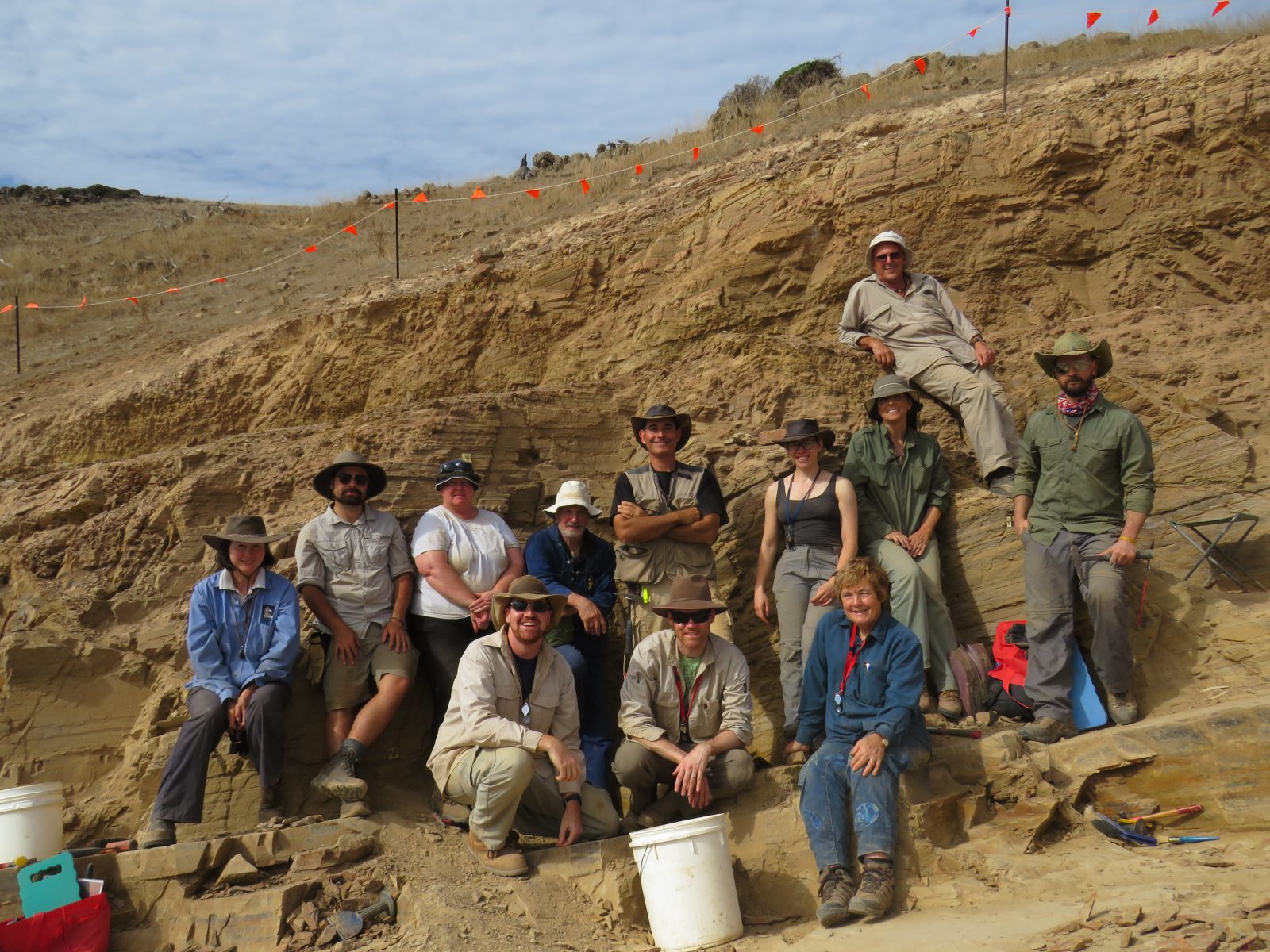
Nine days of splitting rock can produce a very particular view of an ancient sea. During an April 2018 expedition to Kangaroo Island, researchers worked in a private quarry where temperatures often exceeded 35 degrees Celsius. Harriet Drage, studying how trilobites shed their outer skeletons, recorded more than 200 individuals in the field and a comparable number in the South Australian Museum's collections.[1]
The expedition was sampling the Emu Bay Shale, an early Cambrian deposit about 514 million years old. Its fossils include delicate structures that usually disappear before an animal can enter the geological record.[1] Yet recovering extraordinary anatomy is only part of the work. A beautifully preserved eye still needs a sea to look into.
At Emu Bay, reconstructing that sea has required following the evidence from quarry faces into drill cores, then back to the animals themselves.
Read sideways before looking closer
The fossil-bearing rocks occur around Big Gully on Kangaroo Island's north coast. In their 2011 geological study, James Gehling and colleagues described the exceptional fossils mainly within the formation's lowest ten meters. Dark, finely layered mudstone carries the remains, interrupted by thin sandstone beds that the authors interpreted as products of sediment flows or storms.[2]
Those beds do not continue indefinitely. The fossil-bearing mudstones thin southward and disappear roughly 500–600 meters from the coast. Higher in the formation, sandstone becomes more prominent and arthropod tracks are abundant.[2]
This lateral view matters. A collector opening one slab sees a surface; a geologist following the layer sees how quickly the setting changes. The fossil deposit occupies a particular part of a changing sedimentary landscape. It cannot simply be stretched across a reconstruction of the entire Cambrian coast.
The surrounding succession also records folding and faulting while sediment was accumulating. Gehling's team linked older conglomerates to fans of sediment delivered from an uplifted margin nearby.[2] The setting already had a history of movement before its most celebrated animals were buried.
A fresher sample changes the water
Robert Gaines and colleagues brought outcrop observations together with borehole samples and more than 25,000 fossil specimens in a 2024 study. They interpreted the deposit as part of a fan delta: sediment spread into a marine basin beside tectonically active land. Nearshore here could still mean water tens of meters deep.[3]
Fresh core samples contained more organic carbon and preserved pyrite absent from weathered surface samples. Together with other evidence, these findings supported episodes of oxygen depletion near the bottom. The authors inferred that sediment flows carried many animals downslope and buried them rapidly.[3]
The comparison exposes a practical difficulty in reconstructing ancient environments: the rock available at the surface has continued to change. Drilling supplied a less weathered chemical record. Reading the quarry therefore required looking beneath it.
Some trilobites belonged on the bottom
Transport does not mean every fossil was a visitor. A 2023 study by Russell Bicknell and colleagues discusses intact moult arrangements of trilobites, including the small, abundant Estaingia bilobata, as evidence that they lived in or near the oxygen-poor bottom setting. Many other organisms could have arrived from shallower water or settled from above.[4]
A shed skeleton is especially useful here. Its arrangement can preserve something about an animal's activity, helping distinguish a place used during life from a place that merely collected remains. Such evidence supports local occupation without requiring the seabed to have remained hospitable continuously.[4]
Bicknell's team also described damaged and malformed Estaingia. Some injuries could reflect failed attacks; mangled exoskeletons supplied further evidence of predation. But an injury on a large individual might have happened much earlier and survived subsequent moults.[4] Even with an unusually rich sample, the timing of an encounter can remain unresolved.
Eyes open another part of the sea
Above that bottom, vision offered different opportunities. In 2020, John Paterson, Gregory Edgecombe and Diego García-Bellido compared two kinds of compound eye belonging to Emu Bay radiodonts, swimming arthropods from an early branch of the group's evolutionary history.[5]
One had stalked eyes with more than 24,000 lenses each, consistent with hunting in bright water. The other had eyes attached directly to the head, with an upward-facing region of enlarged lenses. The authors interpreted that arrangement as suitable for detecting plankton in dim light filtering down from above.[5]
These are functional interpretations of preserved structures, rather than observations of living animals. The fossils reveal lens arrangements; optics and comparison help researchers infer the conditions in which those arrangements worked. The contrast suggests that even closely associated swimmers could search the water in different ways.[5]
Put those eyes beside the trilobite moults and the field evidence, and Emu Bay gains depth. There is space between the animal shedding its skeleton near the bottom and the swimmer looking upward for food. There is also time between inhabiting that sea, being buried, and having a slab opened in a hot quarry. Keeping those distances visible gives the remarkable fossils a world large enough to live in.
Sources
- Allison Daley, “Fieldwork at the Emu Bay Shale,” University of Lausanne ANOM Lab (21 June 2018)—field season, trilobite research and the quarry-team photograph.
- James G. Gehling and colleagues, “The geological context of the Lower Cambrian (Series 2) Emu Bay Shale Lagerstätte and adjacent stratigraphic units, Kangaroo Island, South Australia,” Australian Journal of Earth Sciences (2011)—institutional record and abstract.
- Robert R. Gaines and colleagues, “The Emu Bay Shale: A unique early Cambrian Lagerstätte from a tectonically active basin,” Science Advances (2024)—published paper, including drill-core chemistry and the fan-delta interpretation.
- Russell D. C. Bicknell and colleagues, “Malformed individuals of the trilobite Estaingia bilobata from the Cambrian Emu Bay Shale and their palaeobiological implications,” Geological Magazine (2023)—published paper on environmental context, injuries and moulting.
- John R. Paterson, Gregory D. Edgecombe and Diego C. García-Bellido, “Disparate compound eyes of Cambrian radiodonts reveal their developmental growth mode and diverse visual ecology,” Science Advances (2020)—institutional record and research abstract.