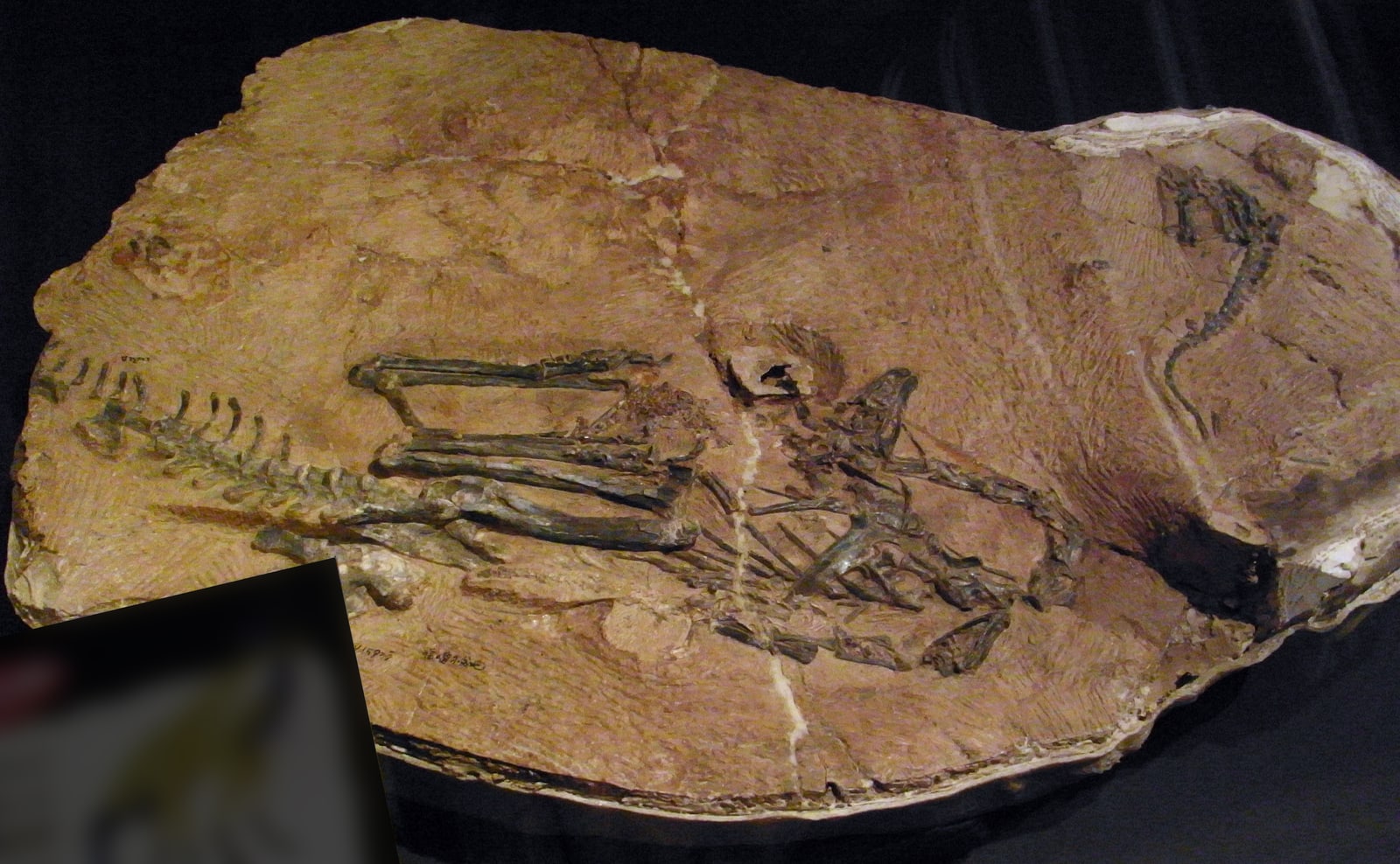
A toothless dinosaur jaw seems to offer a useful shortcut. Give the animal a beak, imagine what it could eat, and build its portrait from there. Limusaurus inextricabilis makes that shortcut troublesome. Its smallest individuals had teeth. The more mature ones had lost them.[4] Age belongs in the portrait.
The specimen that helped name the animal in 2009 preserves an almost complete, articulated skeleton: bones still connected closely enough to recover the body's arrangement.[1] Yet even a beautifully connected skeleton captures only one point in a life. To see what happened to this dinosaur's mouth, researchers needed a collection of deaths spread across different ages.
The animal that the first fossils revealed
Xing Xu and colleagues described Limusaurus from the upper Shishugou Formation near Wucaiwan, in China's Xinjiang region. It lived roughly 160 million years ago, during the Late Jurassic. The name refers to the animals' inferred entrapment in mud. The holotype—the specimen that anchors the species name—is IVPP V15923, held at the Institute of Vertebrate Paleontology and Paleoanthropology in Beijing.[1]
The original description emphasized an unusual combination: a small head, toothless jaws, long neck and elongated hind limbs. A beak and a concentration of swallowed stones supported an interpretation of plant eating. Here was a theropod, belonging to a dinosaur group famous for meat eaters, equipped for a different relationship with food.[1]
The accompanying photograph records a Limusaurus display at Tokyo's Dinosaur Expo 2011.[2] A mounted slab has the authority of a finished object. Scientific descriptions are easier to revise. The question soon became how much of the animal's apparent identity belonged specifically to its stage of growth.
Nineteen skeletons make a life history
The study announced in December 2016 and published in the January 2017 issue of Current Biology examined 19 specimens. Shuo Wang and colleagues sorted them into six growth stages using body size and bone histology—the microscopic structure of bone. Across the series they identified 78 anatomical changes, including the transition from toothed young animals to toothless, beaked older ones.[4]
Size provides a starting point for arranging fossils. Bone tissue adds a separate kind of evidence about growth. The agreement matters: a small skeleton cannot automatically be treated as a baby, any more than every anatomical difference must identify another species.
George Washington University's account of the research places the skeletons in mud traps in Xinjiang, where animals became stuck and died. Co-author James Clark emphasized how unusual it was to have a series spanning such different ages. Josef Stiegler stressed the opportunity to combine external anatomy, bone microstructure and chemistry.[3]
The tragedy of those deposits became their scientific advantage. Several individuals let researchers compare a proposed developmental sequence against repeated observations. A solitary toothless skull could never provide the same test.
The tooth sealed inside its socket
Missing teeth alone would leave an obvious problem: teeth can disappear after death. The jaw itself supplies stronger evidence.
A follow-up 2017 study described the internal architecture revealed by computed tomography. Mature Limusaurus jaws retain remnants of tooth sockets, but those spaces are closed above and incorporated into a canal within the lower jaw. In juvenile specimen IVPP V15301, the researchers identified a replacement tooth inside a socket whose biting surface had closed, preventing normal eruption.[5]
That is a wonderfully specific fossil detail. The hidden tooth records an interrupted process: a replacement had formed but could no longer reach the jaw's surface. Looking only at the jaw's outer edge would miss that history.
The authors connected these structures with a broader hypothesis about tooth development ending earlier as beaks evolved in several dinosaur lineages. Their proposed developmental mechanism goes beyond what a scan can directly reveal.[5] Bone can preserve the architecture left by growth; it cannot preserve an experiment showing which molecular signal caused the change.
What went into the changing mouth?
Wang and colleagues proposed a shift from probable omnivory in juveniles to herbivory in adults. Alongside the jaws, they considered gastroliths—swallowed stones—and stable-isotope evidence.[4] The university's account likewise describes bone chemistry as support for a dietary change, while allowing that young animals might have eaten meat or a mixture of foods.[3]
These are different levels of resolution. The fossil series documents the disappearance of teeth. Reconstructing a menu requires combining clues about food processing and chemistry. It remains harder to say exactly which plants or small animals an individual consumed, or how much its diet varied through a season.
There is also an ecological possibility worth separating from the observations: if youngsters and adults ate different foods, they could have overlapped less in their demands on the same habitat. The growth series makes that question available. It does not measure competition between living animals.
A toothless jaw can retain its past
The comparison now extends beyond Limusaurus. In a 2025 study, Felipe Pierossi and colleagues reported a lower jaw of the Brazilian theropod Berthasaura with vestiges of tooth sockets. Their interpretation was that this animal, too, may have lost teeth during growth.[6]
The difference in evidence remains useful. A jaw retaining socket remnants suggests a history; a series of differently aged individuals lets researchers reconstruct that history in much greater detail.
Return to the fossil slab and the animal becomes less fixed. Its mouth was a structure with a past and, while it lived, a future. The most revealing question to ask of a dinosaur's teeth may be how long it kept them.
Sources
- Xing Xu et al., “A Jurassic ceratosaur from China helps clarify avian digital homologies,” Nature, 2009—original description, specimen identity, locality, anatomy and inferred herbivory; institutional PDF.
- ★Kumiko★, “Limusaurus inextricabilis holotype,” photographed at Dinosaur Expo 2011 in Tokyo—photograph and provenance record, Wikimedia Commons, CC BY-SA 2.0.
- George Washington University, “No Teeth? No Problem. Dinosaur Species Had Teeth as Babies, Lost Them as They Grew,” 22 December 2016—researchers' account of the fossil assemblage, growth series and dietary interpretation.
- Shuo Wang et al., “Extreme Ontogenetic Changes in a Ceratosaurian Theropod,” Current Biology, 2017, published online 22 December 2016—19 specimens, growth stages, tooth loss and dietary evidence; PubMed record and abstract.
- Shuo Wang et al., “Heterochronic truncation of odontogenesis in theropod dinosaurs provides insight into the macroevolution of avian beaks,” PNAS, 2017—internal jaw anatomy, enclosed sockets and the proposed developmental mechanism; institutional PDF.
- Felipe Pierossi et al., data and research abstract for “Convergent evolution among non-carnivorous, desert-dwelling theropods as revealed by the dentary of the noasaurid Berthasaura leopoldinae,” Dryad, 14 July 2025—new lower jaw and the interpretation of socket vestiges.