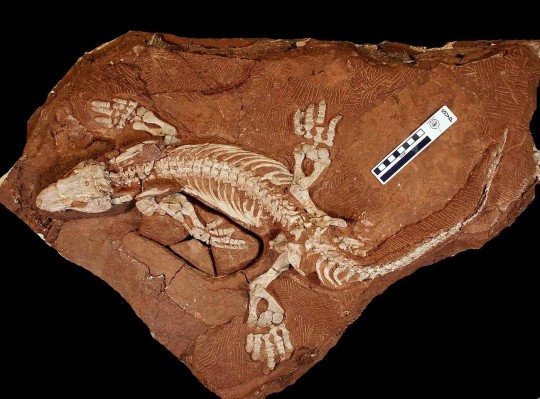
In 1998, paleontologist Amy Henrici pried a piece of rock from the Bromacker quarry floor in Germany and turned it over. An articulated foot appeared. At this unusually generous fossil site, a foot with its bones still connected offered a promising possibility: the rest of the animal might be nearby. It was. The skeleton became the holotype—the specimen anchoring the species name—of Orobates pabsti.[1]
Two decades later, researchers were asking that skeleton a different question. They wanted to know how it walked. Their answer combined fossil anatomy, ancient footprints, observations of living animals and a robot. Each contributed a different test of a proposed movement.[3]
Orobates lived in the Early Permian, roughly 290 million years ago. It was a four-legged herbivore from the Tambach Formation, long before dinosaurs. Its exceptional preservation makes it an unusually good subject for a difficult experiment: finding which movements remain plausible when several kinds of evidence have a chance to rule them out.[1][5]
First, give the bones room to move
The photographed skeleton is MNG 10181, housed in Gotha. Beautifully connected bones still carry the damage of burial. A flattened skull cannot simply be animated as though its present shape were its living shape.[2]
For their 2015 reconstruction, John Nyakatura and colleagues used computed tomography to separate bone from surrounding rock digitally. They repaired fractures, corrected distortion and mirrored preserved limbs. Some vertebrae and ribs required modelling informed by other material and the original anatomical description. The finished skeleton therefore combined measurements with explicit restoration decisions.[2]
That distinction matters at a joint. Moving the reconstructed humerus until it strikes the shoulder girdle estimates a bony limit. Cartilage, ligaments and muscles could have restricted movement further; an animal need not use its entire available range during an ordinary step. The reconstructed joint gives the walking experiment boundaries, without supplying the movement itself.[2]
The footprints constrain the destination
Bromacker also preserves trackways attributed to Orobates, named Ichniotherium sphaerodactylum. Relative toe lengths help connect the tracks with the skeleton. The attribution is anatomical: the body fossil is not the individual caught at the end of its own trail.[1][5]
Footprints tell researchers where feet contacted the ground. They do not directly record the height of the belly, the bending of the trunk or the route a foot took through the air. Think of two people stepping on the same paving stones: matching their contact points would not establish identical movements between them. This is the reconstruction problem in miniature.
The team’s kinematic model tested motions against both the digitized trackway and the skeleton. A candidate walk had to place its feet appropriately while keeping bones connected and avoiding impossible collisions. Researchers varied body height, sideways bending of the spine and patterns of limb movement, exploring alternatives instead of selecting one convincing animation.[3]
Then let the floor push back
Geometry is only the first test. A sequence of positions can fit a skeleton yet demand awkward forces or leave the body poorly balanced. Dynamics adds mass, gravity and contact with the ground to the question of movement.[3]
The 2019 study by Nyakatura, Kamilo Melo and colleagues combined dynamic simulations with OroBOT, a physical walking model. Gaits were evaluated for mechanical power demand, stability, agreement with ground forces measured in living animals, and fidelity to the fossil footprints. These criteria constrain different weaknesses: a walk can reach the right places while performing poorly under another measure.[4]
The robot makes that distinction tangible. Its feet must meet a real surface, where friction and balance affect what happens. But motors are not fossil muscles. The authors explicitly acknowledged that their models omitted actual muscles and other soft tissues. A successful robot trial supports the mechanical feasibility of a proposed gait within the model’s assumptions; it cannot recover the extinct animal’s complete physiology.[5]
The most useful output is therefore a set of defensible movements and an account of why other movements perform badly. The robot’s ability to walk becomes evidence only through those comparisons.
Check the method on animals that can still walk
Living salamanders, skinks, iguanas and caimans supplied comparative observations. Their sprawling limbs do not all produce the same gait, making them useful for separating general mechanical constraints from the habits of one modern species.[3]
The researchers also tested their reconstruction approach on salamanders and caimans, treating their anatomy and tracks as if the animals were extinct. The method recovered their contrasting locomotor styles. That is a stronger check than simply producing an attractive Orobates animation: it asks whether the procedure can distinguish movements whose answers are independently observable.[5]
For Orobates, the combined results favored relatively elevated, balanced, mechanically economical walking over an assumed low sprawl. “Elevated” here concerns how it carried its body; it does not turn the animal into a mammal with legs tucked underneath it. The result remains a reconstruction of plausible gait, rather than a recording of one particular Permian journey.[4]
A walk and a family tree are different results
The original paper framed Orobates as a stem amniote, outside the crown group containing living mammals and reptiles, including birds. Under that placement, its capable terrestrial gait suggested that such locomotion arose before the crown group diversified.[4]
The placement remains disputed. Jasper Ponstein and colleagues’ 2024 analysis recovered diadectomorphs inside Amniota, next to the mammalian branch, in its majority-rule consensus tree; other ways of summarizing their trees did not recover that relationship. Sean Modesto’s separate 2024 review challenged the evidence used to move these animals into the crown group.[6][7]
This distinction changes how the walking result should travel into evolutionary history. The anatomical and mechanical tests can remain informative while the branch carrying Orobates moves. Establishing a plausible gait does not, by itself, establish when that gait first evolved relative to the origin of a larger group.
The foot Henrici exposed supplies a fitting place to return. Its bones constrain shape; comparable impressions constrain contact; experiments test what might connect one contact with the next. Between those observations lies a walk that can be questioned, revised and tested again.
Sources
- Amy Henrici, “The Bromacker Project Part V: Orobates pabsti, Pabst’s Mountain Walker,” Carnegie Museum of Natural History—discovery, track attribution and Dave Berman’s holotype photograph.
- John A. Nyakatura et al., “A Three-Dimensional Skeletal Reconstruction of the Stem Amniote Orobates pabsti (Diadectidae),” PLOS ONE (2015)—specimen restoration, mass and joint mobility.
- EPFL Biorobotics Laboratory, “OroBOT”—the research team’s account of kinematic modelling, living comparisons and dynamic gait tests.
- John A. Nyakatura, Kamilo Melo et al., “Reverse-engineering the locomotion of a stem amniote,” Nature 565 (2019)—the combined experiment and its evolutionary interpretation.
- Nyakatura, Melo and colleagues, “Frequently Asked Questions” (2019), EPFL—trackmaker association, model limitations and validation with living animals.
- Jasper Ponstein, Mark J. MacDougall and Jörg Fröbisch, “A comprehensive phylogeny and revised taxonomy of Diadectomorpha with a discussion on the origin of tetrapod herbivory,” Royal Society Open Science (2024).
- Sean P. Modesto, “Problems of the interrelationships of crown and stem amniotes,” Frontiers in Earth Science (2024)—a critical assessment of proposed crown-group placements.