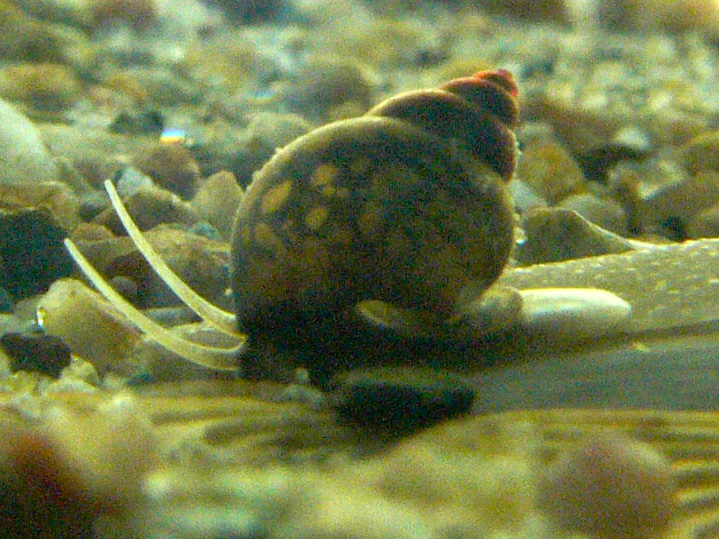
A freshwater snail carries a small door. When Bithynia withdraws, an operculum closes the opening of its shell. Long after the animal dies, that separate piece can retain protein residues within its mineral structure. Their slow chemical alteration gives paleontologists a way to compare the ages of deposits whose animals have otherwise disappeared.[2]
The scale of the opportunity became clear in 2011, when Kirsty Penkman and colleagues reported analyses of 470 opercula from 74 sites. Those inconspicuous remains helped arrange Britain's fragmentary Quaternary record—the past roughly 2.6 million years—against the repeated cold and warm stages known from marine sediments. A snail's door could help place an entire fossil assemblage in time.[2]
The chemistry keeps changing
Proteins are chains of amino acids. Most of these building blocks have two mirror-image forms, conventionally called L and D, that fit together as imperfectly as a left hand and a right glove. For these amino acids, animal protein synthesis uses the L form. After death, or when tissue turnover stops, spontaneous chemical reactions gradually increase the proportion of D forms. Measuring the D/L ratio captures part of that change.[3]
This process, racemization, supplies a direction of travel. It does not provide an unlimited counter. As the proportions approach equilibrium, the ratio becomes less useful for distinguishing additional elapsed time.[3]
Different amino acids move along that path at different rates. In Bithynia opercula, relatively rapid changes in aspartic acid/asparagine help distinguish younger deposits, while slower-changing valine remains useful farther back. Reading several amino acids together extends the useful range and gives researchers more than one measurement to interrogate.[4]
Choose the door, then test the container
The shell and its door are chemically similar without being equivalent archives. Bithynia shells are made of aragonite; their opercula are calcite. Both minerals are calcium carbonate, but calcite is more stable. If shell aragonite recrystallizes during burial, the protein archive can be disturbed. The 2013 expanded study found that opercula gave less variable results and better protein preservation, plausibly reflecting this mineral stability.[4]
The laboratory must also choose which organic material to measure. A fossil contains more than a perfectly sealed remnant of its owner's proteins. Accessible material can have leaked away or exchanged with its surroundings. Measuring everything together risks combining components with different histories.[5]
Researchers therefore powder the sample and use a strong oxidant—bleach—to remove accessible organic matter. The resistant remainder is called the intra-crystalline fraction. In a 2008 experimental study, Penkman and colleagues tested this approach using modern and fossil mollusc shells, including heating experiments designed to examine whether the retained fraction behaved as a closed system.[5]
“Closed” has a practical meaning here: the measured residues should have remained together sufficiently well for their changes to be interpretable. Bleaching selects a promising fraction; it cannot reverse damage that occurred before the sample reached the laboratory. A clean preparation still needs an internal check.
One check compares two portions of the sample. The free amino acid fraction contains amino acids already released from their protein chains. A second portion undergoes laboratory hydrolysis to release the remaining bound residues, yielding the total hydrolysable fraction. Both can then be analyzed by chromatography, which separates the compounds for measurement.[6]
Their ratios are expected to follow a coherent relationship, rather than equal one another. If smaller, mobile molecules have escaped while larger fragments remained, the two measurements can disagree with the expected pattern. Such departures give researchers grounds to question a specimen before allowing it to determine a site's position in the sequence.[4][6]
West Runton changes its place
The advantage is visible in a comparison of three English fossil localities. A 2010 study examined material from the West Runton Freshwater Bed in Norfolk alongside samples from Clacton-on-Sea and Waverley Wood. Earlier amino acid work on shells had placed Waverley Wood before West Runton, an ordering that conflicted with evidence from fossil animals.[7]
The opercula changed that result. All twelve protein-decomposition indicators used in the comparison supported West Runton being older than Clacton. The opercula also placed West Runton before Waverley Wood, bringing the chemical sequence into agreement with the biological evidence. Shell measurements had been less consistent.[7]
This was a useful correction without being an exact birthday. The researchers explicitly declined to assign West Runton to a particular marine isotope stage from the amino acid evidence alone. The method strengthened the ordering of deposits; a more precise placement still depended on other evidence.[7]
That is how a small fossil can reorganize a much larger story. Establishing which assemblage came first changes the sequence in which we interpret faunal arrivals, disappearances, and environmental transitions. The chemical result becomes most informative when it joins a well-recorded geological context.
Temperature sets the pace
A sealed mineral compartment does not insulate its contents from heat. Protein breakdown responds to temperature as well as elapsed time. Two equally old fossils with different burial temperatures can therefore give different results. Comparisons need samples with similar integrated thermal histories, or calibration that addresses the difference.[3]
The British framework was tested against independent dating, river-terrace sequences, and fossil evidence. These checks supplied the context needed to relate chemical ordering to glacial and interglacial history.[2]
An operculum's achievement is consequently more subtle than storing a number of years. It preserves a chemical history that can be tested against other histories. Mineral stability keeps that record available; laboratory comparisons help establish its integrity; geological evidence gives it a place. The little door is valuable because those separate lines of inquiry can meet inside it.
Sources
- Michal Maňas, photograph of a living Bithynia tentaculata (2007), Wikimedia Commons—image provenance and public-domain release.
- Kirsty E. H. Penkman and colleagues, “A chronological framework for the British Quaternary based on Bithynia opercula,” Nature 476 (2011), 446–449—regional dataset and independent chronological comparisons.
- Kirsty E. H. Penkman and colleagues, “Dating the Paleolithic: Trapped charge methods and amino acid geochronology,” PNAS 119 (2022)—racemization, equilibrium, calibration, and temperature dependence.
- Kirsty E. H. Penkman and colleagues, “An aminostratigraphy for the British Quaternary based on Bithynia opercula,” Quaternary Science Reviews 61 (2013), 111–134—mineral stability, multiple amino acids, and screening for compromised samples.
- Kirsty E. H. Penkman, Darrell S. Kaufman, Darrel Maddy and Matthew J. Collins, “Closed-system behaviour of the intra-crystalline fraction of amino acids in mollusc shells,” Quaternary Geochronology 3 (2008), 2–25—bleaching and experimental tests of the protected fraction.
- Kirsty E. H. Penkman and colleagues, “Testing the aminostratigraphy of fluvial archives: the evidence from intra-crystalline proteins within freshwater shells,” Quaternary Science Reviews 26 (2007), 2958–2969—free and total hydrolysable fractions, chromatography, and preservation limits.
- Kirsty E. H. Penkman, Richard C. Preece, David H. Keen and Matthew J. Collins, “Amino acid geochronology of the type Cromerian of West Runton, Norfolk, UK,” Quaternary International 228 (2010), 25–37—relative ordering of West Runton, Clacton, and Waverley Wood.