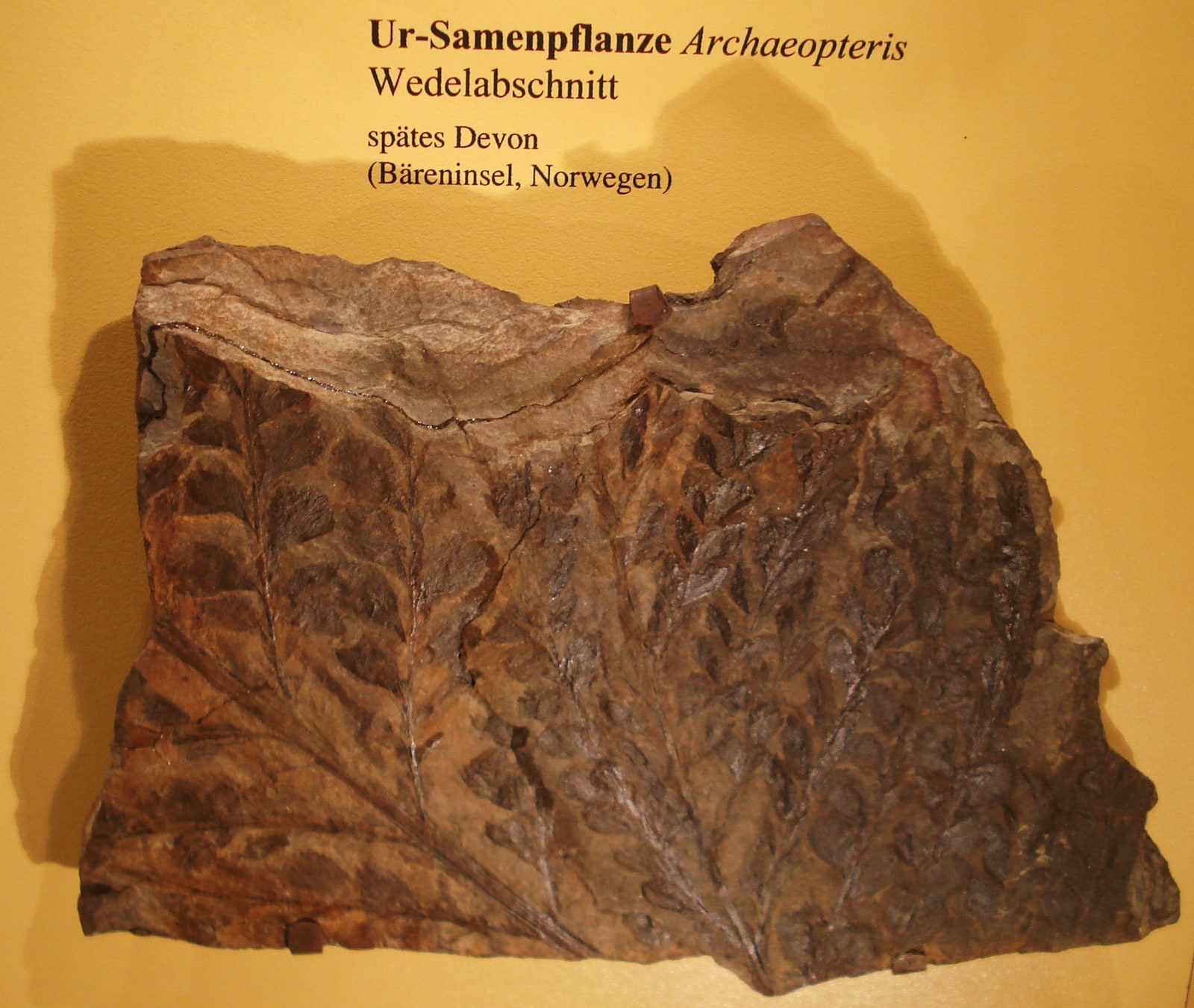
The fossil looks almost too familiar. Across a brown slab, flattened sprays divide into smaller, leaflike units. The museum label identifies a partial frond of Archaeopteris from the Late Devonian of Bjørnøya, Norway. To a modern eye, it is simply foliage pressed into rock.[7]
That familiarity hides the evolutionary problem. Archaeopteris was a woody progymnosperm: it combined substantial secondary wood with spore reproduction and belonged to an extinct branch close to the seed-plant story. It was not a fern, and it was not a seed plant wearing fern leaves. By the time this frond grew, roughly 370 million years ago, one lineage had already assembled a convincing leaf-bearing tree. Other plant lineages had reached leafy bodies by different routes.[1][4]
The first vascular plants did not hand one ancestral leaf down to every clubmoss, fern, horsetail, conifer, and flowering plant. Their early fossils, appearing around 420 million years ago, preserve branching axes and spore-bearing structures but no leaves. Lateral photosynthetic organs arose later—securely more than once, and possibly several times within the broad group that contains ferns and seed plants.[1][2][6]
That changes the question. Instead of asking when “the leaf” was invented, paleobotany asks how separate lineages repeatedly turned shoots, surface outgrowths, and inherited developmental programs into organs that solved the same problem: expose a controlled area to light without losing control of water, heat, support, or growth.
Before a leaf, the shoot did everything
Early vascular-plant bodies were organized around axes. Forms such as Cooksonia carried sporangia at the ends of simple branching systems. Rhynie chert plants preserve more anatomical detail, while trimerophyte-grade plants such as Pertica and Psilophyton show taller, increasingly unequal branch systems. The photosynthetic surface was still distributed along stems and branches rather than concentrated in a familiar blade.[1]
These fossils are not frames from a film in which one species turns directly into the next. They are scattered branches and structural grades. What they preserve is a sequence of available capacities: branching, a persistent shoot apex, separation between fertile and sterile growth, unequal branch development, and lateral organs. A lineage could recruit those capacities without retracing the exact route taken by another lineage.
The family tree makes that independence visible. Lycophytes—the line containing living clubmosses, spikemosses, and quillworts—split from the euphyllophyte line that later produced ferns, horsetails, seed plants, and their extinct relatives. Leafless fossils occur near the early history of both sides. A leafy common ancestor would therefore require repeated losses followed by remarkably similar reacquisitions; the fossil and phylogenetic evidence instead supports independent origins.[1]
“Microphyll” and “megaphyll” are a map, not a verdict
Botany traditionally divides vascular-plant leaves into microphylls and megaphylls. A lycophyte microphyll typically carries one unbranched vascular trace. A megaphyll, in the traditional sense, has more complex venation and occurs among euphyllophytes. The names sound as if they describe small and large leaves, but size is not the decisive feature: extinct tree-sized lycophytes could carry abundant leaves while still belonging to the microphyll lineage.[1][2]
The division is useful until it becomes a false family certificate. The independent origin of lycophyte leaves and euphyllophyte leaves is comparatively secure. The idea that all “megaphylls” share one origin is not. Fossil trees place leafless precursors near several euphyllophyte branches, and developmental studies do not supply a single feature that proves every fern and seed-plant leaf is the same inherited organ. Published hypotheses range from one origin for vascular-plant leaves to two broad origins to several independent events; current reviews leave the exact count open.[1][2]
The safest language is therefore lineage-specific. A lycophyte leaf, a fern frond, and a seed-plant leaf may perform comparable work and reuse ancient cellular machinery without being three modified copies of one original blade.
Early foliage refuses a tidy assembly line
Two classic models show why the origin problem remains live. In one, lycophyte leaves began as small outgrowths of the stem surface that later acquired a vascular supply. Another proposes that sterile versions of formerly spore-bearing lateral structures contributed to the organ. Fossils and living developmental programs preserve clues compatible with both ideas; they do not preserve the act of origin itself.[1][2]
For euphyllophytes, the influential telome model begins with a three-dimensional branch system. One branch overtops another, lateral systems become flattened into a plane, and tissue fills the spaces between branchlets to make a blade. Overtopping, planation, and “webbing” are useful transformations to look for in fossils. They should not be mistaken for three mandatory frames that every euphyllophyte lineage passed through in the same order.[1][2]
Eophyllophyton bellum makes that caution concrete. The plant comes from the Early Devonian Posongchong Formation near Wenshan in Yunnan, China, and was described from a flora of exceptional anatomical and taxonomic variety. Its small laminate divisions carried branching veins; fertile structures paired leaflike units with clusters of sporangia. Anatomical sections indicate a uniform mesophyll, while some divisions appear to occupy more than one plane. Preservation can distort their original orientation, but the fossils do not look like a perfectly planar branch system waiting for one final webbing step.[3]
Nor is Eophyllophyton a documented parent of fern or seed-plant leaves. It is an early, isolated euphyllophyte experiment. Its value lies in timing and combination: laminate tissue and branching venation were present in the Pragian, roughly 410 million years ago, long before broad leaves became visually dominant across terrestrial floras.[3][5]
Separate lineages entered the same design space
A larger fossil sample turns this plurality from a collection of striking specimens into a pattern. Kevin Boyce and Andrew Knoll compared 641 Paleozoic leaf species from North American and European floras, ranging from the Middle Devonian through the Permian. Ferns, sphenopsids, progymnosperms, and seed plants each moved from relatively simple lateral systems toward a wider range of laminated forms. Each lineage radiated rapidly in leaf shape, then became more constrained as the available developmental design space filled.[4]
The result does not establish that leaves evolved exactly four times everywhere. It follows four sampled trajectories, in particular regions, through an incomplete record. Other euphyllophyte relationships and homologies remain debated. What the analysis does show is repeated structural convergence: different branches acquired marginal growth and explored similar shapes without needing one fully formed ancestral leaf.[2][4]
The cover fossil belongs inside that pattern. Archaeopteris was one of those progymnosperm outcomes, not a generic “fern tree” and not a universal midway point. The photographed frond from Bjørnøya preserves a late stage of one experiment: a flattened, divided photosynthetic system attached to a plant that also built a substantial woody body.[4][7] One beautiful slab cannot demonstrate parallel evolution by itself. It becomes evidence for that argument only when placed in a family tree and compared with other lineages.
Climate opened the blade after development made it possible
There is a second timing puzzle. Small laminate leaves existed early, yet broad blades did not spread immediately. One biophysical hypothesis treats that delay as an atmospheric constraint rather than a missing developmental invention.[5]
Early Devonian carbon-dioxide concentrations were high. Under that condition, plants could acquire enough carbon with relatively few stomata—the pores that also release water vapour. Fewer stomata meant less evaporative cooling. A broad blade absorbing sunlight could therefore overheat even if its tissues were developmentally possible. As atmospheric carbon dioxide fell, higher stomatal densities could support both carbon uptake and stronger cooling, making larger surfaces more viable.[5]
Colin Osborne and colleagues tested that model against 300 fossil plants from major European collections. In two independent clades, they measured a 25-fold enlargement of leaf blades as carbon dioxide declined; preliminary stomatal data linked the first abrupt size increase with an eightfold rise in pore density.[5] The pairing of a physical model with two lineages is more persuasive than a simple coincidence in time.
It is still a model, not a fossilized thermostat. Atmospheric reconstructions, fossil ages, preservation, and sampling all carry uncertainty. Roots, water supply, plant height, and local climate also constrained blade size. Most importantly, the result addresses the delayed expansion of large leaves, not the first origin of every leaf program. Eophyllophyton had already crossed the laminate threshold while broad-leaf ecology remained restricted.[3][5]
Old genes can build independently acquired organs
Living plants add an apparent paradox. If lycophyte and euphyllophyte leaves arose independently, why do they share parts of their developmental machinery?
Work on the spikemoss Selaginella kraussiana found that a conserved interaction involving KNOX and ARP proteins helps mark the transition from a growing shoot apex to a determinate lateral organ. Related machinery operates in seed-plant leaves. Gene-expression evidence and a cross-species complementation experiment led the researchers to propose that the mechanism originally worked in ancient shoot branching, then was recruited independently during leaf evolution.[6]
Shared tools therefore do not require a shared finished organ. A lineage inherits a regulatory toolkit from deep ancestors; evolution can deploy it in a new place, combine it with other programs, and arrive at a leaflike surface. More recent comparisons across lycophytes, ferns, and seed plants find a mosaic of shared regulators, lineage-specific expression, and different relationships among the shoot apex, sporangia, veins, and leaf tissues. No single gene acts as a homology stamp.[2]
This distinction keeps three levels of evidence apart. Fossils directly preserve branching, attachment, venation, tissue, and sometimes fertile structures. Phylogenetic analysis infers where those character combinations sit among lineages. Developmental and climate models explain how a transition may have worked or why it accelerated when it did. The second and third levels are testable interpretations of the first, not details photographed in stone.
Seen at that scale, the leaf stops being a universal object with one birthday. It becomes a recurring evolutionary answer. Devonian plants inherited branches, vascular tissues, sporangia, growth regulators, and an atmosphere in flux. Separate lineages assembled those materials into photosynthetic surfaces on different schedules and by different developmental routes. The familiar green blade outside a window is not evidence that evolution found one solution early. It is what convergence looks like after hundreds of millions of years have made several solutions feel like the same thing.
Sources
- C. Jill Harrison and Jennifer L. Morris, “The origin and early evolution of vascular plant shoots and leaves,” Philosophical Transactions of the Royal Society B 373 (2018)—fossil, phylogenetic, and developmental evidence for leafless precursors and multiple leaf origins.
- Marina A. Romanova et al., “All together now: Cellular and molecular aspects of leaf development in lycophytes, ferns, and seed plants,” Frontiers in Ecology and Evolution 11 (2023)—current review of competing origin hypotheses, organ homology, and developmental programs.
- Hao Shougang and Xue Jinzhuang, The Early Devonian Posongchong Flora of Yunnan (Science Press, 2013)—formation context, anatomy, and phylogenetic treatment of Eophyllophyton and other early leafy plants.
- C. Kevin Boyce and Andrew H. Knoll, “Evolution of developmental potential and the multiple independent origins of leaves in Paleozoic vascular plants,” Paleobiology 28 (2002)—analysis of 641 species and parallel leaf-morphology trajectories in four lineages.
- Colin P. Osborne et al., “Biophysical constraints on the origin of leaves inferred from the fossil record,” PNAS 101 (2004)—fossil blade size, stomatal density, and the falling-carbon-dioxide cooling hypothesis.
- C. Jill Harrison et al., “Independent recruitment of a conserved developmental mechanism during leaf evolution,” Nature 434 (2005)—gene-expression and complementation evidence for parallel recruitment of an older developmental pathway.
- Wikimedia Commons, “File:Archaeopteris.JPG”—source page and metadata for Ghedoghedo’s photograph of the Late Devonian partial frond from Bjørnøya used as the article image.