A dinosaur egg can preserve a shell, a crushed outline, even the curled bones of an animal that never hatched. None of those things is automatically a stopwatch. Egg size can be compared with living species, and the degree of skeletal development can place an embryo broadly within its growth sequence, but both approaches depend heavily on choosing the right modern analogue. A bird and a crocodilian can take very different amounts of time to develop an egg of comparable mass.
Teeth offered a more intimate clock. As a tooth grows, cells add dentine in microscopic increments around its pulp cavity. In most living amniotes, one particular set of increments—the lines of von Ebner—forms daily. When researchers found the same rhythm preserved in the teeth of dinosaur embryos, they could count days that had passed inside an egg rather than predict them from egg size alone.[1][2]
That sounds like a direct route from microscope slide to hatch date. It is not. The lines date the tooth, while incubation begins before the tooth exists. Turning one clock into the other requires CT scans, destructive histology, comparative embryology, and a careful account of what has gone missing. The method is powerful because those layers can be separated, not because they disappear.
A tooth becomes a clock only after calibration
Dentine is laid down by odontoblasts along the inner surface of a growing tooth. Under polarized light, daily advances can appear as alternating bands, usually only a few to a few tens of micrometres apart. Gregory Erickson's earlier work compared those bands in dinosaur teeth with equivalent structures in living and fossil crocodilians. Periodic chemical labelling in crocodilians established the daily rhythm; matching position, scale, and morphology supported reading the dinosaur bands as the same biological feature rather than as cracks or mineral alteration produced during fossilization.[2]
The distinction matters. No one watched a dinosaur odontoblast work for twenty-four hours. “Daily” is a comparative inference anchored in living archosaurs, then tested against the fossil tissue. Later studies have continued to examine that foundation. Work on alligator teeth found that where a transect crosses the tooth, and how it intersects the increments, can shift the estimated average spacing enough to distort a calculated formation time. The clock is real, but sampling is part of the instrument.[5]
Counting is also not always literal. Where every increment can be followed, researchers can total the lines. Where preservation or geometry prevents that, they may measure dentine thickness and divide it by a well-sampled mean increment width. CT data help reveal which tooth belongs to which generation within a jaw, while a thin section exposes the microscopic record. The estimate therefore combines a three-dimensional map with a sacrificed slice.[1][5]
The nest had to survive the question
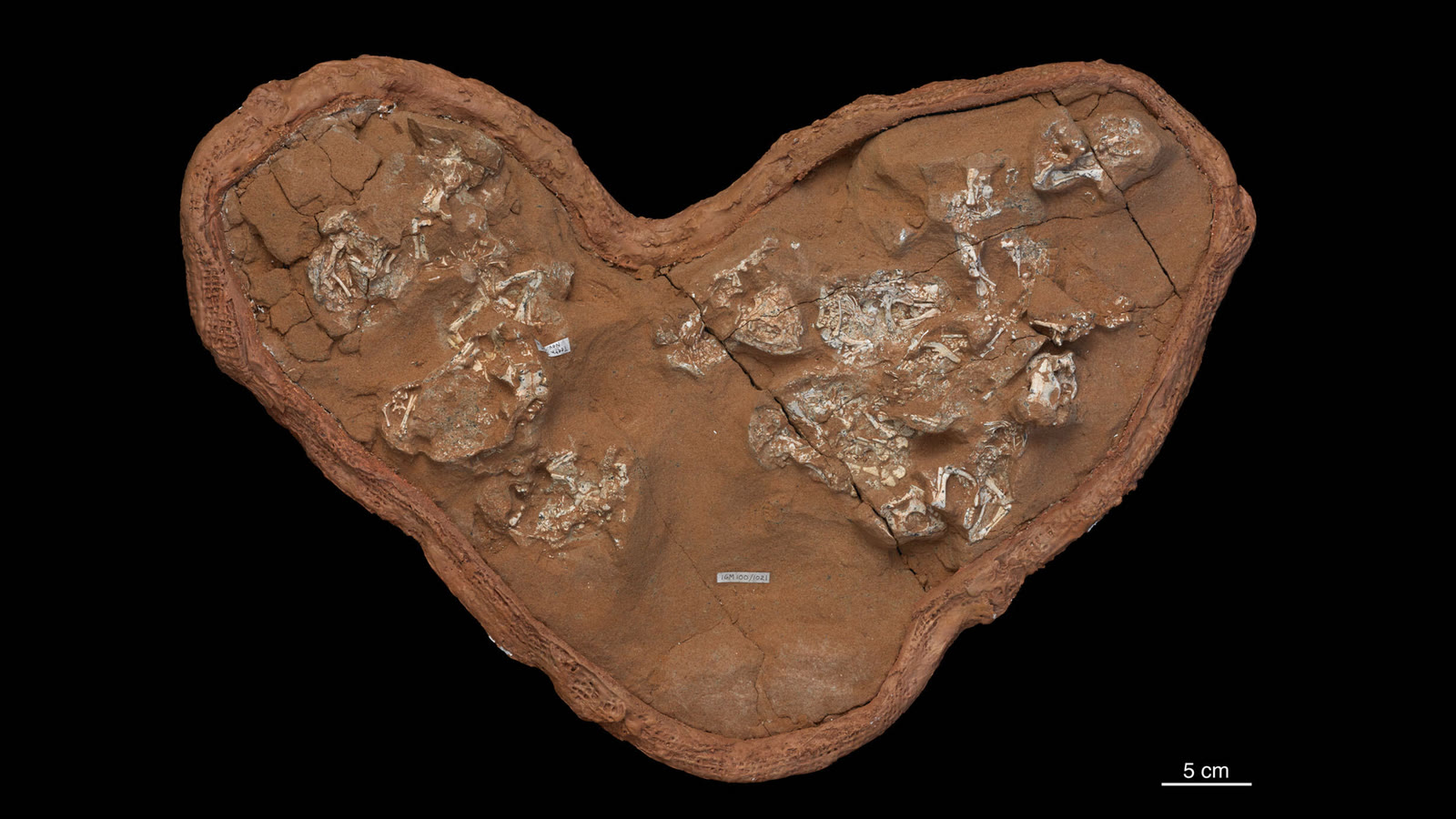
The smaller of the two embryos in the 2017 incubation study came from Protoceratops andrewsi clutch IGM 100/1021, a nest of twelve partly crushed eggs recovered from Late Cretaceous rocks of Mongolia's Gobi Desert. Each egg held a well-ossified embryo with a developed dentition. The cover photograph shows the clutch as a physical object: pale curls of bone distributed across reddish sediment, not twelve tidy ovals waiting to be timed.[1][6]
The larger comparison came from Hypacrosaurus stebingeri, a hadrosaur whose studied eggs were recovered from the Oldman Formation at Devil's Coulee in southern Alberta. Its eggs approached the upper end of known dinosaur egg size, and the near-term embryos already carried dense tooth batteries. Some teeth had even worn against one another before hatching. That wear was biological evidence, but it also erased part of the very record the researchers wanted to count.[1]
Before sectioning, the team scanned the jaws at high resolution. The scans established the order of functional and replacement teeth in each tooth family. Selected jaws and an isolated Hypacrosaurus tooth were then cut, polished, and examined microscopically. This sequence is easy to overlook: the visible bands matter only after the specimen's internal architecture tells the researchers which tooth's history they are reading.[1]
One count became two incubation estimates
In the Protoceratops embryo, the most developed functional tooth represented about 48 days of formation. That did not mean the egg was 48 days old. Comparisons with living crocodilians suggested that the functional dentition destined for hatching began no earlier than roughly 42 percent of the way through incubation. Adding the unrecorded early interval produced a minimum estimate of about 83 days.[1]
The Hypacrosaurus calculation required an extra repair. The oldest functional tooth had lost its crown to wear, so its full set of increments was gone. The team aged the next-younger tooth at about 55 days, then added a roughly 44-day replacement interval to reconstruct the older tooth's formation time. Applying the same conservative developmental offset yielded a minimum near 171 days.[1]
Those estimates were more than twice the durations predicted for bird eggs of similar masses and much closer to values expected from living reptiles. The result challenged a convenient assumption: because birds are dinosaurs, perhaps the rapid incubation of modern birds characterized non-avian dinosaurs generally. At least for these two ornithischians, it did not.[1]
The word minimum carries much of the scientific weight. The embryos had not yet hatched, so an unknown final interval was absent. The 42-percent starting point came from the earliest end of a range observed in living crocodilians; a later onset would lengthen the total. Researchers also could not be certain that every visible tooth belonged to the final dentition the animal would have carried out of the egg. The measured days are precise within the tissue, but the conversion to total incubation is deliberately conservative.[1]
The model begins where the lines stop
It helps to sort the evidence into three levels. First, the fossils preserve dentine increments, tooth generations, wear, and the geometry of embryonic jaws. Second, living crocodilians supply the case that the increments are daily and a developmental window for when a hatchling's functional teeth begin forming. Third, the calculation links tooth age to total time in the egg. Only the first level is directly fossilized.[1][2]
Each level has a different failure mode. Poor preservation can blur increments. A section taken off-axis can bias mean spacing. A missing crown can erase early tooth growth. A living analogue may not reproduce the exact developmental schedule of an extinct lineage. And a beautifully preserved embryo may still be several unknown days short of hatching. None of these problems makes the method useless; together they explain why one estimate should not be reported as an exact birthday.[1][5]
The rarity of the material creates a further boundary. Near-term dinosaur embryos with teeth are uncommon, and histology consumes part of a specimen. A 2025 review of dinosaur reproduction emphasizes both the uneven distribution of embryo-bearing eggs across the family tree and the value of expanding non-destructive micro-CT datasets. More specimens can reveal variation, but access, preservation, and responsible sampling decide which clocks can be opened at all.[4]
A theropod changed the shape of the story
The first two estimates did not license a single incubation rate for Dinosauria. In 2018, another team studied a near-term embryonic tooth from a Two Medicine Formation clutch assigned in that paper to Troodon formosus. Synchrotron imaging and a histological section preserved 31 increments; the researchers reconstructed another eight in the missing tip, making the tooth about 39 days old. Using a crocodilian comparison for when the functional tooth began to form, they estimated an incubation period around 74 days.[3]
That value fell between bird-like and reptile-like predictions for an egg of its mass. The authors connected the intermediate duration with a reproductive system that also looked intermediate: troodontid eggs were partly buried, yet nest structure and other evidence are compatible with some adult brooding and elevated incubation temperatures. The tooth did not prove a parent's body temperature or posture. It added a time estimate that made those independent lines of evidence easier to evaluate together.[3]
The comparison changes the evolutionary picture. Protoceratops and Hypacrosaurus support slow, reptile-grade development in two ornithischians; the troodontid suggests that faster incubation had begun to evolve on the theropod line before the fully exposed, rapidly incubated eggs of modern birds. The current record is still a handful of taxonomically scattered specimens, not a smooth curve through the dinosaur family tree.[3][4]
What an embryonic tooth cannot explain alone
Long incubation plausibly increased the time eggs spent exposed to predators, drought, flooding, infection, or nest failure. It may also have extended the interval between reproductive attempts. The 2017 study proposed that such costs could have disadvantaged non-avian dinosaurs during ecological recovery after the end-Cretaceous extinction. That is an evolutionary scenario, not a cause of extinction preserved in the lines themselves. A tooth can constrain how long development took; it cannot show which hazard killed an embryo, much less why an entire clade vanished.[1]
Nor does the method demonstrate that teeth themselves forced every dinosaur to develop slowly. Tooth formation has physiological limits, and losing teeth may have removed one constraint on the evolution of rapid avian development. But incubation also depends on egg construction, nest temperature, gas exchange, parental behaviour, and embryonic metabolism. The clock records their combined outcome without assigning each mechanism a share.[1][3][4]
The strongest conclusion is narrower and more interesting than “dinosaur eggs took months.” Some non-avian dinosaurs did; at least one theropod appears to have occupied an intermediate lane; and modern birds inherited a reproductive system assembled in stages. Inside each useful fossil, the evidence arrives in the same order: a microscopic daily rhythm, a tooth's formation history, a calibrated developmental offset, and only then an incubation estimate. The hatch date is not written on the shell. It has to be reconstructed from the clock that started late.
Sources
- Gregory M. Erickson et al., “Dinosaur incubation periods directly determined from growth-line counts in embryonic teeth show reptilian-grade development,” PNAS 114 (2017)—the Protoceratops and Hypacrosaurus specimens, histological method, estimates, and uncertainty boundaries.
- Gregory M. Erickson, “Incremental lines of von Ebner in dinosaurs and the assessment of tooth replacement rates using growth line counts,” PNAS 93 (1996)—the comparative basis for identifying dinosaur dentine increments as daily lines.
- David J. Varricchio, Martin Kundrát, and Jason Hogan, “An Intermediate Incubation Period and Primitive Brooding in a Theropod Dinosaur,” Scientific Reports 8 (2018)—the troodontid embryonic tooth, intermediate estimate, and nesting interpretation.
- Kimberley E. J. Chapelle, Christopher T. Griffin, and Diego Pol, “Growing with dinosaurs: a review of dinosaur reproduction and ontogeny,” Biology Letters 21 (2025)—updated synthesis of incubation evidence, sampling gaps, and research priorities.
- Jens C. D. Kosch and Lindsay E. Zanno, “Sampling impacts the assessment of tooth growth and replacement rates in archosaurs: implications for paleontological studies,” PeerJ 8 (2020)—experimental assessment of section placement, increment-width sampling, and propagated error using alligator teeth.
- American Museum of Natural History, “Protoceratops embryo clutch IGM 100/1021” (photograph by M. Ellison)—original institutional photographic asset used as the article image.