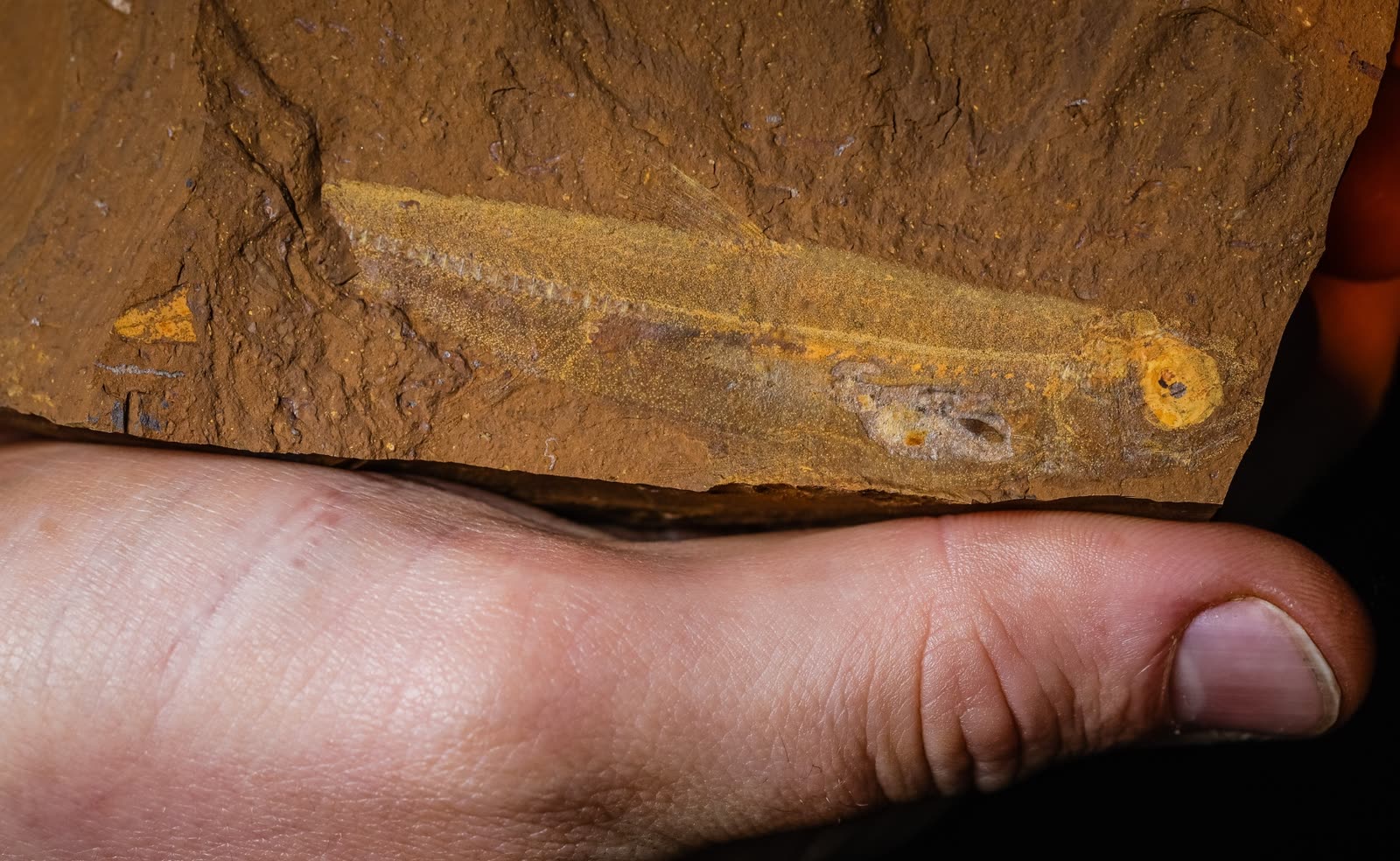
The stone is the colour of a neglected tool. Split it, and a fish appears in gold-brown relief: eye, backbone, fins, belly, even traces of its last meals. Nothing about the rust-red slab looks like the fine shale, limestone, or volcanic ash usually associated with exquisite fossils. That is precisely why McGraths Flat matters.
Buried beneath farmland near Gulgong in the Central Tablelands of New South Wales, on Wiradjuri Country, the deposit records an oxbow lake surrounded by wet forest between roughly 16 and 11 million years ago. Its finely layered rock is composed almost entirely of goethite, an iron oxyhydroxide. Within it are leaves, flowers, pollen, fungi, fish, a feather, spiders, and insects preserved at a resolution that can reach cells and subcellular structures.[1][2]
When the site was first described in 2022, the surprise was the ecosystem: a rare, densely detailed view of Australian rainforest life before later drying transformed much of the continent. A 2026 taphonomic study has sharpened the stranger part of the story. The iron is not merely a rusty stain added long after burial. It was the burial medium, the mineral copyist, and—under a narrow set of conditions—the reason fragile bodies entered the fossil record at all.[1][2]
Image context: the cover photograph shows the fossil fish Ferruaspis brocksi held in its goethite slab. A real hand and a real specimen make the preservation problem visible: this is a small animal embedded in dense iron-rich rock, not a life reconstruction. Research on the fish identified stomach contents, an attached mussel larva on one specimen, and microscopic moulds left by pigment-bearing structures.[5][7]
A billabong became an iron trap
The 2026 model begins outside the lake. Under warm, seasonally wet conditions, chemical weathering attacked nearby basalt. Acidic soil water mobilised reduced iron and carried it underground. That iron-rich groundwater then seeped into an abandoned river channel—an oxbow lake, or billabong—where changing chemistry and oxygen availability converted dissolved iron into extraordinarily fine iron oxyhydroxide particles.[1]
Those particles settled in thin layers. Dead leaves, insects, spiders, and aquatic animals reaching the lake floor could be coated before their delicate structures disappeared. Iron oxidation occurred through both abiotic and microbial pathways; precipitation buried the remains while mineral growth replicated tissues. With later alteration, the sediment became laminated goethite-rich ferricrete: rock cemented overwhelmingly by iron.[1]
This sequence matters because “rust preserved a rainforest” can otherwise sound like magic. Each step has a physical constraint. Basalt supplied the iron. Warm, wet weathering mobilised it. Groundwater transported it. A quiet, low-energy lake concentrated fine sediment. Oxidation made the iron precipitate. Rapid mineral coating narrowed the interval in which decay could erase anatomy.
The model is still a reconstruction, not an eyewitness account of a single fatal flood. The deposit contains repeated laminae, and the animals entered the lake in different ways. Leaves and land insects could fall or wash in; fish and aquatic larvae lived in or moved through connected water. The strongest claim is therefore not that one catastrophe made the entire archive. It is that the same geochemical system repeatedly turned an ordinary-looking billabong into an unusual preservation machine.[1][2]
The rock opens through the animal
Most compression fossils split along the boundary between body and sediment, exposing an external surface. McGraths Flat often behaves differently. A hammer and chisel can break the brittle goethite through the fossil itself. The opened slab becomes a cross-section through an insect, plant, or fish, revealing internal anatomy that a surface split would conceal.[2][4]
That is a gift with a cost. Caddisfly fossils preserve parts of the gut, silk glands, tracheoles, developing genitalia, and compound eyes. Yet the same fracture can hide wing venation or other external characters needed to name a species. A spider may retain tiny setal bases while other diagnostic surfaces remain locked in matrix. Exceptional preservation does not mean complete preservation; it changes which questions the rock can answer.[4][6]
Nor are these soft tissues sitting intact after 15 million years. The fossils are mineral replicas, moulds, and replacements. Iron particles only a few micrometres across copied cellular spaces before the organic material was lost. Scanning electron microscopy can then read structures far below what the unaided eye sees. In the caddisflies, researchers imaged the ordered nanocoating of the cornea without first covering the iron-rich specimen in a conductive film.[1][4]
The red slab is therefore both specimen and instrument surface. Its chemistry saved microscopic form; its density and fracture pattern determine how that form becomes visible.
Pollen dated a rock that acid could not dissolve
Iron preservation also created a dating problem. Palynologists commonly extract pollen and spores from sediment with acids, but McGraths Flat rock is itself iron oxyhydroxide. Standard digestion could not separate the microfossils in the usual way.[3]
The workaround treated the unprocessed rock as a landscape to be scanned. Automated electron microscopy collected 25,200 images across 1.85 square centimetres of three samples. On the Australian Museum's DigiVol platform, 271 citizen scientists helped identify 300 pollen grains and spores in those images. The resulting assemblage constrained both age and environment without removing the fossils from the rock.[3]
Pollen places the deposit broadly between 11 and 16 million years old. It also supports a wet, temperate rainforest containing southern beeches, conifers, and diverse flowering plants, while some pollen and leaves point to drier vegetation nearby. That mix is more informative than a simple “rainforest before desert” slogan. McGraths Flat sampled a moist lake and its catchment inside a landscape already containing ecological contrasts.[2][3]
The five-million-year age interval should remain visible. It does not pin every layer to one instant in the middle Miocene's climatic changes. The pollen provides a defensible window; it does not turn the whole deposit into a precisely dated snapshot.
A food web survives in attachments and stomachs
A fossil list tells us what was preserved. McGraths Flat sometimes preserves the links between organisms.
The original site study reported pollen carried on an insect, a nematode associated with a beetle, fish stomach contents, and other evidence of pollination, parasitism, and predation.[2] These are unusually direct ecological observations because the relationship survives on or inside the body. They still record individual encounters, not the frequency of those behaviours across the whole forest.
The caddisflies make that boundary clear. More than 100 larvae and pupae preserve claws, internal organs, tracheoles, and, in two specimens, corneal nanostructure. The absence of adults, cases, and ordinary cocoons led researchers to infer that disruptive events may have dislodged immature insects from their retreats. The fossils support an unstable aquatic setting, but they do not identify one unique storm, flood, or chemical pulse as the cause.[4]
The trapdoor spider Megamonodontium mccluskyi adds a geographic afterlife. Its fine hairs and claw structures place it near a lineage now represented in Southeast Asian and western Pacific rainforests rather than modern Australia. That makes local extinction during Australia's drying plausible. One spider cannot narrate the retreat of an entire biome, but it preserves a branch that a living-species map alone would miss.[6]
The fish in the cover photograph pushes the evidence from anatomy into daily life. Ferruaspis brocksi, described in 2025, retained phantom-midge larvae in its stomach; another specimen carried a juvenile freshwater mussel, or glochidium, attached near the tail. Moulds of melanosomes and their distribution support a darker back, pale underside, and two lateral stripes.[5]
That is a reconstruction of pattern, not recovered colour. The fossil's present yellow and brown tones belong to iron minerals. The microscopic position of pigment-associated structures, compared with living fish anatomy, supports the countershading inference. McGraths Flat is powerful precisely because it lets these levels stay separate: mineral colour, cellular mould, anatomical placement, and inferred appearance.[5]
The archive is rich, but it is not a census
It is tempting to treat the deposit as a complete rainforest sealed in iron. The lake was never neutral. Organisms had to live in the water, fall into it, wash in from the catchment, or be carried there. They then had to avoid scavenging and decay long enough for mineral coating, survive later alteration, be reached by excavation, split into a readable plane, and be recognised under a microscope.
Those filters help explain why tiny insects, aquatic larvae, leaves, pollen, and fish can dominate the story while other parts of the forest remain faint. An absent mammal or canopy animal is not evidence that it was absent from the wider ecosystem. An abundant phantom-midge larva may reflect genuine lake ecology, a mortality event, preservation chemistry, or all three.
McGraths Flat is consequently strongest as a high-resolution local archive, not a miniature version of all Miocene Australia. It records what one iron-rich lake admitted. Pollen expands the view into surrounding vegetation; spider biogeography and fish anatomy add longer evolutionary threads. None removes the lake's sampling boundary.[2][3][5][6]
Rust becomes a search image
The widest implication of the 2026 study lies beyond Gulgong. Ferricrete has often been treated as a weathering crust rather than a promising host for fragile terrestrial fossils. McGraths Flat shows that, under the right depositional conditions, iron-rich sediment can preserve soft anatomy as finely as more familiar fossil rocks.[1]
The proposed search image is specific: ancient river channels cutting landscapes with weathered basalt; evidence for warm, humid conditions and acidic groundwater; exceptionally fine, laminated ferricrete; and chemistry not overwhelmed by carbonate or sulphur minerals that would divert the iron into other products. Those clues do not make every red rock a Lagerstätte. They identify places where an iron-transport system and a quiet basin might once have met.[1]
That is the site's most durable surprise. The fossil fish is spectacular, but it does not stand alone. A basalt source, groundwater pathway, abandoned channel, mineral reaction, fracture plane, electron microscope, and network of human identifiers all sit between a living animal and the image we can read.
McGraths Flat preserved a rainforest in rust, but not by freezing life whole. It translated bodies into iron at several scales, then forced researchers to learn the grammar of that translation. The next comparable archive may already look familiar from the surface: another unpromising band of red rock waiting for someone to split it.
Sources
- Tara Djokic et al., “Taphonomy of soft-tissue preservation in ferricrete at the McGraths Flat Lagerstätte,” Gondwana Research 149 (2026) — primary geochemical and depositional model for basalt weathering, iron transport, oxbow-lake precipitation, cellular replication, and the search criteria for comparable sites.
- Matthew R. McCurry et al., “A Lagerstätte from Australia provides insight into the nature of Miocene mesic ecosystems,” Science Advances 8 (2022) — primary description of the site, fossil assemblage, age range, rainforest setting, preservation, and ecological interactions.
- Tara Djokic et al., “Inferring the age and environmental characteristics of fossil sites using citizen science,” PLOS ONE 18 (2023) — primary study of in-situ electron-microscope imaging, DigiVol identification, pollen-based dating, and environmental reconstruction.
- Michael Frese, Matthew R. McCurry, and Alice Wells, “Miocene caddisflies from Australia: iron-rich sediments preserve internal organs, tracheoles, and corneal nanocoating of larvae and pupae,” Zoological Journal of the Linnean Society 202 (2024) — specimen anatomy, imaging, preservational limits, and environmental inference.
- Matthew R. McCurry et al., “The paleobiology of a new osmeriform fish species from Australia,” Journal of Vertebrate Paleontology (2025) — primary description of Ferruaspis brocksi, stomach contents, glochidium attachment, and pigment-pattern evidence.
- Matthew R. McCurry, Michael Frese, and Robert Raven, “A large brush-footed trapdoor spider (Mygalomorphae: Barychelidae) from the Miocene of Australia,” Zoological Journal of the Linnean Society 200 (2024) — primary description of Megamonodontium, microscopic preservation, and biogeographic interpretation.
- Australian National University Research School of Earth Sciences, “Scientists discover 15 million-year-old Australian fish fossil” (19 March 2025) — institutional account and source page for Laura Martin's photograph of the Ferruaspis fossil used as the cover image.