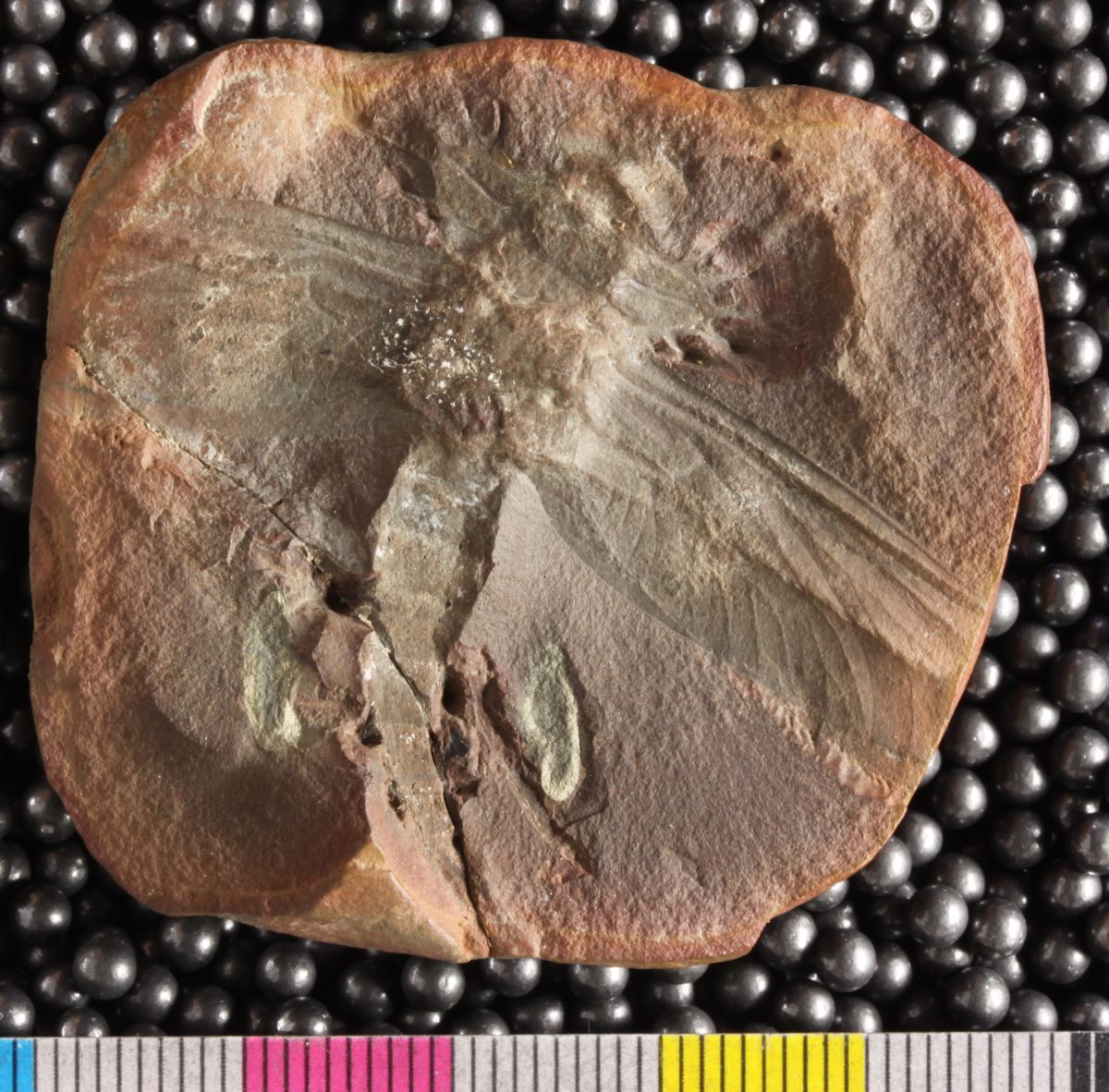
The fossil on the cover is almost too accomplished for an origin story. Notorachis wolfforum lies across a Mazon Creek concretion with broad wings, long veins and cross-veins already organized into a working surface. The GBIF occurrence record identifies it as a palaeodictyopteran from the Middle Pennsylvanian Francis Creek Shale in Illinois.[7] Nothing about it resembles a tentative flap of cuticle waiting to discover air.
That is the central difficulty. The earliest definitive fossils of winged insects, from roughly 325 million years ago, already have wings. Some molecular-clock estimates place the origin of insect flight substantially earlier, but the interval in which a wingless insect became a flier is almost empty of bodies.[1] Paleontology has excellent later wings and very few first steps. The transition therefore has to be approached sideways: through the joints of Carboniferous juveniles, the development of living insects, gene experiments in a crustacean, and the disputed ecology of extinct lineages.
Those lines of evidence have changed the old question. An insect wing is no longer well framed as either a new shelf grown from the back or a gill-like branch borrowed from a leg. The more provocative possibility is that part of the insect body wall was itself made from ancestral leg segments. If so, “body wall” and “leg” are not cleanly opposed addresses. They are layers of the same evolutionary history.
The first wing is hidden behind the first good wing
Flight is not just a sheet attached to a thorax. A powered wing needs a blade stiffened by veins, a hinge that permits controlled rotation, muscles able to cycle it, and nerves and sensory structures that keep the system stable. A broad fixed lobe might aid falling, skimming, sailing, temperature control or respiration without being capable of powered flight. The origin problem is therefore two problems: where the wing tissue came from, and how that tissue became one component of an integrated flight apparatus.[1]
For much of the debate, two anatomical models divided those questions differently. The paranotal model treated wings as expansions of the tergum, the dorsal plate of the thorax. A lateral shelf could first produce lift or control a fall, then acquire articulation and muscles. The exite model looked lower on the body. Arthropod limbs can carry outer branches called exites; a plate or gill associated with a proximal leg segment could already possess useful plumbing, nerves and mobility before being recruited into a wing.[1][3]
Each model solved one difficulty and inherited another. A tergal shelf puts the blade in the right place but must explain how a largely fixed outgrowth acquired a hinge and powered control. A leg-derived exite begins with appendicular machinery but must explain how the structure moved dorsally and became continuous with the thorax. “Dual origin” models proposed that tergal and leg-associated tissues contributed together. The phrase sounds like compromise. Fossils and developmental biology have made it a much more anatomical claim.
Carboniferous juveniles preserve a seam that adults conceal
Adult wings are remodeled endpoints. Their plates and joints do not necessarily advertise how their components first met. Juveniles of extinct palaeodictyopterans preserve a more revealing construction.
In 2017, Jakub Prokop and colleagues examined Carboniferous palaeodictyopteran nymphs with three pairs of wing pads, including lobes on the first thoracic segment. The pads were broadly continuous with the notum along their front and rear margins, yet they also possessed a medial line of articulation and axillary elements associated with the side of the body. Their limited freedom of movement would not have supported active flight at that juvenile stage.[2]
The useful evidence is the junction, not the extra pair. A pad joined extensively to the dorsal thorax supports a notal contribution. A jointed medial series consistent with pleural, appendage-related elements supports another contribution at its base. Later insect development rotates and separates the wing pad, reducing the broad notal connection and making the primitive arrangement difficult to read in living adults.[2]
These nymphs do not show the first protowing. They lived tens of millions of years after the oldest definitive wing fossils, inside an already specialized extinct group. Their anatomy cannot be placed in a simple ancestor-to-descendant row leading to a dragonfly or beetle. What it can do is preserve a plausible old boundary: blade continuous with the back, hinge assembled nearer the leg-bearing flank. The fossil record supplies a structural constraint without pretending to supply the missing event.
A crustacean leg makes the insect flank less simple
The deepest revision comes from an animal without wings. In 2020, Heather Bruce and Nipam Patel used CRISPR knockouts of five leg-patterning genes in the amphipod crustacean Parhyale hawaiensis. They compared which portions of the crustacean limb disappeared with the effects of corresponding genes in insects. Their alignment suggested that two proximal leg segments present in the shared pancrustacean ancestor are no longer expressed as free-standing leg segments in insects. They were incorporated into the lateral body wall.[3]
That relocation matters because one of those ancestral leg-base regions carried an exite. As proximal segments broadened into the insect flank, the exite would have been carried dorsally with them. A structure now growing from the side or edge of the tergum could therefore remain homologous to an older appendicular outgrowth. In Bruce and Patel’s model, the wing did not leap from leg to back; the leg base changed what “back” included.[3]
This turns the historical either-or into a question of depth. At the developmental moment visible in an insect, the wing blade can grow from lateral tergal tissue. At a deeper evolutionary level, that lateral tissue may derive from a proximal leg segment. A body-wall observation and an exite homology can both be correct while referring to different stages in the same transformation.[1][3]
The experiment is powerful, but its boundary should stay visible. Knocking out patterning genes in a living amphipod reveals correspondences among regions; it does not replay the Devonian or Carboniferous transition. Homology is not a film of motion. The model becomes persuasive because gene function, comparative anatomy and fossil joints constrain one another, not because any single result provides a complete ancestor.
A cricket shows where a modern wing grows
Living insect development tests the other side of the proposed continuity. Fruit flies are highly transformed insects: their wings form inside imaginal discs and emerge through complete metamorphosis. Takahiro Ohde and colleagues instead studied the two-spotted cricket Gryllus bimaculatus, whose nymphal body remains directly comparable with the adult thorax.[4]
They mapped overlapping wing-patterning activity to the lateral tergal margin using expression patterns for apterous, wingless and vestigial. Removing the anterior part of that margin from a young cricket produced an adult with most of the wing blade missing; removing a posterior region had little effect. RNA interference also tied the wing’s disproportionate growth to conserved Wnt, Fat-Dachsous and Hippo signaling. The cricket does not grow a wing from any arbitrary patch of back. It expands a specific lateral organizer.[4]
Read alone, the result sounds like a victory for the old paranotal model: the blade comes from the tergal edge. Read beside the crustacean work, it becomes more interesting. Ohde and colleagues distinguish the lateral tergum from the more medial “bona fide” tergum and connect the lateral region to an ancestral proximal leg component.[4] Development identifies the current launch point; comparative genetics supplies its older address.
There is still a gap between a growth field and flight. Neither the cricket experiment nor the amphipod knockouts explain exactly how the first hinge, flight muscles, venation and control circuitry became coordinated. A tissue can be homologized before its original performance is known. The origin of a wing blade is not automatically the origin of powered flight.[1]
Anatomy has narrowed; habitat has not
The next temptation is to make the exite answer the ecological question. If an ancestral limb outgrowth could resemble a gill, perhaps wings began under water and moved into air. That is possible, but the ancestry of a structure and its selective use are separate claims.
A large 2019 phylogenomic study by Benjamin Wipfler and colleagues analyzed 3,014 protein-coding genes and reconstructed 112 anatomical, behavioral and ecological characters across living insects. It inferred that the last common ancestor of winged insects was terrestrial through all life stages. On that tree, wings did not originate as the gills of an aquatic juvenile.[5]
Fossils keep the verdict open. In 2023, Prokop and colleagues described several larval stages of the late Carboniferous palaeodictyopteran Katosaxoniapteron brauneri from Piesberg, Germany. The larvae carried delicate dorsolateral and tail gills. Their lateral abdominal outgrowths and thoracic wing pads shared form and surface microstructure, leading the authors to propose serially repeated respiratory structures and an aquatic or semiaquatic juvenile ecology.[6]
The studies do not cancel each other. The phylogenomic reconstruction estimates an ancestral condition mostly from living branches. The Piesberg fossils demonstrate that one extinct early winged-insect branch later possessed aquatic larvae whose respiratory outgrowths resembled wing pads. That is important evidence for a viable water-linked pathway, but Katosaxoniapteron is not the last common ancestor caught in transition. A terrestrial origin can be followed by secondary aquatic development; an aquatic ancestral state can also be obscured when extinct branches are absent from a living-only reconstruction.[5][6]
The honest result is asymmetric. Evidence for the anatomical source of the wing has converged: lateral tergal tissue, pleural hinge elements and an incorporated proximal leg base now fit into a shared model.[1][2][3][4] Evidence for the initial use of its precursor remains divided among respiration, surface locomotion, controlled descent and other functions. A plate’s homology does not choose the environment in which selection first acted on it.
What an older fossil would need to preserve
Another complete adult wing will refine venation and diversity without necessarily solving origin. The decisive fossil would come from the Devonian or earliest Carboniferous gap and preserve a body, not an isolated wing. Its value would lie at the attachment: repeated lateral outgrowths, the extent of their continuity with the tergum, any joint or muscle scar at the pleural edge, and whether comparable structures occurred on abdominal segments. Juvenile and adult stages from the same species would be especially powerful because they could separate a temporary respiratory pad from an adult flight surface.[1][2][6]
Living comparisons can test a different package. If insect wings inherit an old leg-base exite, researchers should be able to compare not only blade-patterning genes but also muscles, motor neurons, articulation and sensory wiring across crustacean exites and insect flight systems. Similar gene expression alone can reflect reused developmental tools. Correspondence across position, gene function, joints and innervation would make the homology much harder to explain away.[1][3]
Return, finally, to Notorachis. Its photograph is visually generous and historically late. The wings display what the fossil record preserves best: a finished surface. The most consequential part of their history is compressed into the small, difficult region where wing meets thorax—and into an even older event in which part of a leg ceased looking like a leg.
That is why insect-wing origins have become stranger as they have become clearer. The wing may grow from the body wall. The body wall may carry an ancestral leg base. And knowing both still does not tell us whether the first useful flap worked in water, in a fall, or at the surface between them.
Sources
- Lisa A. Treidel et al., “Insect Flight: State of the Field and Future Directions,” Integrative and Comparative Biology 64 (2024)—review of the fossil gap, anatomical-origin models, developmental evidence and unresolved adaptive setting.
- Jakub Prokop et al., “Paleozoic Nymphal Wing Pads Support Dual Model of Insect Wing Origins,” Current Biology 27 (2017)—Carboniferous palaeodictyopteran wing-pad attachment and articulation.
- Heather S. Bruce and Nipam H. Patel, “Knockout of crustacean leg patterning genes suggests that insect wings and body walls evolved from ancient leg segments,” Nature Ecology & Evolution 4 (2020)—comparative CRISPR evidence for incorporated proximal leg segments and an exite-derived wing.
- Takahiro Ohde, Taro Mito and Teruyuki Niimi, “A hemimetabolous wing development suggests the wing origin from lateral tergum of a wingless ancestor,” Nature Communications 13 (2022)—cricket gene expression, ablation and wing-growth experiments.
- Benjamin Wipfler et al., “Evolutionary history of Polyneoptera and its implications for our understanding of early winged insects,” Proceedings of the National Academy of Sciences 116 (2019)—phylogenomics and ancestral-state reconstruction supporting terrestrial life stages.
- Jakub Prokop et al., “Thoracic and abdominal outgrowths in early pterygotes: a clue to the common ancestor of winged insects?” Communications Biology 6 (2023)—Piesberg larval fossils, gill anatomy and the aquatic-function hypothesis.
- Field Museum of Natural History via GBIF, occurrence record 1423790120 for Notorachis wolfforum holotype PE 21699—taxonomy, horizon, creator and CC BY-NC 4.0 metadata for the archival fossil photograph.