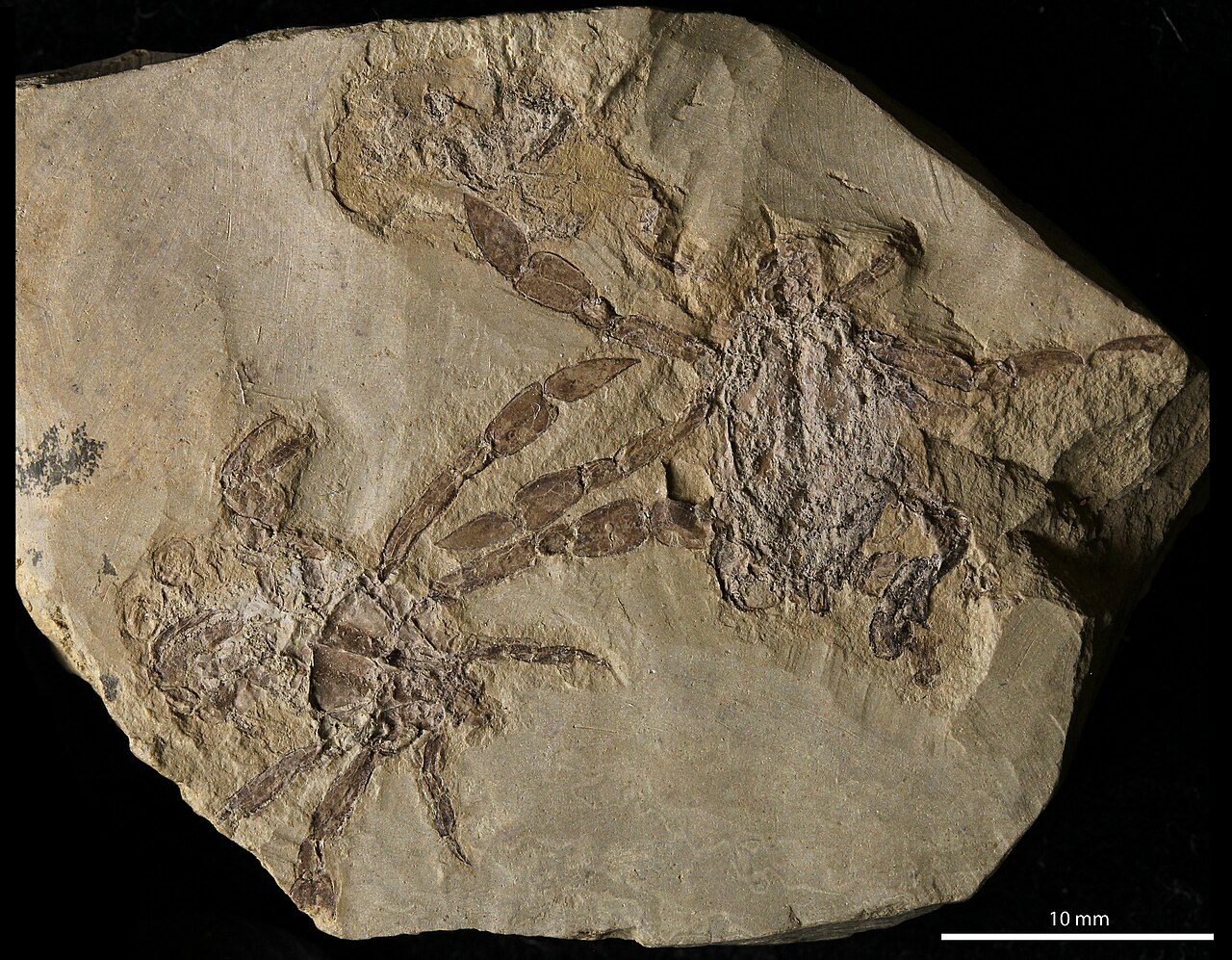
The two fossils on the cover look unfinished in the most persuasive possible way. Each dark body is narrow where a familiar crab should be broad. The abdomen remains visible instead of folding discreetly beneath a compact shell, while long jointed limbs spread into paddles. Nothing has to be reconstructed to see that mismatch; it is present in the photographed stone.[5]
The mismatch is also misleading. Callichimaera perplexa was not a baby crab buried before it acquired an adult shape. The Colombian specimens include a growth series and sexually mature individuals. Their larva-like outline survived into adulthood, where it was integrated with reproductive anatomy, powerful swimming limbs, and a visual system built for active use.[1][2]
That distinction makes this mid-Cretaceous fossil more than an evolutionary oddity. Callichimaera shows how a body can become novel by changing the schedule of development rather than inventing every component from nothing. But the fossils do not preserve that schedule directly. A close reading must keep three claims apart: the adult anatomy in the rock, the comparative case for retained larval traits, and the ecological inferences drawn from paddles and eyes.
The proof of adulthood sits beneath the strange outline
The 2019 description drew on 64 Colombian specimens spanning several sizes. Across the type series, carapace length ranges from 6.6 to 15.1 millimeters and width from 3.8 to 9.6 millimeters. Those are small crabs, but they do not form the tight size-and-shape cluster expected from a single larval stage. They record multiple growth instars.[1]
Superficially, the animal resembles a megalopa, the final swimming larval stage between the planktonic zoea and the first juvenile crab. Both can have an elongated carapace, an extended abdomen, leg-like mouthparts, and conspicuous eyes. If only one tiny Callichimaera had survived, “fossil larva” would have been a reasonable first reading.[1]
The larger sample overturns it. Bigger specimens preserve sexual differences in the abdomen and its appendages. Males carry two pairs of hardened gonopods used in reproduction and lack the following pleopods; females retain a different pleopod series. A megalopa should not possess those mature sexual structures. Callichimaera also lacks the uropods normally present, at least as remnants, in megalopae, and its hooked claws resemble those of juvenile and adult crabs more than larval claws.[1]
These features make adulthood direct fossil evidence. The developmental explanation is one step more inferential. Luque and colleagues proposed pedomorphosis, a form of heterochrony in which features associated with an early life stage persist in the adult. The term does not mean the whole animal stopped developing. Reproductive anatomy matured; the eyes continued to grow; limbs differentiated sharply. What persisted was a mosaic of traits, not an entire frozen larva.[1][2]
Nor does the growth series reveal which genetic switches changed or whether every unusual feature arose through the same developmental shift. Pedomorphosis is the best comparative reading of the adult-and-larval resemblance. It is not a time-lapse film preserved in limestone.
A true crab can lose the standard crab finish
The common crab silhouette is so familiar that it can masquerade as a definition: a short, wide carapace; lateral margins; and an abdomen tucked beneath the body. Callichimaera violates all three. Its carapace is longer than wide, its abdomen remains partly exposed, and its narrow body looks closer to a small lobster or a late-stage crab larva than to a shore crab.[1]
Yet the diagnosis of a true crab rests on a suite of less theatrical structures. Callichimaera has short first and second antennae positioned between the eyes, a symmetrical and sexually differentiated abdomen, a reduced terminal segment, one pair of claws rather than several, and male gonopods arranged as they are in brachyurans. Those characters supported its placement within Brachyura as its own extinct section, Callichimaeroida—a classification retained in the 2023 systematic Treatise on Invertebrate Paleontology.[1][3]
Its exact address inside the crab family tree is less secure. Different versions of the original morphological analysis moved neighboring branches or collapsed deeper relationships, partly because many of the animal's traits also evolved in unrelated swimming or burrowing crabs. The robust claim is that Callichimaera represents a distinct true-crab lineage. The weaker claim would be to present it as a neat transitional rung leading toward any living family.[1][3]
This distinction also corrects the popular idea that evolution simply keeps “turning things into crabs.” Carcinization—the repeated evolution of a broad carapace and folded abdomen—is real, but so is movement away from that integrated form. Researchers call the latter decarcinization. Crab-like anatomy has been gained and partly lost in several decapod branches; the shape is recurrent, not compulsory.[4] Callichimaera is therefore not a failed attempt at crabbiness. It is evidence that a true crab could leave the standard silhouette and remain a coherent adult animal.
The middle legs read as oars, not walking feet
The strongest ecological signal begins with an asymmetry among the legs. The second and third walking-leg pairs are long and broad, with their outer segments flattened into blades. The fourth and fifth pairs are much smaller, narrow, and directed toward the rear. Beneath them, the fifth and sixth plates of the sternum are exceptionally broad—room for the muscles needed to drive the enlarged limbs.[1]
Small pits line the paddle margins. In life, they likely anchored setae that would have expanded the working surface, as they do on the swimming legs of modern blue crabs and other aquatic arthropods. None of this preserves a stroke in motion, but the package is mechanically consistent: a wide muscle platform, two dominant limb pairs, flattened distal segments, and a fringe that could move more water.[1]
Could the same legs have been shovels? Several crab groups use flattened limbs for digging, and convergence makes shape alone treacherous. The rest of Callichimaera argues against a primarily buried life. Its paddle joints lack the sharp bend that lets many burrowing crabs pull their legs close to the carapace. Its rear legs are poorly suited to excavation. It also lacks obvious respiratory channels and filtering structures used by crabs that breathe while concealed in sediment. Most awkwardly for a burrower, its huge eyes are permanently exposed rather than retractable into protected orbits.[1]
The original authors therefore reconstructed an active swimmer moving near the seafloor or into open water, while allowing that occasional backward burrowing cannot be ruled out. That is the right evidential boundary. The skeleton supports propulsion more strongly than excavation; it cannot tell us how often the animal swam, how fast it moved, or whether it ever settled into sediment.
The eyes turn a silhouette into an ecology
The eyes are not merely large dark circles. Several specimens preserve hexagonal corneal facets and parts of the optic lobes beneath them—a rare combination of external lenses and internal neural tissue in a post-Paleozoic arthropod. A 2022 study compared the fossil growth series with 14 living crab species and found that Callichimaera had both the largest eyes relative to carapace length and the fastest eye-growth rate in the sample.[2]
That result matters because a retained larval location does not imply an underdeveloped adult organ. In the fossil series, the eyes became disproportionately important as the crab grew. Their unprotected form may be pedomorphic; their scale and internal investment are functional signals.[2]
One especially well-preserved specimen allowed the researchers to measure the spacing and size of its facets. An average interommatidial angle of 0.57 degrees indicates fine spatial resolution by arthropod standards. A low eye-parameter value of 0.35 is consistent with activity in bright, shallow water rather than the light-gathering design expected in darkness. Combined with the paddles, those measurements support a highly visual, active predator. The abundant comma shrimp found in the same Colombian deposit are a plausible prey item, but no gut content or captured victim links them directly.[2]
The precision of the numbers should not erase their limits. Facet-based calculations came from one specimen because the others were wrinkled or deformed near the growing eye margin. Compaction can alter dimensions, even though the study chose methods intended to minimize that error. The hexagonal facets also rule out one ancestral mirror-eye design without distinguishing among three other compound-eye types. The fossils license “acute vision in bright water” more confidently than a complete optical reconstruction.[2]
A tropical fossil window made the tiny anatomy legible
The Colombian type material comes from the upper Cenomanian to lower Turonian Churuvita Group near Pesca in Boyacá, deposited roughly 95 to 90 million years ago. Additional fossils from the Turonian Frontier Formation of Wyoming show that the lineage reached far beyond one tropical locality. The Colombian specimens, collected between 2005 and 2014, remain in the Colombian Geological Survey and the Mapuka Museum of Universidad del Norte; the United States material is housed at the Smithsonian's National Museum of Natural History.[1][3]
Preservation is part of the argument. The Churuvita surfaces hold not only carapaces but antennae, mouthparts, abdominal appendages, eye facets, and, in places, three-dimensional internal optical tissue. The associated assemblage includes true shrimp and hundreds to thousands of comma shrimp. This is not a lone shell forced to carry an entire ecology.[1][2]
Tropical fossil records are nevertheless uneven. Deep weathering, dense vegetation, limited rock exposure, and fewer collecting programs make Lagerstätten at low modern latitudes comparatively scarce. Callichimaera does not prove that unusual crab evolution was uniquely tropical. It shows what a tropical record can add when exceptional preservation and sustained fieldwork overcome that sampling gap.[1]
The cover photograph captures only the first layer of that evidence. The two bodies are visibly strange, but much of the diagnosis came from preparation under magnification, scanning electron microscopy, coated and uncoated specimens, and comparison across the full series. The image is valuable because it preserves the scale and material reality of the fossils. It should not be mistaken for the entire dataset.[1][5]
What the chimera actually proves
Read in order, the evidence forms a ladder. Fossils directly preserve several sizes, mature reproductive appendages, a true-crab anatomical suite, enlarged middle legs, and unusually complete eyes. Comparison with living and fossil crabs supports three further interpretations: larval traits persisted into adults, the broad limbs worked mainly as paddles, and the visual system suited an active predator in well-lit water.[1][2]
Above that line, uncertainty returns. No fossil records the developmental mechanism in action. The precise position of Callichimaeroida among early crab branches remains sensitive to phylogenetic method and convergent anatomy. No preserved meal identifies prey, and no trackway records a swimming stroke.[1][2][3]
Those limits do not make Callichimaera less remarkable. They make its real achievement easier to see. This was not a larva on the way to becoming a conventional crab. It was a sexually mature, visually specialized swimmer whose adult body kept part of a larval-looking architecture and made that architecture work. Evolution did not leave the crab unfinished. It finished on a different schedule.
Sources
- Javier Luque et al., “Exceptional preservation of mid-Cretaceous marine arthropods and the evolution of novel forms via heterochrony,” Science Advances 5 (2019)—original description, specimen series, anatomy, locality, phylogeny and swimming interpretation.
- Kelsey M. Jenkins, Derek E. G. Briggs and Javier Luque, “The remarkable visual system of a Cretaceous crab,” iScience 25 (2022)—eye preservation, growth comparison, optical measurements, ecological inference and stated limitations.
- Javier Luque et al., “Systematic Descriptions: Section Callichimaeroida,” Treatise Online 169 (2023)—current systematic diagnosis and accepted composition of the extinct crab section.
- Joanna M. Wolfe, Javier Luque and Heather D. Bracken-Grissom, “How to become a crab: Phenotypic constraints on a recurring body plan,” BioEssays 43 (2021), Smithsonian Research record—review of carcinization, decarcinization and the integrated crab body plan.
- Wikimedia Commons, “Callichimaera perplexa 02 Photo by Javier Luque.jpg”—source and CC BY-SA 4.0 metadata for the two-specimen fossil photograph used as the cover image.