Homo naledi keeps inviting one large headline: did a small-brained hominin deliberately place its dead deep inside the Rising Star cave system? That question matters, but it is too big to be the first question. The stronger field reading starts one layer lower, with the material itself: an enormous single-species hominin assemblage, a difficult chamber, a surprisingly recent age, and a depositional setting that remains central to every behavioral claim.[1][2][3]
The reason this story still matters in 2026 is that the published record has moved past the first discovery splash. The original 2015 description made H. naledi scientifically unavoidable because it joined a small brain and primitive-looking trunk with humanlike hands, feet, and lower limbs, all represented by more than 1,500 fossil specimens and at least 15 individuals from the Dinaledi Chamber.[1] The 2017 dating paper then made the taxon harder to place by constraining the Dinaledi fossils to roughly 236,000 to 335,000 years ago, meaning this morphologically primitive hominin survived into a later Pleistocene world that also included early members of our own species.[3]
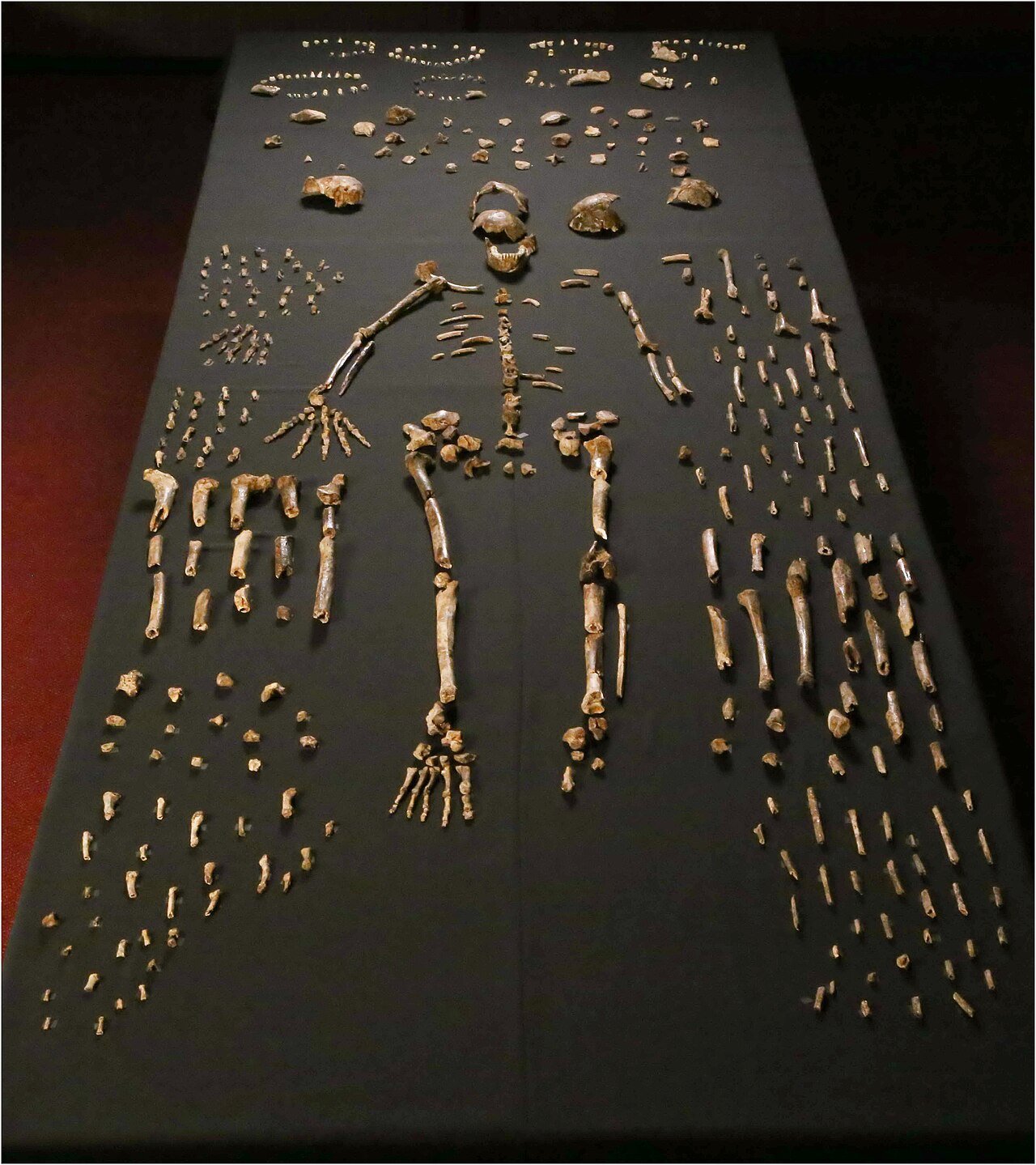
Image context: the cover uses a real photograph from the 2015 eLife article, hosted on Wikimedia Commons. It shows the Dinaledi skeletal specimens arranged as a composite visual inventory, with many separate elements around the central layout. That image is the right anchor because Homo naledi is a collection-scale problem before it becomes a behavior story.[1][7]
What is secure before the debate begins
The high-confidence core is already remarkable. Berger and colleagues named Homo naledi in 2015 from the Dinaledi Chamber in South Africa's Cradle of Humankind, describing a body plan that resisted easy sorting into either an old australopith-like package or a familiar later Homo template.[1] The cranium was small, the dentition was generally small and simple, the hand and wrist had humanlike manipulative adaptations, and the foot and lower limb also looked humanlike in important respects.[1] At the same time, the trunk, shoulder, pelvis, and proximal femur retained more primitive or australopith-like traits.[1]
That mosaic is not a decorative detail. It is the reason the fossil keeps forcing method discipline. If a reader starts from the skull alone, H. naledi can look like a primitive outlier. If the reader starts from the foot and hand, it can look much more familiar. The correct unit of reading is the whole body plus the whole cave assemblage. The Dinaledi material was treated as one species because repeated elements were morphologically homogeneous and because distinctive traits recurred across the recovered sample rather than appearing as a random mixture from unrelated taxa.[1]
The cave context is just as important. Dirks and colleagues described the deposits as unusual for the Cradle of Humankind: numerous hominin remains concentrated deep inside the cave, in largely unconsolidated mud-rich sediments, away from an obvious present opening.[2] The 2017 age paper sharpened that setting by noting that the Dinaledi Chamber lies about 30 meters below the surface, with most fossils contained in a particular fossil-bearing subunit, and with the chamber sedimentary environment distinct from more typical cave assemblages in the region.[3]
The age result made the fossil stranger, not simpler
Before the dating work, the morphology invited old-age expectations. A small-brained, primitive-looking hominin from South Africa could have been placed loosely in an earlier chapter of the genus Homo if age were guessed from anatomy alone. The 2017 dating paper made that shortcut untenable. By combining optically stimulated luminescence, uranium-thorium, palaeomagnetic work, and U-series electron spin resonance dating of teeth, Dirks and colleagues constrained the depositional age of the Dinaledi material to between 236 ka and 335 ka.[3]
That date range does two things. First, it prevents a simple "primitive equals ancient" reading. A body can preserve older-looking anatomical features while living much later than morphology alone would suggest.[3] Second, it raises the stakes of behavior claims. If H. naledi was present in southern Africa during the later Middle Pleistocene, then questions about cave access, body transport, fire, marking, and mortuary behavior are no longer background curiosities. They become claims about what a small-brained hominin could do in a time and landscape shared with other hominins.[3][4]
The age result does not by itself prove any behavior. It changes the frame in which behavior has to be argued. That distinction is where many public accounts lose resolution.
The burial claim now has a final paper, and also a serious counter-record
The current debate should be read as a live evidentiary contest, not as a settled slogan. In September 2025, the eLife version of record for "Evidence for deliberate burial of the dead by Homo naledi" was published after earlier reviewed-preprint versions.[4] The paper argues from spatial positioning, skeletal material, sediments, access routes, and contextual observations that the Rising Star remains include evidence for mortuary behavior, including deliberate burial, by H. naledi.[4]
That claim is consequential because it would move complex mortuary behavior away from a large-brained-human-only story. It would also force a different model of how bodies entered hard-to-reach cave spaces. The Dinaledi Subsystem and related areas require difficult movement through narrow passages today, and the eLife paper spends substantial space on access, cave change, and sediment context for that reason.[4]
At the same time, the counter-record is not a casual objection from outside the field. Martinon-Torres and colleagues argued in the Journal of Human Evolution that the evidence presented was not compelling enough to support deliberate burial or rock art, calling for fuller chronology, taphonomy, sedimentology, micromorphology, geochemistry, and archaeothanatological analysis before natural or post-depositional processes can be ruled out.[5] A later geoarchaeological critique in PaleoAnthropology focused more narrowly on the sediment and geochemical case, arguing that available data did not distinguish proposed burial features from surrounding sediment and did not support deliberate burial from a geoarchaeological standpoint.[6]
This is the useful state of the argument: one research team now has a final article making a positive burial case; critical papers argue that the evidentiary threshold has still not been met, especially for sedimentary and archaeological inference.[4][5][6] A responsible field report has to keep both statements visible.
How to read the cave without flattening it
The best reading method is to separate five layers.
First, there is taxonomic and anatomical evidence. H. naledi is a valid and deeply interesting hominin because the fossil assemblage preserves a coherent mosaic of cranial, dental, hand, foot, and postcranial traits across many individuals.[1]
Second, there is geochronology. The Dinaledi fossils are not vague deep-time props. The published age constraint places them in the later Pleistocene, roughly 236-335 ka, which changes the evolutionary neighborhood in which the animal must be understood.[3]
Third, there is cave access. The chambers are hard to reach now, and the geometry of access matters, but cave systems change. Access arguments need geology rather than drama. A tight modern passage is evidence to be modeled, not a cinematic proof on its own.[2][3][4]
Fourth, there is taphonomy and sediment. The remains accumulated in an unusual setting with limited non-hominin macrofossils and with mixed evidence including articulated material, scattered material, and reworking.[2][3] That is precisely why burial claims need sedimentary and spatial evidence at high resolution.[5][6]
Fifth, there is behavior. Deliberate burial is a behavior-level inference. It sits above the other four layers and depends on them. If the lower layers are overcompressed, the behavior claim becomes too neat. If they are kept separate, the claim can be tested rather than merely admired or dismissed.[4][5][6]
Why Homo naledi still earns attention
Even if the burial debate remains unresolved for many readers, Homo naledi does not need the most dramatic interpretation to stay important. The fossil already forces three durable lessons.
The first is anatomical: evolution does not update the whole body at one pace. H. naledi combines primitive-looking and humanlike features in a way that makes single-trait classification feel clumsy.[1] The second is chronological: morphology cannot be used as a private clock. The age result is young enough to punish confident first impressions based on anatomy alone.[3] The third is methodological: behavior claims in paleontology are strongest when they move through explicit layers of context, not when the desired behavior becomes the organizing frame from the start.[4][5][6]
That is why Rising Star remains a high-value field problem. The cave did not merely produce a new hominin name. It produced an evidence system whose parts keep pulling against simple narration: a large assemblage, a restricted chamber, a recent age, difficult access, disputed depositional readings, and a behavior claim with real consequences. Read that way, Homo naledi is more interesting than either a miracle headline or a debunking headline. It is a test of how carefully paleontology can move from bones in sediment to claims about minds, bodies, and the dead.
Sources
- Lee R. Berger et al., "Homo naledi, a new species of the genus Homo from the Dinaledi Chamber, South Africa," eLife 4:e09560 (2015).
- Paul H. G. M. Dirks et al., "Geological and taphonomic context for the new hominin species Homo naledi from the Dinaledi Chamber, South Africa," eLife 4:e09561 (2015).
- Paul H. G. M. Dirks et al., "The age of Homo naledi and associated sediments in the Rising Star Cave, South Africa," eLife 6:e24231 (2017).
- Lee R. Berger et al., "Evidence for deliberate burial of the dead by Homo naledi," eLife version of record (2025).
- Maria Martinon-Torres et al., "No scientific evidence that Homo naledi buried their dead and produced rock art," Journal of Human Evolution 195:103464 (2024), via PubMed.
- Kirsten Foecke, Alain Queffelec, and Robyn Pickering, "No Geoarchaeological Evidence for Deliberate Burial by Homo naledi," PaleoAnthropology 2025:1.
- Wikimedia Commons file page for the Homo naledi skeletal specimens photograph used as the article image.